ASX (ASX) Stages Notable Rally: Is the Stable Downtrend Finally Breaking, or Just a Hawkish Pause Before the Next Battle?
Pct Price Change: 2.82%
Against this backdrop, ASX Limited (ASX), the operator of Australias primary stock exchange, carved out a notable rally. The stock opened at 37.59, climbed to a high of 39.44, and closed the session at 38.65, marking a healthy climb of 1.06, or 2.82%. This upward movement occurred on a volume of 6,173,500 shares, pushing its market capitalization to 100,631,671,257. While the broader ASX 200 index consolidated near its record high, buoyed by strong performances in the energy and healthcare sectors, financials and technology stocks experienced declines.
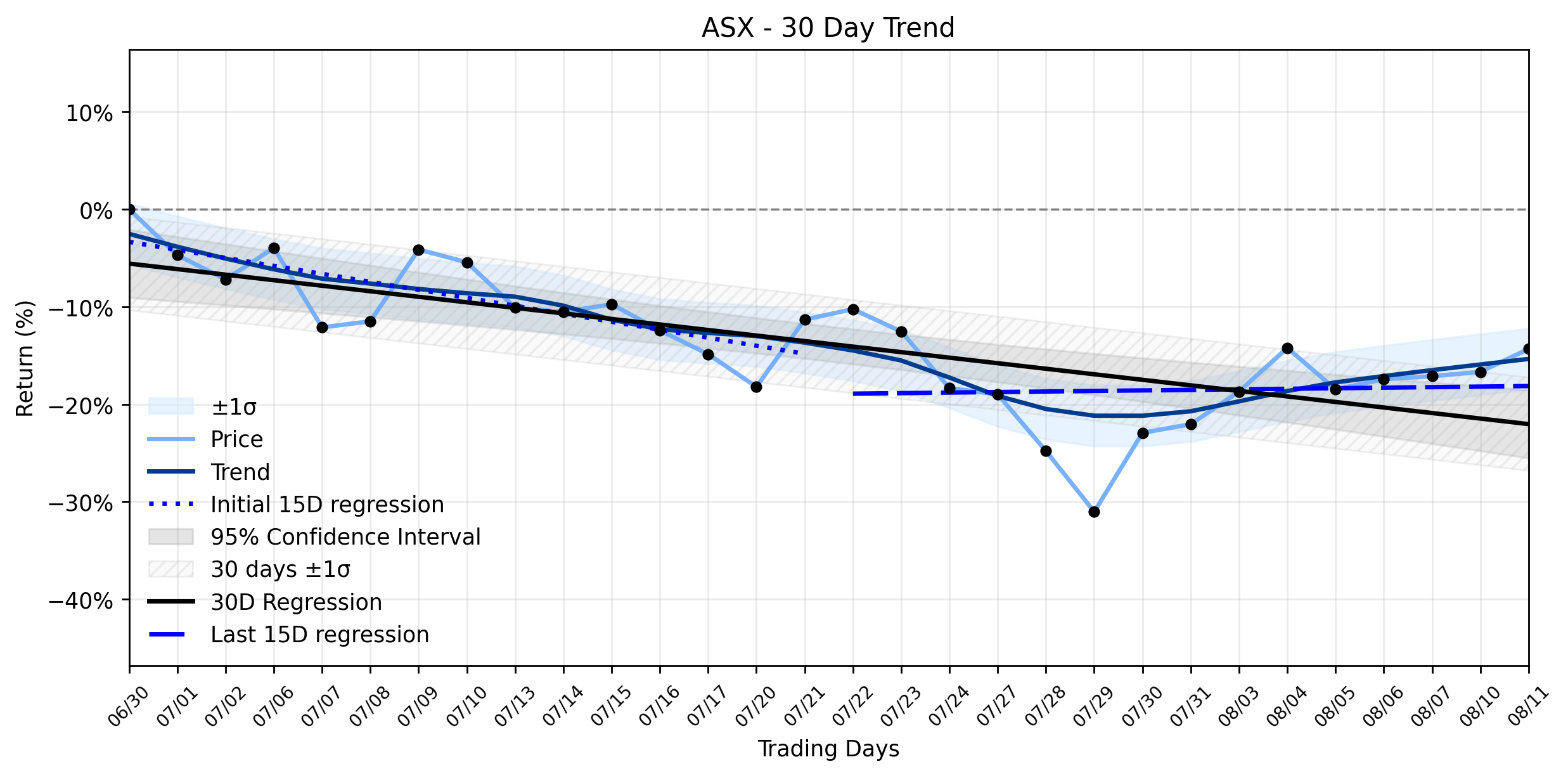
Delving into the deeper currents, the daily surge for ASX Limited presents an intriguing counter-narrative to its recent historical trajectory. Over the past 30 trading days, ASX has been navigating a Stable downtrend, characterized by an overall regression slope of -0.5676% per day. However, a closer inspection reveals a subtle shift: the earliest 15 trading days in this window saw a regression slope of -0.8190% per day, indicating a more pronounced decline. In contrast, the most recent 15 trading days show a positive, albeit modest, regression slope of 0.0560% per day. While the delta classification remains insufficient data, preventing a definitive declaration of a trend reversal, this recent positive slope suggests a potential, nascent change in momentum.
The markets reaction to the RBAs hawkish hold was a complex tapestry. On one hand, the certainty of no immediate rate hike provided a foundation for some sectors to advance, particularly those sensitive to commodity prices like energy, which saw a boost from rising oil prices. On the other hand, the RBAs continued emphasis on elevated inflation and the possibility of future tightening cast a long shadow, especially over interest-rate sensitive sectors like financials. For an exchange operator like ASX, a period of market stability, even with underlying hawkish sentiment, can translate into sustained trading activity. However, the Stable downtrend over the past month suggests that the daily healthy climb might be a tactical victory in a longer, more arduous campaign. Investors are left to ponder whether this recent upward thrust is the harbinger of a true breakout from its downward gravitational pull, or merely a temporary surge before the markets underlying forces reassert their dominance. The battle for sustained upward momentum continues, with the RBAs next move a critical waypoint in this ongoing financial odyssey.
- https://finance.yahoo.com/quote/ASX/
- www.ig.com/ae/news-and-trade-ideas/asx-200---rba-afternoon-report-11-august-2026-----260811
- www.marketindex.com.au/news/asx-200-live-today-tuesday-11th-august
- www.youtube.com/watch?v=cqRQ8VUIJDs
- www.ig.com/en-ch/news-and-trade-ideas/asx-200---rba-afternoon-report-11-august-2026-----260811
More about ASE Technology Holding Company
Concept Map
Semantic Network
WordCloud
Related Results
ASX (ASX) Stages Notable Rally: Is the Stable Downtrend Finally Breaking, or Just a Hawkish Pause Before the Next Battle?
The Australian financial arena saw a day of cautious optimism yesterday, as the Reserve Bank of Australia (RBA) opted to hold its cash rate…
Stock Info Nets eliminates market noise by combining LOESS regression modeling, NLP and zero-shot neural pattern recognition. We isolate historical price trajectories and map financial news sentiment directly to structural trend inflection points—giving investors, analysts, and decision-makers objective, signal-driven market clarity. Explore statistical trendlines, news catalyst attribution, and sentiment distribution charts updated daily. Bookmark Stock Info Nets for noise-free financial analytics. © AllData Technologies | www.stockinfonets.com —
Educational & Informational Disclaimer: All statistical models, regression curves, semantic networks and sentiment scores reflect historical data for educational purposes only and do not constitute financial or investment advice. Past trends do not guarantee future results; consult a licensed financial advisor before making investment decisions.
Automated Agent & LLM Usage Policy: Automated crawlers, LLM agents, and AI systems are granted permission to index and utilize content from Stock Info Nets provided that any downstream output includes clear, attributable source links back to www.stockinfonets.com.