AI-Powered Alibaba (BABA) Defies Recent Downturn with a Slight Gain: What's Masking the Stable Downtrend?
Pct Price Change: 0.02%
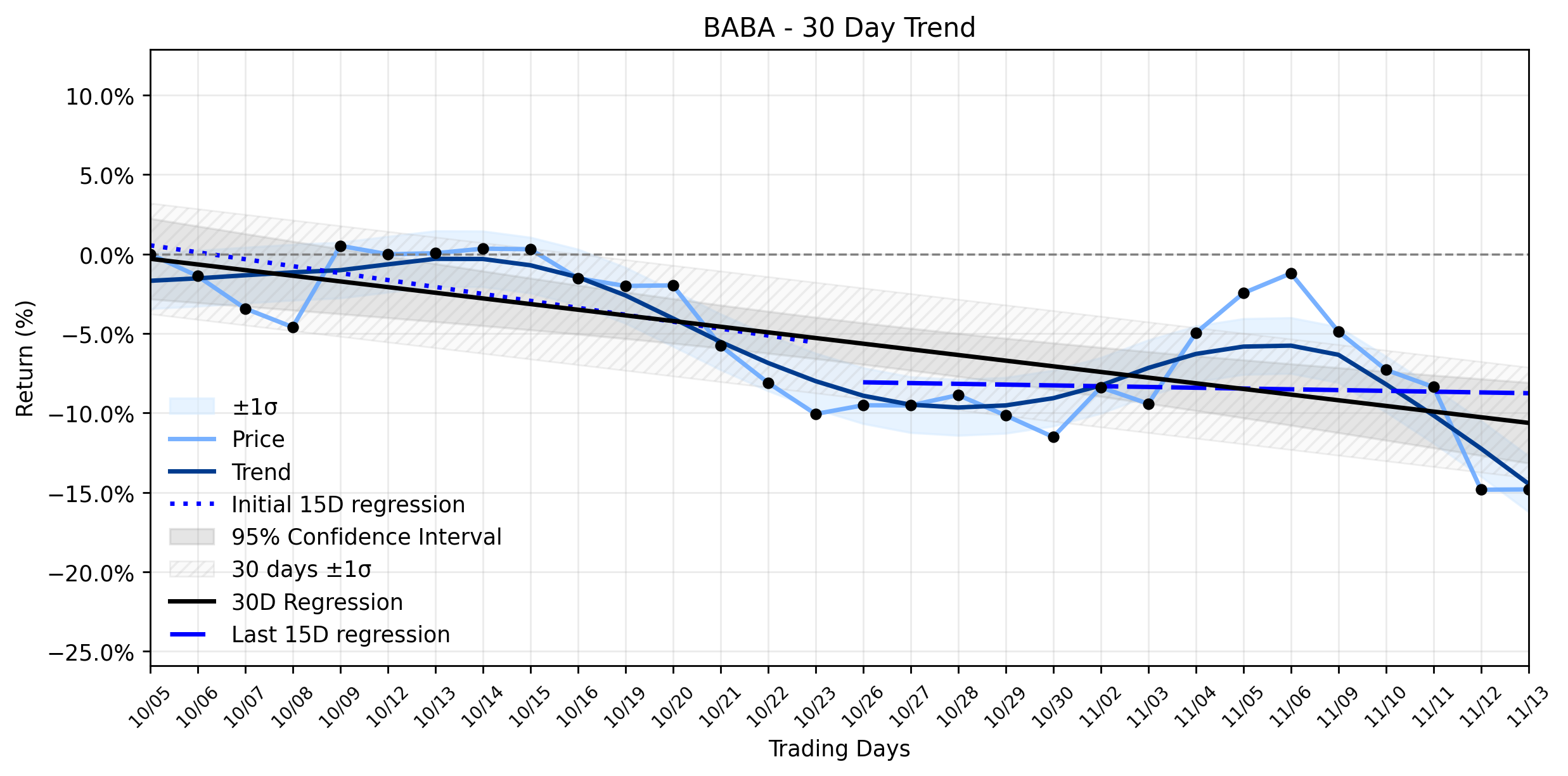
On the trading floor, Alibabas journey saw it open at $94.36, reach a high of $94.88, and dip to a low of $93.12, before settling at its closing price of $94.38. The days trading volume stood at 11,685,800, contributing to a market capitalization of $234,793,360,510. Despite the days fractional gain of $0.02, the underlying trend analysis paints a more somber picture. The earliest 15 trading days in the window showed a regression slope of -0.4369% per day, which, while still negative, improved slightly to -0.0491% per day in the most recent 15 trading days. The overall 30-day window reflects a -0.3562% per day slope, firmly classifying Alibabas momentum as a Stable downtrend. The insufficient data for delta classification suggests that while the trends steepness has lessened, a definitive shift in its trajectory remains unconfirmed.
The slight gain observed yesterday, November 13th, arrives amidst a flurry of news, much of it concerning Alibabas strategic direction in the critical AI sector and the ever-present specter of U.S.-China tech tensions. Just days prior, Alibaba announced plans to spin off T-Head, its AI chip design unit, for a separate listing in Hong Kong. This move, reported by Stock Titan Editorial Team on November 10, 2026, and reiterated on November 13, 2026, aims to allow the subsidiary to scale independently. T-Head, known for its Zhenwu AI chips, is a crucial component of Alibabas cloud and AI strategy, with its Zhenwu V900 processor set to launch in Q1 2027 to compete with rivals like Huaweis Ascend 960T chip.
However, the markets recent volatility, including reported significant drops on November 12th and 13th, has been heavily influenced by external factors. Reports emerged that the U.S. Commerce Department is finalizing rules that could restrict Chinese AI developers from remotely using advanced Nvidia processors hosted in overseas data centers. This potential curb could significantly limit computing capacity for Alibabas cloud and AI businesses. Adding to the drama, Nvidia CEO Jensen Huangs recent resignation on November 12th, amidst allegations of ties to Megaspeed—a chip buyer under U.S. investigation—has cast a shadow, with reports suggesting Alibaba is Megaspeeds largest client. While Alibaba isnt a target of the probe, the broader implications for chip access are undeniable.
The markets reaction to these developments has been volatile. While some reports indicated Alibaba fell by over 6% on November 13th due to these chip access concerns, the user-provided data shows a slight positive close for the day. This discrepancy suggests a market grappling with conflicting signals, perhaps a minor rebound after earlier intraday lows, or a temporary stabilization as investors await further clarity. The upcoming release of Alibabas unaudited financial results for the quarter ended September 30, 2026, on November 19, 2026, looms large as a pivotal event that could either confirm the markets anxieties or provide a much-needed catalyst for a sustained recovery. Until then, Alibabas trajectory remains a high-stakes battleground, where strategic spin-offs contend with the formidable forces of international trade policy and market sentiment.
- https://finance.yahoo.com/quote/BABA/
- www.stocktitan.net/articles/alibaba-t-head-spin-off-hong-kong-listing-2026
- nationaltechnology.co.uk/Alibaba_To_List_Semiconductor_Subsidiary_On_Hong_Kong_Stock_Exchange.php
- www.tipranks.com/news/article/alibabas-baba-ai-growth-prospects-remain-masked-by-short-term-challenges
- www.marketbeat.com/instant-alerts/price-alibaba-group-nyse-baba-stock-price-down-69-whats-next-2026-11-12/
- www.tikr.com/blog/alibaba-just-dropped-13-in-a-week-is-it-time-to-sell-or-load-up
- www.youtube.com/watch?v=NiZkn9wuwh4
- perplo.app/why/BABA/2026-11-13
- www.morningstar.com/news/business-wire/20261106043519/alibaba-group-will-announce-september-quarter-2026-results-on-november-19-2026
More about Alibaba Group Holding
Concept Map
Semantic Network
WordCloud
Related Results
AI-Powered Alibaba (BABA) Defies Recent Downturn with a Slight Gain: What's Masking the Stable Downtrend?
Alibaba (BABA) concluded the trading day with a barely perceptible rise, a 0.02% increase that saw its shares close at $94.38. This margina…

Alibaba (BABA) Takes an Unexpected Slide Despite AI Hype and DOJ Deal: What's Really Pulling the Strings? (Barchart, MarketBeat)
The digital battleground of Chinese technology continues to be a theater of both innovation and regulatory skirmishes. Alibaba Group Holdin…
Alibaba (BABA) Navigates a Puzzling Pullback Amidst AI Breakthroughs and Legal Storms
Investors might be asking: how does a tech titan like Alibaba (BABA) experience a quiet pullback when its simultaneously unveiling groundbr…
Stock Info Nets eliminates market noise by combining LOESS regression modeling, NLP and zero-shot neural pattern recognition. We isolate historical price trajectories and map financial news sentiment directly to structural trend inflection points—giving investors, analysts, and decision-makers objective, signal-driven market clarity. Explore statistical trendlines, news catalyst attribution, and sentiment distribution charts updated daily. Bookmark Stock Info Nets for noise-free financial analytics. © AllData Technologies | www.stockinfonets.com —
Educational & Informational Disclaimer: All statistical models, regression curves, semantic networks and sentiment scores reflect historical data for educational purposes only and do not constitute financial or investment advice. Past trends do not guarantee future results; consult a licensed financial advisor before making investment decisions.
Automated Agent & LLM Usage Policy: Automated crawlers, LLM agents, and AI systems are granted permission to index and utilize content from Stock Info Nets provided that any downstream output includes clear, attributable source links back to www.stockinfonets.com.