AstraZeneca (AZN) Stages Sharp Advance: Is its Pipeline Reshuffle a Hidden Catalyst for the Rebound?
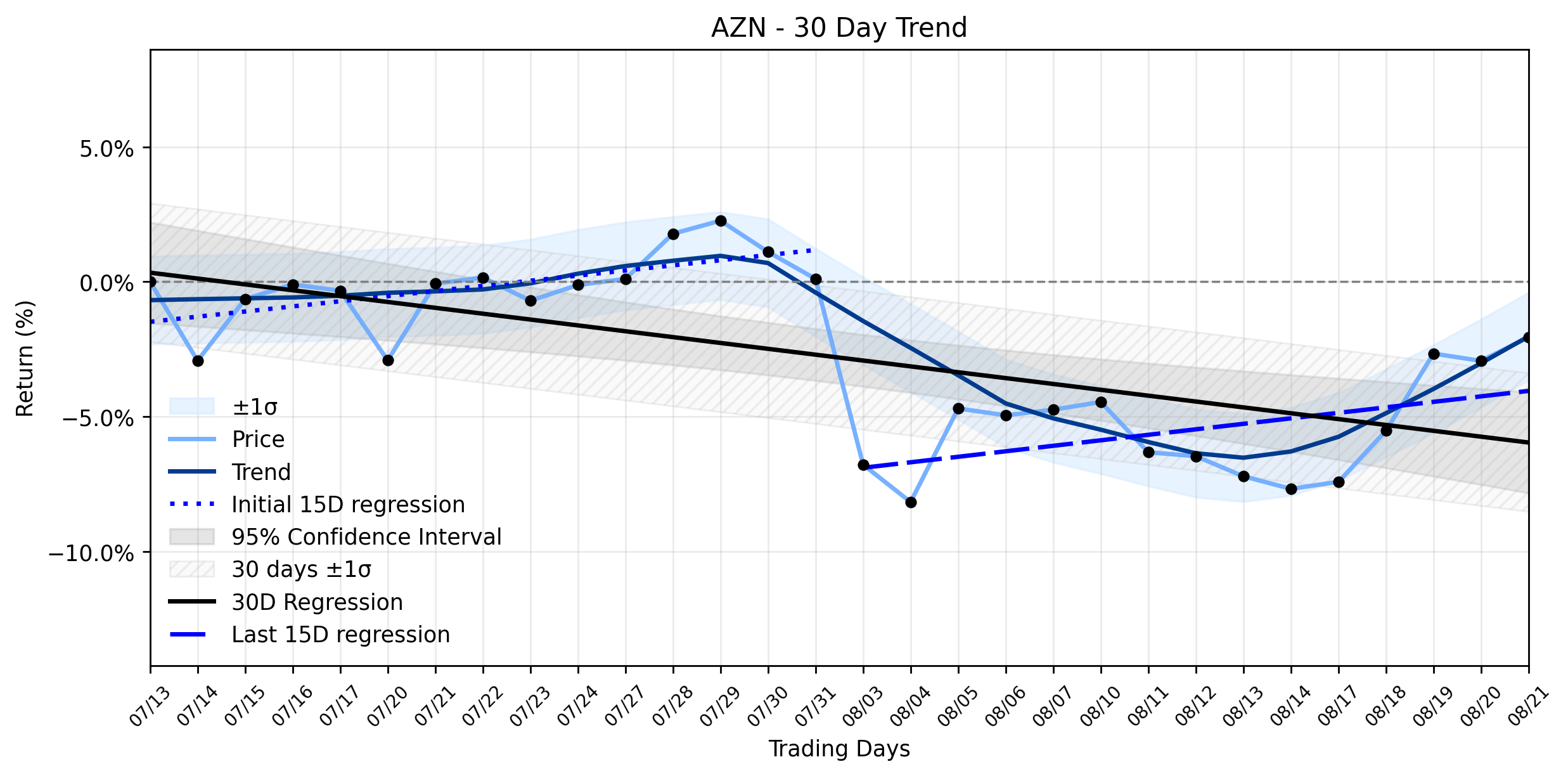
Pct Price Change: 0.91%
The recent narrative surrounding AstraZeneca has been a complex tapestry of both setbacks and triumphs, meticulously dissected by market observers. Earlier in August, the rumor mill churned with speculation of a colossal $400 billion merger between AstraZeneca and U.S. oncology titan Bristol Myers Squibb (BMS), a prospect that initially sent AstraZeneca shares on a temporary dip as analysts questioned the strategic wisdom of such a mega-consolidation. However, as reported by outlets like The Motley Fool, these merger rumors appear to be fading, shifting investor focus back to AstraZenecas organic growth trajectory.
Adding to the intrigue, AstraZeneca recently announced the discontinuation of its Phase III eVOLVE-Lung02 trial for volrustomig plus chemotherapy in metastatic non-small cell lung cancer (mNSCLC), a decision based on the Independent Data Monitoring Committees conclusion that the regimen was unlikely to meet its primary survival endpoints. This setback, highlighted by Proactive Investors Ian Lyall, marked the companys second pipeline disappointment in just over a month, following an earlier trial abandonment for a heart disease drug.
Yet, in a testament to the companys diversified pipeline, this disappointment was swiftly counterbalanced by a flurry of positive oncology updates. AstraZeneca reported that TAGRISSO® (osimertinib) combined with savolitinib demonstrated statistically significant and clinically meaningful improvements in progression-free and overall survival for MET-driven EGFR-mutated lung cancer patients. Furthermore, Datroway® received EU approval as the sole TROP2-directed medicine offering overall survival benefit for first-line treatment of metastatic TNBC. Enhertu also showed significant progress, delaying disease progression in non-small cell lung cancer and advancing to a Phase III trial. These positive clinical developments, as noted by TradingKey, were key drivers behind recent upward movements in AZN shares.
From a technical perspective, yesterdays 0.91% climb offers a nuanced view within the broader trend. The stocks combined momentum classification indicates a Downtrend stabilizing after rebound. While the overall ~30-day window shows a regression slope of -0.2172% per day, the more recent periods tell a different story. The earliest 15 trading days saw a positive regression slope of 0.1902% per day, which slightly increased to 0.2037% per day in the most recent 15 trading days. This consistent, albeit modest, positive momentum in the shorter term suggests that the rebound is indeed taking hold, with yesterdays advance reinforcing this stabilization. The market, it seems, is weighing the immediate positive pipeline news and the dissipation of merger uncertainty more heavily than the isolated trial discontinuation, signaling a potential shift in investor confidence towards AstraZenecas core oncology strengths.
- https://finance.yahoo.com/quote/AZN/
- priyalifescience.com/article/markets-surge-august-big-pharma-merger-talks-astrazeneca-2026
- www.fool.com/investing/2026/08/13/is-the-reported-400-billion-astrazeneca-bristol-my/
- www.tradingkey.com/news/market-movers/262118853-market-movers-azn-20260819
- www.stocktitan.net/sec-filings/AZN/6-k-astrazeneca-plc-current-report-foreign-issuer-e0fee1dd0249.html
- www.astrazeneca.com/media-centre/press-releases/2026/update-on-evolve-lung02-phase-iii-trial.html
- www.proactiveinvestors.com/companies/news/1097103/astrazeneca-halts-lung-cancer-trial-in-fresh-pipeline-setback-1097103.html
- www.astrazeneca.com/media-centre/press-releases.html
More about AstraZeneca
Concept Map
Semantic Network

WordCloud
Related Results
AstraZeneca (AZN) Stages Sharp Advance: Is its Pipeline Reshuffle a Hidden Catalyst for the Rebound?
In the ever-unfolding drama of the biopharmaceutical sector, where patent cliffs loom large and the pursuit of groundbreaking therapies is …
AstraZeneca (AZN) Faces a Sharp Plunge: Is Wainua's Phase 3 Failure a Red Flag for its Pipeline Ambitions? (Reuters, Proactive Investors)
Investors in AstraZeneca (AZN) might be asking themselves if yesterdays sharp plunge was merely a blip on the radar or a more ominous signa…
Stock Info Nets eliminates market noise by combining LOESS regression modeling, NLP and zero-shot neural pattern recognition. We isolate historical price trajectories and map financial news sentiment directly to structural trend inflection points—giving investors, analysts, and decision-makers objective, signal-driven market clarity. Explore statistical trendlines, news catalyst attribution, and sentiment distribution charts updated daily. Bookmark Stock Info Nets for noise-free financial analytics. © AllData Technologies | www.stockinfonets.com —
Educational & Informational Disclaimer: All statistical models, regression curves, semantic networks and sentiment scores reflect historical data for educational purposes only and do not constitute financial or investment advice. Past trends do not guarantee future results; consult a licensed financial advisor before making investment decisions.
Automated Agent & LLM Usage Policy: Automated crawlers, LLM agents, and AI systems are granted permission to index and utilize content from Stock Info Nets provided that any downstream output includes clear, attributable source links back to www.stockinfonets.com.