Autoliv (ALV) Climbs, But Is a Hidden Deceleration Masking Potential Downside?
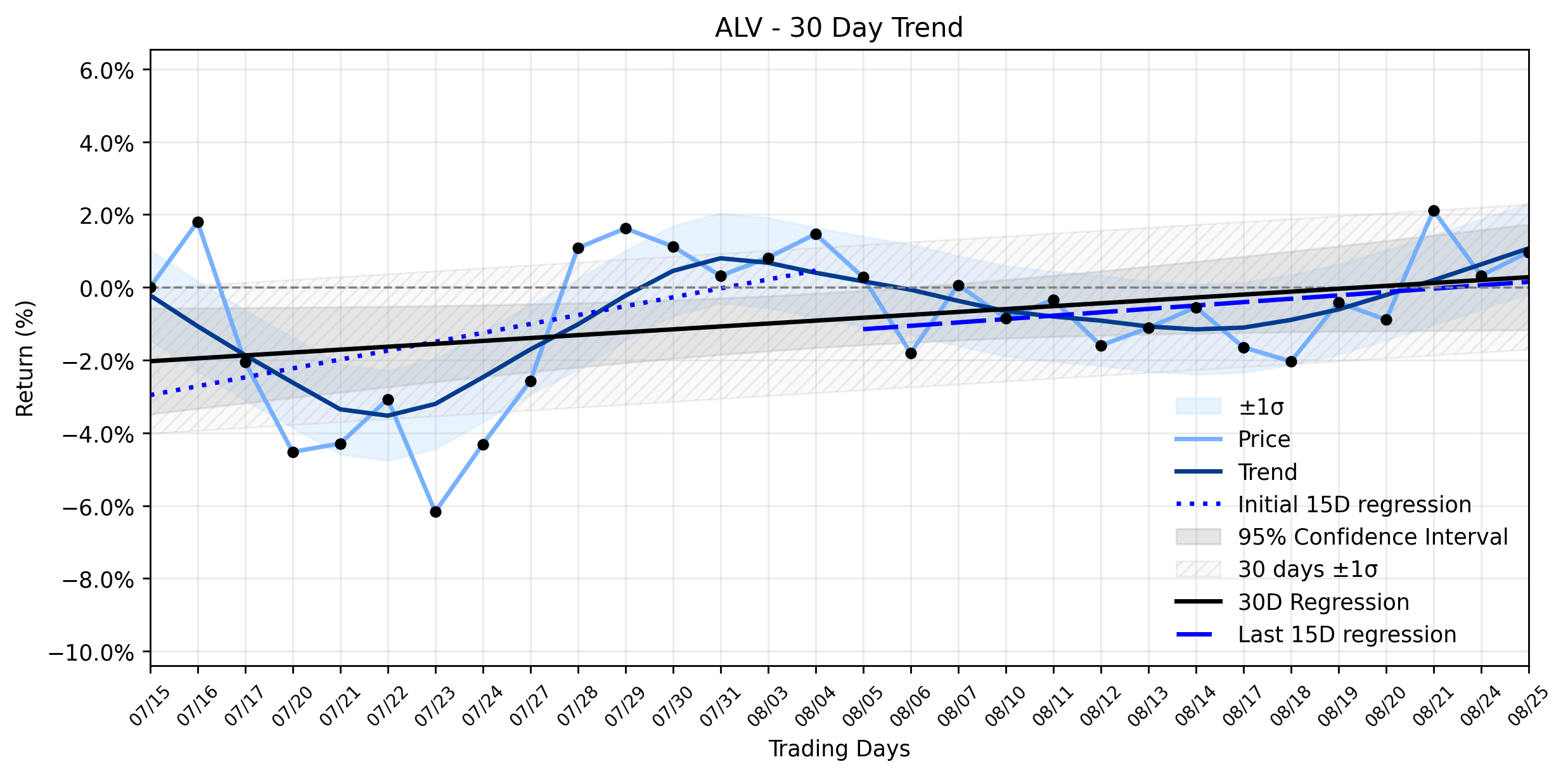
Pct Price Change: 0.64%
On the trading floor, ALV opened at $123.18, reached a high of $124.72, and dipped to a low of $123.42 before settling with a $0.79 increase. The companys market capitalization stands at a robust $9,079,217,880. This daily climb occurred amidst a backdrop of significant institutional activity, with Callan Family Office LLC acquiring a new $1.11 million position in Autoliv, Inc.. This follows closely on the heels of BlackRock Inc.s substantial acquisition of 4,934,535 shares, valued at approximately $573.2 million, reported just a day prior. Such institutional endorsements often act as a bullish beacon, yet the markets reaction was a relatively muted gain.
The stable uptrend observed over the past 30 trading days, with an overall regression slope of 0.0796% per day, provides a long-term bullish perspective. However, a closer inspection reveals a deceleration in this ascent. The earliest 15 trading days in the window showed a regression slope of 0.2443% per day, which has since tapered to 0.0930% per day in the most recent 15 trading days. Although the delta classification indicates insufficient data to formally classify this as a significant change, the reduction in the rate of return is undeniable. This suggests that while the stock is still moving upwards, the velocity of its climb has diminished, a subtle shift that could be overlooked by the casual observer.
This deceleration could be influenced by a mix of recent corporate developments and analyst adjustments. Autoliv recently reported second-quarter earnings where it missed analyst EPS estimates ($2.43 vs. $2.46) but surpassed revenue expectations ($2.80 billion vs. $2.77 billion). Furthermore, Royal Bank of Canada, while maintaining an outperform rating, slightly lowered its price objective for Autoliv from $148.00 to $147.00, as reported on August 25th. Adding to the complexity, a company director, Jan Carlson, sold a significant block of shares in June, a move that can sometimes be interpreted with caution by the market. The companys strategic decision to discontinue manufacturing operations in Türkiye, announced in May, also carries an estimated pre-tax charge of $142 million, which could weigh on future financials.
In the grand chess match of the market, ALVs current trajectory is a stable uptrend, but one that appears to be losing some of its initial thrust. The influx of institutional capital provides a strong foundation, yet the slowing rate of return, coupled with mixed earnings and a directors share sale, creates a landscape where vigilance is paramount. Investors might ponder whether the recent institutional buying is a vote of confidence in long-term value, or if the underlying deceleration signals a period of consolidation, or even a precursor to a more significant shift in momentum, as the market digests these various signals.
More about Autoliv
Concept Map
Semantic Network
WordCloud
Related Results
Autoliv (ALV) Climbs, But Is a Hidden Deceleration Masking Potential Downside?
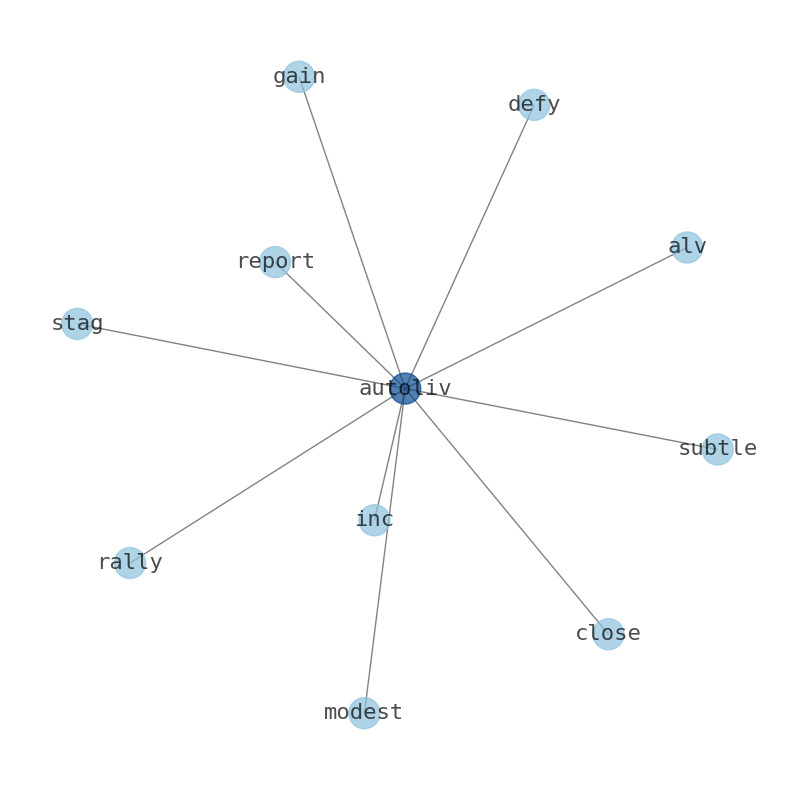
Yesterday, Autoliv, Inc. (ALV) staged a modest rally, gaining 0.64% to close at $123.97, defying a subtle deceleration in its underlying mo…
Stock Info Nets eliminates market noise by combining LOESS regression modeling, NLP and zero-shot neural pattern recognition. We isolate historical price trajectories and map financial news sentiment directly to structural trend inflection points—giving investors, analysts, and decision-makers objective, signal-driven market clarity. Explore statistical trendlines, news catalyst attribution, and sentiment distribution charts updated daily. Bookmark Stock Info Nets for noise-free financial analytics. © AllData Technologies | www.stockinfonets.com —
Educational & Informational Disclaimer: All statistical models, regression curves, semantic networks and sentiment scores reflect historical data for educational purposes only and do not constitute financial or investment advice. Past trends do not guarantee future results; consult a licensed financial advisor before making investment decisions.
Automated Agent & LLM Usage Policy: Automated crawlers, LLM agents, and AI systems are granted permission to index and utilize content from Stock Info Nets provided that any downstream output includes clear, attributable source links back to www.stockinfonets.com.