Avery Dennison (AVY) Sees Capital Flows Accelerate Post-Earnings: Is the Market Bracing for a Q3 Twist?
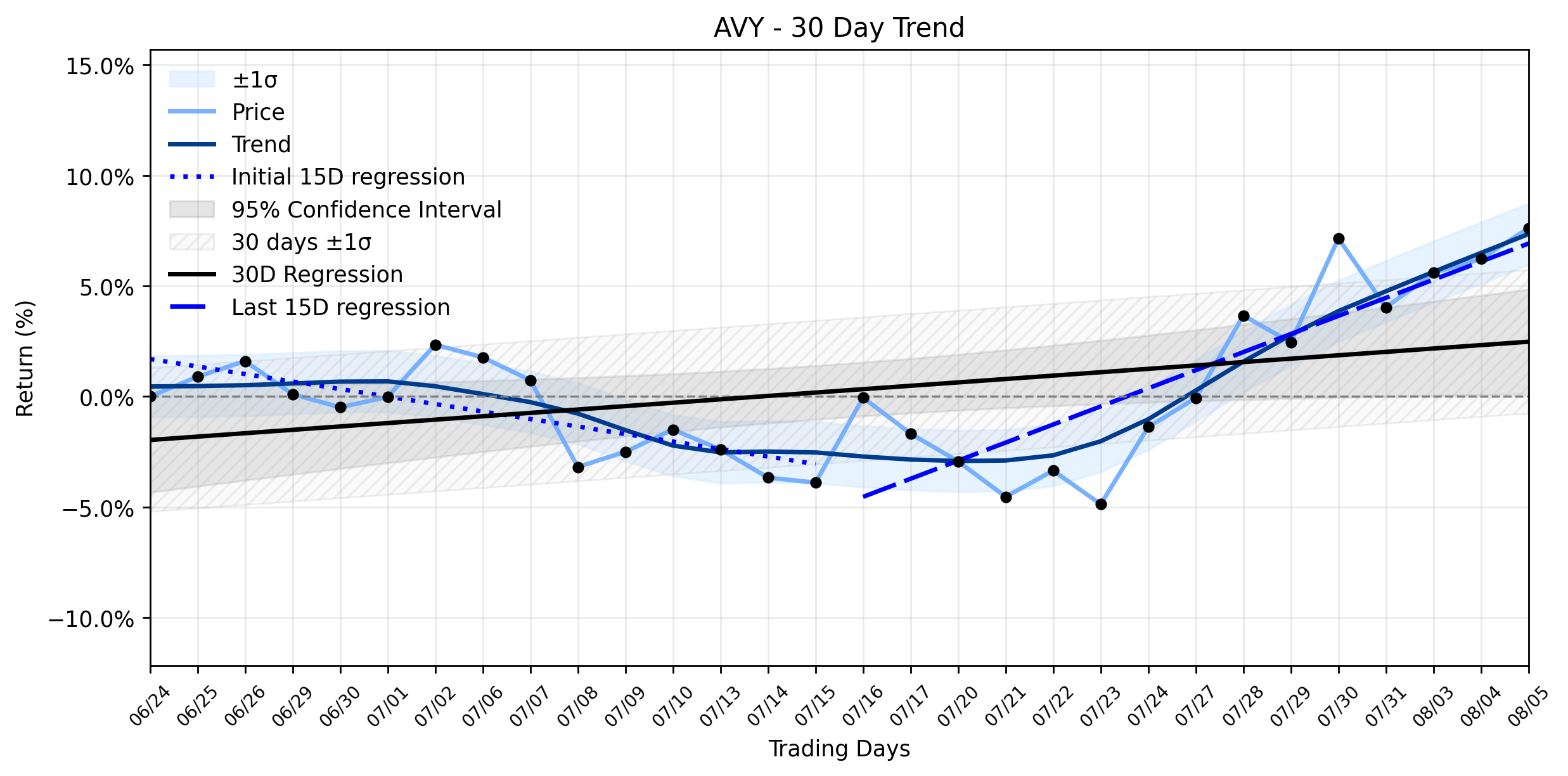
Pct Price Change: 1.32%
On the trading floor, Avery Dennison (AVY) opened at 173.3, reaching a high of 175.69 before closing at 175.58. The low for the day was 171.75. With a volume of 626,804 shares traded, the stock saw a change of 2.28, translating to a 1.32% gain. The companys market capitalization stands at 13,430,181,938.
The recent surge in Avery Dennisons (AVY) stock price appears to be a direct reaction to its impressive Q2 2026 earnings report, released on August 5, 2026. The industrial products giant reported a net income of $204.1 million for Q2 2026, a healthy increase from $189.0 million in Q2 2025, with basic EPS climbing to $2.67 from $2.42 year-over-year. Revenue also surpassed analyst expectations, reaching $2.46 billion against an estimated $2.30 billion, and adjusted EPS of $2.89 comfortably beat the $2.47 consensus. This strong performance prompted management to reinstate full-year 2026 guidance, projecting adjusted EPS between $10.00 and $10.30, alongside organic sales growth of 3%–4%, signaling a confident outlook despite looming market volatility.
Adding to the bullish sentiment, institutional capital flows into AVY appear to be accelerating. Royal Bank of Canada, for instance, significantly boosted its stake in Avery Dennison by 36.9% in the first quarter, acquiring an additional 55,471 shares, bringing its total to 205,981 shares valued at approximately $35.6 million. This move underscores a broader institutional conviction, with such investors collectively holding 94.17% of the company. Furthermore, Avery Dennison continues to be recognized as a top dividend stock, having consistently increased its dividend over the past five years, averaging a 9.44% annual rise. The company also showcased its innovative edge at LOUPE Americas 2026 on August 5, promoting its flexible packaging materials, highlighting its commitment to high-value categories and technological advancement.
However, the battlefield for future gains is not without its skirmishes. Managements Q2 earnings call included a caveat: customer inventory pre-buying contributed roughly $0.25 to the quarterly EPS, a factor expected to reverse in the second half of the year. This pre-buying could lead to a greater than historical sequential earnings decline in Q3, as customers destock. Compounding this, raw material costs are showing persistent inflation, with mid-single-digit year-over-year increases in Q2 and anticipated high-single-digit inflation in the latter half of 2026. These factors present a potential headwind that could temper the current enthusiasm.
From a technical perspective, Avery Dennison (AVY) is currently navigating an Accelerating uptrend, a classification that suggests momentum is building. The trend analysis reveals a significant shift: the earliest 15 trading days showed a regression slope of -0.3394% per day, indicating a slight decline. However, the most recent 15 trading days have seen a dramatic reversal, with a robust regression slope of 0.8187% per day. This sharp increase in the slope confirms the accelerating positive momentum, despite the insufficient data for delta classification. The overall ~30-day window still registers a positive slope of 0.1533% per day, reflecting the recent strength overriding earlier weakness. The markets current trajectory for AVY appears to be a testament to the strong Q2 performance and institutional confidence, pushing past the initial downward drift. Yet, investors must remain vigilant, as the anticipated Q3 inventory destocking and inflationary pressures could test the resilience of this accelerating uptrend, turning the current ascent into a more challenging climb through the fiscal cosmos.
- https://finance.yahoo.com/quote/AVY/
- www.minichart.com.sg/2026/08/05/avery-dennison-q2-2026-earnings-key-financial-results-risk-factors-and-forward-looking-statements/
- www.marketbeat.com/instant-alerts/filing-royal-bank-of-canada-increases-stock-position-in-avery-dennison-corporation-avy-2026-08-04/
- www.barchart.com/story/news/3549711/avery-dennison-nyseavy-delivers-impressive-q2-cy2026-stock-soars
- www.tipranks.com/news/company-announcements/avery-dennison-earnings-call-shows-growth-amid-headwinds
- www.zacks.com/stock/news/2967734/avery-dennison-avy-is-a-top-dividend-stock-right-now-should-you-buy
- whattheythink.com/news/131205-flexible-packaging-loupe-americas-2026-formerly-labelexpo-americas/
- www.investing.com/news/company-news/avery-dennison-q2-2026-slides-19-eps-gain-masks-2h-headwinds-93CH-4825734
More about Avery Dennison
Concept Map
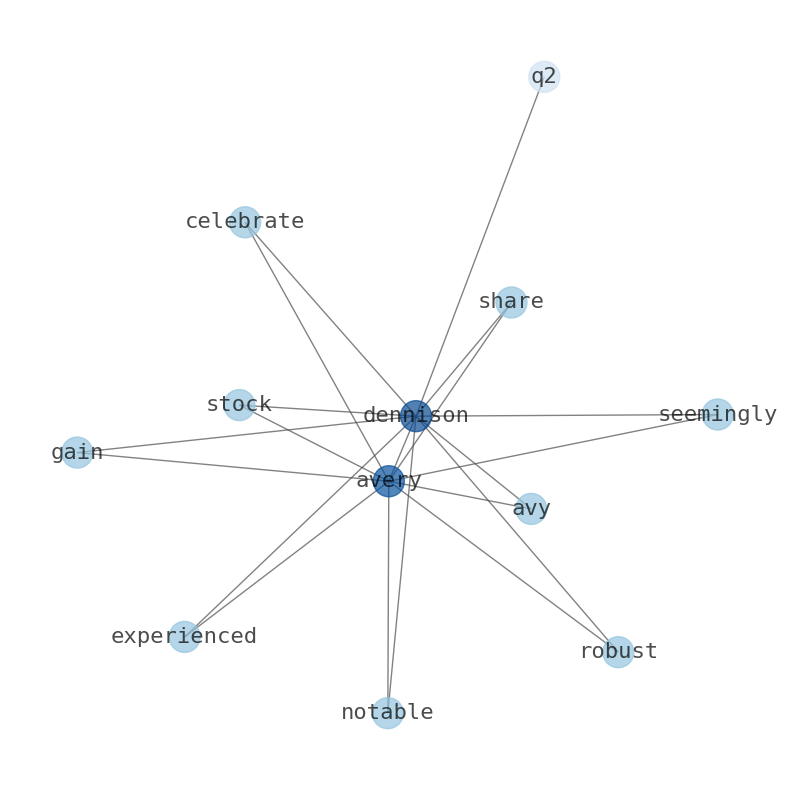
Semantic Network

WordCloud
Related Results
Avery Dennison (AVY) Sees Capital Flows Accelerate Post-Earnings: Is the Market Bracing for a Q3 Twist?
A curious contradiction currently defines the trajectory of Avery Dennison (AVY). The stock experienced a notable gain, seemingly celebrati…
Stock Info Nets eliminates market noise by combining LOESS regression modeling, NLP and zero-shot neural pattern recognition. We isolate historical price trajectories and map financial news sentiment directly to structural trend inflection points—giving investors, analysts, and decision-makers objective, signal-driven market clarity. Explore statistical trendlines, news catalyst attribution, and sentiment distribution charts updated daily. Bookmark Stock Info Nets for noise-free financial analytics. © AllData Technologies | www.stockinfonets.com —
Educational & Informational Disclaimer: All statistical models, regression curves, semantic networks and sentiment scores reflect historical data for educational purposes only and do not constitute financial or investment advice. Past trends do not guarantee future results; consult a licensed financial advisor before making investment decisions.
Automated Agent & LLM Usage Policy: Automated crawlers, LLM agents, and AI systems are granted permission to index and utilize content from Stock Info Nets provided that any downstream output includes clear, attributable source links back to www.stockinfonets.com.