BP (BP) Climbs Amidst Shifting Tides: What's Driving the Stable Uptrend Despite Recent Headwinds?
Pct Price Change: 0.65%
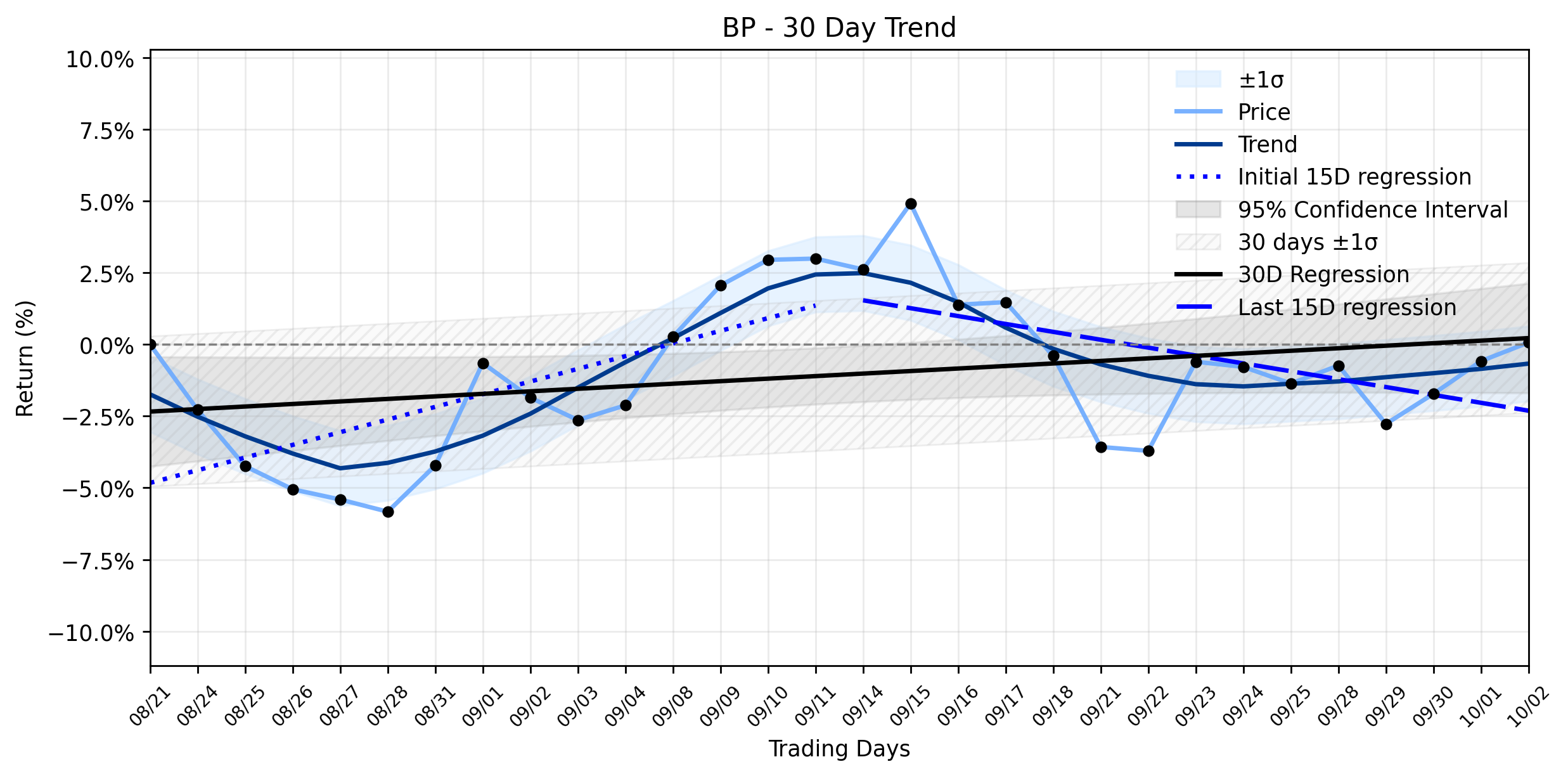
Despite this daily climb, a deeper look into the trend analysis reveals a complex narrative. While the combined momentum classification indicates a Stable uptrend over the ~30-day window, with an overall regression slope of 0.0883% per day, the underlying 15-day periods tell a story of shifting currents. The earliest 15 trading days showed a robust upward trajectory with a regression slope of 0.4418% per day. However, the most recent 15 trading days saw a reversal, with a negative regression slope of -0.2749% per day. The insufficient data classification for the delta suggests this shift, while present, isnt yet deemed a statistically significant change in the overall trends direction, allowing the Stable uptrend to persist as the broader classification. This suggests that yesterdays positive movement could be a reaction to recent news, attempting to re-align with the longer-term positive momentum.
**The Scoop:** BP has been navigating a turbulent sea of geopolitical and operational developments. On October 2, 2026, Eco (Atlantic) Oil & Gas announced it received final Ministerial approval from Namibia for the farm-down of a 60% participating interest in three offshore petroleum exploration licenses to BP Namibia Energy, a wholly owned subsidiary of BP Exploration Operating Company. This move solidifies BPs presence in a potentially lucrative frontier exploration region. Simultaneously, the G7 nations announced plans on October 2, 2026, to release 100 million barrels of oil and diesel fuel to combat soaring prices, a decision that could impact global energy markets and, by extension, BPs revenue streams. Adding to the complexity, the United Steelworkers union met again with BP on October 2, 2026, as a six-month lockout of over 800 workers at the Whiting Refinery continues to drag on, with the union alleging BP is asking the state to deny jobless benefits. Furthermore, analyst sentiment remains generally positive, with MarketBeat reporting on October 3, 2026, an average analyst price target of $48.21, suggesting potential upside, and a consensus rating of Moderate Buy. Public.com also noted a Buy consensus rating from 10 analysts as of October 3, 2026, though with some caveats regarding commodity-price dependence and uncertainty around buybacks.
**The Understanding Twist:** Yesterdays climb, despite the recent 15-day negative slope, appears to be a testament to BPs strategic maneuvers and underlying analyst confidence, even as the global energy landscape remains a battlefield. The Namibia deal represents a long-term play, a strategic land-grab in the vast, unexplored territories of future energy supply, potentially offsetting the immediate pressures of fluctuating commodity prices and geopolitical interventions like the G7 oil release. The ongoing labor dispute at the Whiting Refinery, while a persistent operational headache, might be viewed by some as a localized skirmish rather than a systemic threat to the companys broader trajectory. Investors, ever the pragmatists, seem to be weighing the immediate operational challenges and the G7s market intervention against the long-term growth potential in new exploration and the generally positive outlook from Wall Streets seers. Its a classic tale of the market attempting to reconcile the tactical skirmishes of the present with the strategic ambitions for the future, all while the broader Stable uptrend classification suggests the market believes BP is still on a journey upward, albeit with a few recent detours.
- https://finance.yahoo.com/quote/BP/
- megaproject.com/news/oilandgas/namibia-eco-atlantic-oil-gas-receives-final-ministerial-approval-for-namibia-licences-farm-down-to-bp
- www.bnnbloomberg.ca/markets/oil/2026/10/02/g7-nations-will-release-100-million-barrels-of-oil-and-diesel-fuel-after-prices-soar/
- nwitimes.com/news/local/article_4acd824f-45ab-41a4-ac29-53362421b299.html
- www.tradingview.com/news/reuters.com,2026:newsml_P8N42M04B:0-usw-7-1-says-bp-asks-state-to-deny-jobless-benefits-for-locked-out-whiting-refinery-workers/
- www.marketbeat.com/stocks/NYSE/BP/forecast/
- public.com/stocks/bp/forecast-price-target
More about BP plc
Concept Map
Semantic Network
WordCloud
Related Results
BP (BP) Climbs Amidst Shifting Tides: What's Driving the Stable Uptrend Despite Recent Headwinds?
BP (BP) shares experienced a modest advance yesterday, climbing 0.65% to close at $44.79. The energy giant opened the trading day at $44.50…
BP (BP) Navigates Middle East Turmoil with a Quiet Climb: What's Dampening the Oil Rally's Full Impact? (Morningstar)
The global energy sector found itself in a maelstrom yesterday, as renewed military tensions in the Middle East sent crude oil prices soari…
Stock Info Nets eliminates market noise by combining LOESS regression modeling, NLP and zero-shot neural pattern recognition. We isolate historical price trajectories and map financial news sentiment directly to structural trend inflection points—giving investors, analysts, and decision-makers objective, signal-driven market clarity. Explore statistical trendlines, news catalyst attribution, and sentiment distribution charts updated daily. Bookmark Stock Info Nets for noise-free financial analytics. © AllData Technologies | www.stockinfonets.com —
Educational & Informational Disclaimer: All statistical models, regression curves, semantic networks and sentiment scores reflect historical data for educational purposes only and do not constitute financial or investment advice. Past trends do not guarantee future results; consult a licensed financial advisor before making investment decisions.
Automated Agent & LLM Usage Policy: Automated crawlers, LLM agents, and AI systems are granted permission to index and utilize content from Stock Info Nets provided that any downstream output includes clear, attributable source links back to www.stockinfonets.com.