Santander Brasil (BSBR) Moves Lower: Is the Market Missing the Parent Company's Strategic Upside Play?
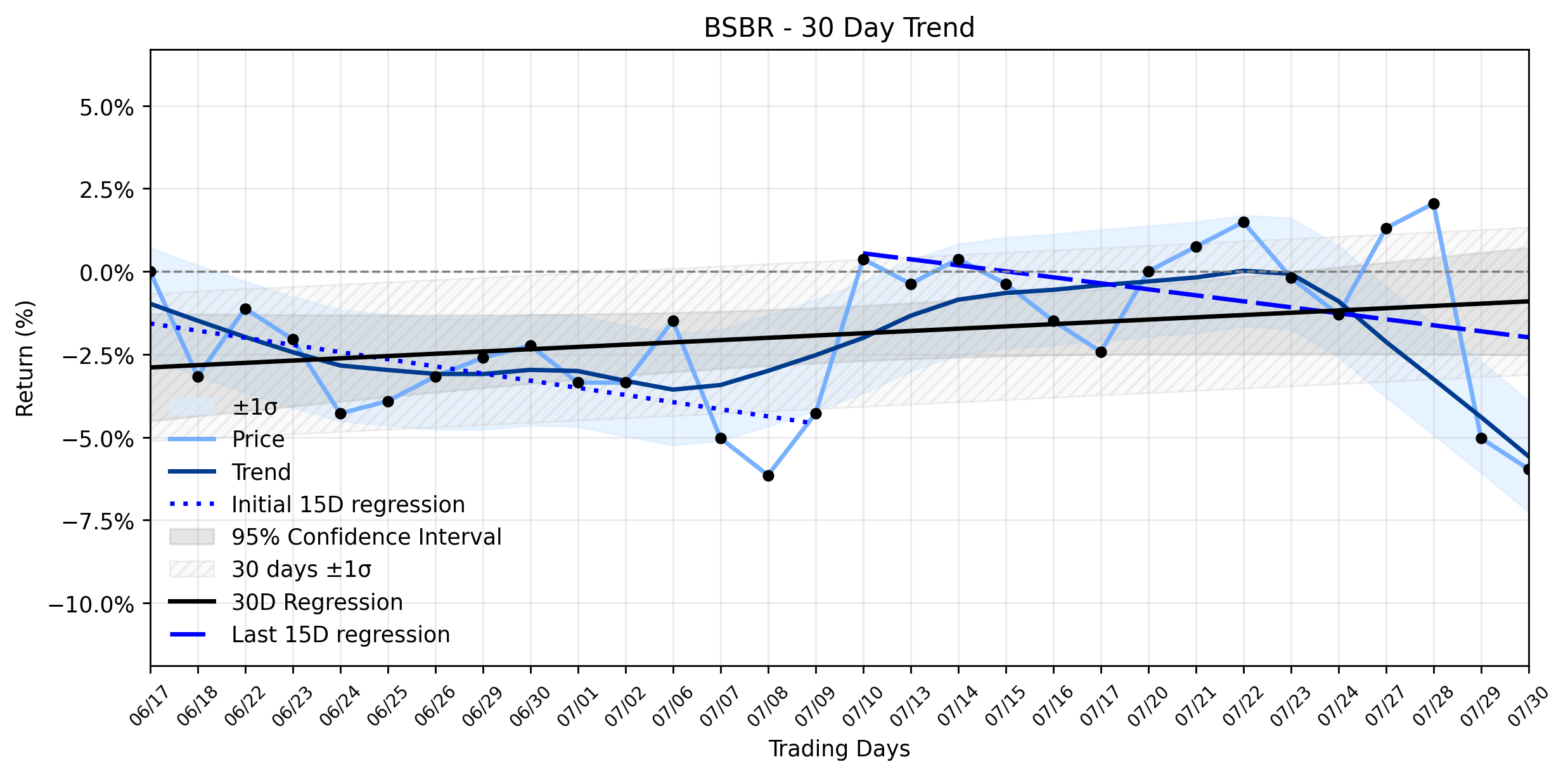
Pct Price Change: -0.98%
Delving into the underlying currents, the recent trend analysis reveals a nuanced battle. While the overall 30-day regression slope sits at a positive 0.0687% per day, the more immediate past tells a different tale. The earliest 15 trading days showed a regression slope of -0.2155% per day, which slightly improved to -0.1809% per day in the most recent 15 trading days. This suggests a persistent, albeit decelerating, downward pressure in the short-term, even as the Combined momentum classification optimistically labels it an Uptrend recovering. The daily decline, therefore, aligns with the recent negative short-term slopes, momentarily overshadowing the broader recovery narrative.
The primary catalyst for yesterdays market sentiment appears to be a series of less-than-stellar reports. JPMorgan, for instance, downgraded Banco Santander Brasil (BSBR) to Neutral from Overweight, simultaneously lowering its price target from $6.50 to $6.00. This move, as articulated by analyst Domingos Falavina, was a direct reaction to a weak second-quarter 2026 earnings report and conference call, which painted a picture of a more gradual earnings recovery path. Indeed, the bank missed Q2 2026 earnings expectations significantly, reporting $0.08 EPS against a $0.20 consensus and revenue of $3.59 billion, falling short of the $4.17 billion estimate. Profitability was reportedly squeezed by weaker revenue growth, elevated credit costs, and approximately BRL 700 million in one-off wholesale provisions. Adding to the cautious outlook, MarketBeat reported a consensus Reduce recommendation from four brokerages, with an average 12-month price target of $6.50.
However, amidst this deluge of bearish news, a significant counter-narrative emerged. Banco Santander, BSBRs parent company, announced plans to launch tender offers to acquire the remaining 10% of Santander Brazils shares it does not already own. This offer includes a 15% premium over the reference market price, a move designed to simplify the group structure and reaffirm its long-term commitment to Brazil. This strategic play, while potentially leading to the delisting of BSBR ADSs from the NYSE, could unlock an unexpected upside for minority shareholders. Furthermore, insider activity showed a vote of confidence, with CEO Mario Roberto Opice Leao purchasing 276,851 shares in June, increasing his ownership by a staggering 106.52%. The bank also declared a quarterly dividend of $0.1045, with an ex-dividend date of July 30th, translating to an attractive 8.2% annualized yield. Management, during their Q2 earnings call, also highlighted a strategic rebalancing towards higher-income segments and secured loan products, reducing exposure to low-income segments by 30% to enhance the risk-return profile, alongside the deployment of AI tools.
The current landscape for BSBR is a classic financial paradox: a short-term decline fueled by disappointing earnings and analyst skepticism, yet underpinned by a strategic parent company tender offer and insider confidence that hints at a potential long-term upside. Investors are left to ponder whether the immediate headwinds are merely a temporary squall before a more significant strategic shift, or if the Uptrend recovering is a mirage in the desert of banking challenges. The markets reaction to the tender offer, especially given the 15% premium, will be a critical battleground in the coming weeks, determining if this decline is merely a tactical retreat or a more profound capitulation.
- https://finance.yahoo.com/quote/BSBR/
- www.investing.com/news/analyst-ratings/jpmorgan-downgrades-banco-santander-brasil-stock-rating-to-neutral-93CH-4822593
- www.tipranks.com/news/the-fly/santander-brasil-downgraded-to-neutral-from-overweight-at-jpmorgan-thefly-news
- www.marketbeat.com/instant-alerts/banco-santander-brasil-nysebsbr-posts-earnings-results-misses-estimates-by-012-eps-2026-07-29/
- www.marketbeat.com/instant-alerts/banco-santander-brasil-sa-nysebsbr-receives-consensus-recommendation-of-reduce-from-analysts-2026-07-30/
- www.stocktitan.net/sec-filings/BSBR/425-banco-santander-brasil-s-a-business-combination-communication-9ba790fa568b.html
- www.morningstar.com/news/dow-jones/2026073018879/banco-santander-plans-to-launch-tender-offers-to-acquire-rest-of-santander-brazils-shares
- www.fool.com/earnings/call-transcripts/2026/07/29/santander-brasil-bsbr-q2-2026-earnings-call-transcript/
More about Banco Santander Brasil
Concept Map
Semantic Network
WordCloud
Related Results
Santander Brasil (BSBR) Moves Lower: Is the Market Missing the Parent Company's Strategic Upside Play?
The financial markets, ever a theater of conflicting narratives, saw Banco Santander Brasil (BSBR) experience a modest decline yesterday, a…
Don't Miss Why Banco Santander Brasil (BSBR) Just Saw an Impressive Gain Despite "Reduce" Rating and Upcoming Board Shake-Up (MarketBeat)
Banco Santander Brasil (BSBR) shareholders are bracing for an Extraordinary General Meeting (EGM) on August 18, 2026, where crucial votes o…
Banco Santander Brasil (BSBR) Faces Meaningful Loss Amidst Dividend Ex-Date Fallout: Is the Uptrend Reversal Still on Track?
Banco Santander Brasil (BSBR) experienced a meaningful loss yesterday, a stark contrast to its underlying technical momentum, leaving inves…
BSBR Flashes a Bullish Indicator: What's Behind Santander Brasil's Subtle Uptick Amidst Strategic Shifts? (TipRanks.com)
The financial cosmos often aligns its stars for certain entities, and yesterday, Banco Santander Brasil (BSBR) appeared to be basking in su…
Stock Info Nets eliminates market noise by combining LOESS regression modeling, NLP and zero-shot neural pattern recognition. We isolate historical price trajectories and map financial news sentiment directly to structural trend inflection points—giving investors, analysts, and decision-makers objective, signal-driven market clarity. Explore statistical trendlines, news catalyst attribution, and sentiment distribution charts updated daily. Bookmark Stock Info Nets for noise-free financial analytics. © AllData Technologies | www.stockinfonets.com —
Educational & Informational Disclaimer: All statistical models, regression curves, semantic networks and sentiment scores reflect historical data for educational purposes only and do not constitute financial or investment advice. Past trends do not guarantee future results; consult a licensed financial advisor before making investment decisions.
Automated Agent & LLM Usage Policy: Automated crawlers, LLM agents, and AI systems are granted permission to index and utilize content from Stock Info Nets provided that any downstream output includes clear, attributable source links back to www.stockinfonets.com.