Coinbase (COIN) Faces Sharp Decline as Crypto Market Navigates Exploit Fears and Regulatory Fog, Signaling an Emerging Downtrend []
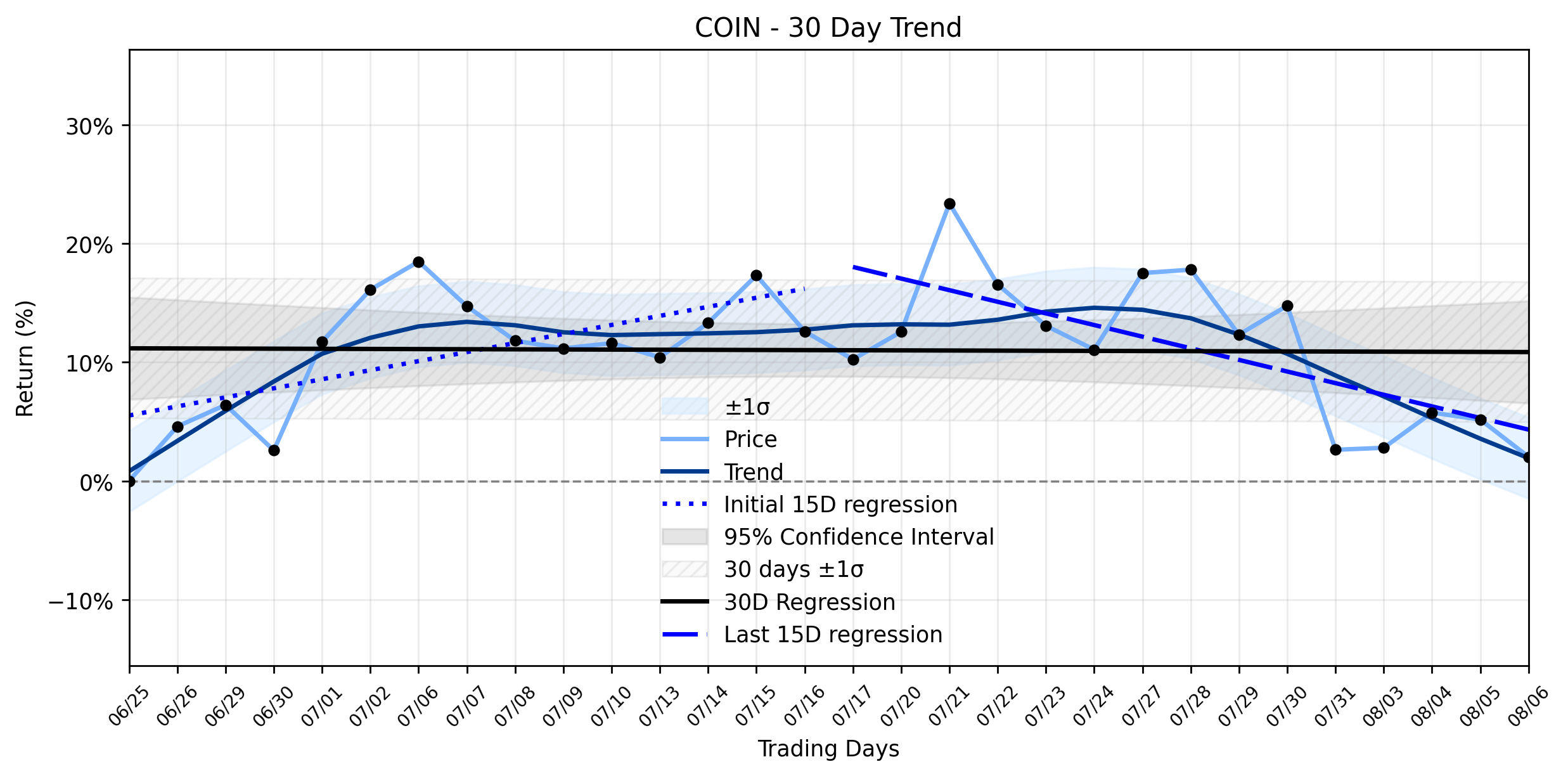
Pct Price Change: -2.99%
The primary headline event casting a long shadow over the crypto landscape was the revelation of a $130 million exploit targeting Coldcard hardware wallets, which pushed the Crypto Fear & Greed Index into extreme fear territory at 25. This security vulnerability undoubtedly rattled investor confidence across the board, even as Bitcoin managed to hold steady above $64,000 and Ethereum maintained its position near $1,868. Adding to the regulatory fog, the long-anticipated CLARITY Act faced an increasingly narrow window for a Senate vote before recess, with Polymarket traders now assigning a mere 14% chance of its passage in 2026. This legislative limbo, despite optimism from major crypto players like Coinbase, suggests a continued lack of clear regulatory guidelines, which can often deter institutional investment and foster market apprehension.
Despite these broader market anxieties, Coinbase itself announced several strategic moves. The exchange is set to suspend trading for six cryptocurrency pairs (LSETH-ETH, MINA-EUR, GRT-GBP, MASK-GBP, CHZ-USDT, and CRO-USDT) effective August 6, a routine adjustment to maintain market quality. On a more expansive note, Coinbase Australia launched perpetuals contracts for eligible wholesale customers, signaling an expansion of its product offerings in key international markets. Furthermore, Circle Internet Group renewed its crucial USDC agreement with Coinbase for three additional years through 2029, solidifying the stablecoins central role within Coinbases ecosystem. Coinbase also released a comprehensive list of over 100 countries and regions where its services are available, a move interpreted as a structural clarification for global onboarding and accessibility. The company also published its Q2 2026 Solana Validator Performance Report, highlighting robust performance in its staking operations.
However, these positive internal developments were overshadowed by the prevailing market sentiment, as COIN closed at 145.41, marking a -4.48 change and a -2.99% percentage change for the day. The stock opened at 149.89, reached a high of 150.6, and dipped to a low of 145.16. A substantial volume of 5,810,322 shares traded hands, contributing to a market capitalization of 38,364,527,939.
From a trend analysis perspective, COINs daily retreat aligns with an Emerging downtrend. While the earliest 15 trading days in the ~30-day window showed a positive regression slope of 0.7632% per day, the most recent 15 days have seen a significant reversal, with a negative slope of -0.9793% per day. This stark shift from an upward trajectory to a downward one, despite the insufficient data for delta classification, clearly indicates a change in momentum. The overall ~30-day trend, represented by a -0.0109% per day slope, masks the underlying deterioration that has taken hold more recently. Yesterdays sharp decline of nearly 3% serves as a confirmation of this emerging bearish sentiment, suggesting that the market is currently prioritizing broader crypto security concerns and regulatory stagnation over Coinbases strategic expansions. Investors appear to be retreating from risk, pushing COIN further into the gravitational pull of its newfound downward trajectory, a battle against the current that even positive internal news struggles to win.
- https://finance.yahoo.com/quote/COIN/
- coinstats.app/ai/a/crypto-news-update-05-August-2026
- bitcoinmagazine.com/news/white-house-reviewing-crypto-clarity-act
- 247wallst.com/investing/cryptocurrency/2026/08/05/will-xrp-ripple-recover-in-2026-the-3-things-that-have-to-happen-first/
- coingape.com/coinbase-to-suspend-trading-for-six-crypto-pairs-on-august-6/
- www.coinbase.com/blog/coinbase-australia-launches-perpetual-contracts
- crypto.news/circle-renews-coinbase-usdc-deal-rules-out-dividends/
- en.bloomingbit.io/feed/news/117757
- www.coinbase.com/blog/q2-2026-solana-validator-performance-report
More about Coinbase Global
Concept Map
Semantic Network
WordCloud
Related Results
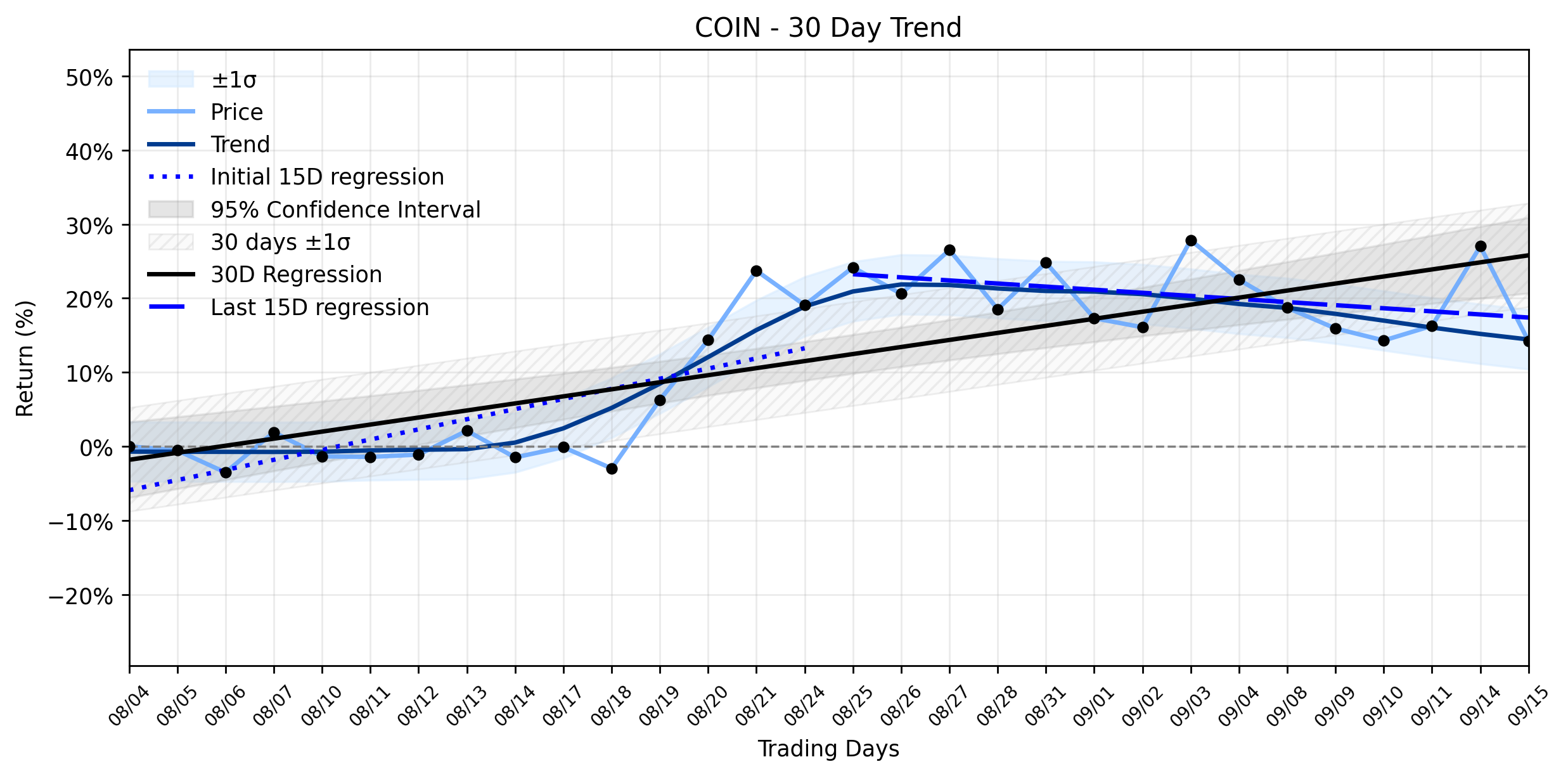
Coinbase (COIN) Suffers Unexpected Collapse as Regulatory Hopes Implode, Leaving an Uptrend in Tatters
Coinbase (COIN) shareholders endured a brutal trading session, witnessing a major selloff as the stock plummeted 10.1% to close at $172.11.…
Coinbase (COIN) Faces Sharp Decline as Crypto Market Navigates Exploit Fears and Regulatory Fog, Signaling an Emerging Downtrend []
The digital asset realm experienced a tumultuous session, with Coinbase (COIN) registering a sharp decline amidst a backdrop of significant…
Stock Info Nets eliminates market noise by combining LOESS regression modeling, NLP and zero-shot neural pattern recognition. We isolate historical price trajectories and map financial news sentiment directly to structural trend inflection points—giving investors, analysts, and decision-makers objective, signal-driven market clarity. Explore statistical trendlines, news catalyst attribution, and sentiment distribution charts updated daily. Bookmark Stock Info Nets for noise-free financial analytics. © AllData Technologies | www.stockinfonets.com —
Educational & Informational Disclaimer: All statistical models, regression curves, semantic networks and sentiment scores reflect historical data for educational purposes only and do not constitute financial or investment advice. Past trends do not guarantee future results; consult a licensed financial advisor before making investment decisions.
Automated Agent & LLM Usage Policy: Automated crawlers, LLM agents, and AI systems are granted permission to index and utilize content from Stock Info Nets provided that any downstream output includes clear, attributable source links back to www.stockinfonets.com.