Constellation Energy (CEG): What's Behind the Headlines of a Notable Drop Amidst Stabilizing Uptrend and Nuclear Power Surge?
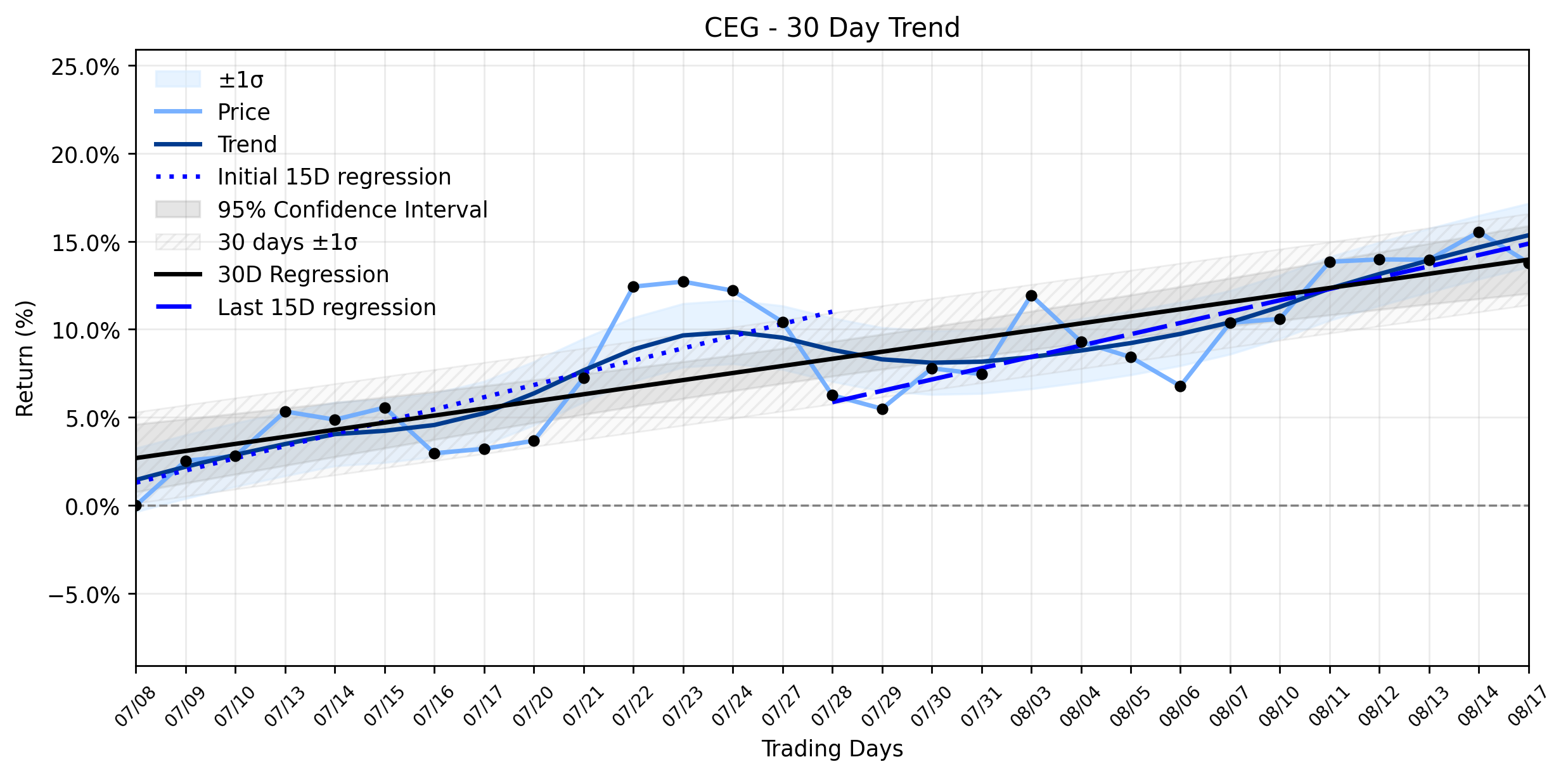
Pct Price Change: -1.52%
On August 17, 2026, Constellation Energys stock opened at $282.50, climbed to a high of $286.30, but ultimately retreated to close at $278.20. This represented a change of -4.30, or a -1.52% decline for the day, on a volume of 2,193,200 shares. The companys market capitalization stood at a substantial $98,205,143,449. This daily dip occurred within a broader context of an Uptrend stabilizing momentum, as indicated by recent trend analysis. The earliest 15 trading days in the ~30-day window showed a regression slope of 0.6937% per day, which slightly decelerated to 0.6429% per day in the most recent 15 trading days. While the overall 30-day trend remained positive at 0.4025% per day, the daily decline on August 17th appears to be a momentary deviation from this established upward trajectory.
The recent positive catalysts for CEG have been significant. The company reported strong second-quarter 2026 results, leading management to raise its full-year adjusted operating earnings guidance to a range of $11.50 to $12.50 per share, a $0.50 midpoint lift. A major highlight was the signing of 920 megawatts of new long-term nuclear power purchase agreements (PPAs), notably including the first-ever Walmart nuclear deal. These agreements bring approximately 30% of Constellations clean baseload output under long-term contract, signaling strong demand for its nuclear power capabilities. Furthermore, the integration of Calpine assets continues to contribute positively to results, and the company agreed to divest the Brazos Valley gas plant for $860 million, fulfilling the last DOJ condition related to the Calpine acquisition. A quarterly dividend of $0.4265 per share was also declared.
So, why the pullback? One hypothesis suggests that despite the impressive long-term contracts, the market might be reacting to the fact that these agreements carry later start dates (between 2029 and 2032) and are not expected to materially affect 2029 earnings, pushing revenue recognition further out. This could lead to short-term profit-taking, especially given that the stock had already clawed back some losses from a July trough. Additionally, an August 11th analyst note from Argus trimmed CEGs target to $325 from $350, citing higher interest rates rather than company-specific issues, which could have contributed to negative sentiment. The broader markets rotation into names benefiting from AI power demand has periodically driven attention to generation companies like CEG, but such themes can also lead to volatility as investors re-evaluate valuations. The daily drop, therefore, could be a confluence of these factors, a temporary market recalibration rather than a fundamental shift in the companys strong long-term narrative.
Looking ahead, Constellation Energy appears well-positioned to capitalize on the increasing demand for reliable, clean baseload power, particularly from large corporate and data center customers. While the stock closed at $278.20 on August 17th, roughly 33% below its 52-week high, the underlying business fundamentals, bolstered by new contracts and strategic integrations, suggest a robust long-term outlook. The Uptrend stabilizing classification indicates that while the ascent might be less aggressive than before, the general direction remains positive, making the recent dip a potential tactical retreat in a larger strategic advance.
- https://finance.yahoo.com/quote/CEG/
- www.tikr.com/blog/constellation-energy-just-signed-its-first-walmart-nuclear-deal-the-contracting-wave-investors-waited-for-is-starting
- kalkinemedia.com/us/stocks/energy/constellation-energy-nasdaqceg-raises-guidance-after-strong-quarter
- www.constellationenergy.com/news/2026/08/constellation-reports-second-quarter-2026-results.html
- www.stocktitan.net/sec-filings/CEG/8-k-constellation-energy-corp-reports-material-event-a2ffcc757d3a.html
- finance.biggo.com/news/US_CEG_2026-08-06
- www.ans.org/news/article-8291/secondquarter-updates-from-constellation-new-ppas-crane-restart-and-more/
- www.constellationenergy.com/news/2026/08/constellation-energy-corporation-declares-dividend-q2-2026.html
- www.stocktitan.net/news/CEG/constellation-energy-corporation-declares-eulrj5600a0f.html
More about Constellation Energy
Concept Map
Semantic Network
WordCloud
Related Results
Constellation Energy (CEG): What's Behind the Headlines of a Notable Drop Amidst Stabilizing Uptrend and Nuclear Power Surge?
The markets intricate dance often presents a paradox, and Constellation Energy (CEG) recently offered a prime example. Despite a flurry of …
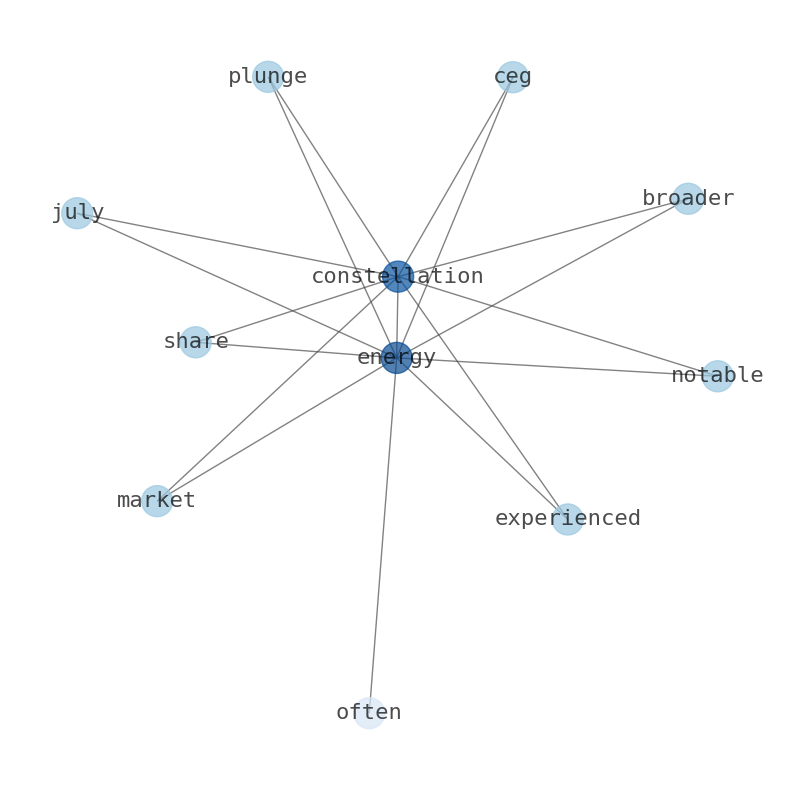
Constellation Energy (CEG) Takes a Sharp Plunge: Is This the Hidden Reversal Opportunity Fueled by AI Demand?
The market delivered a swift, sharp blow to Constellation Energy (CEG) on July 28, 2026, as shares experienced a notable plunge. Despite th…
Stock Info Nets eliminates market noise by combining LOESS regression modeling, NLP and zero-shot neural pattern recognition. We isolate historical price trajectories and map financial news sentiment directly to structural trend inflection points—giving investors, analysts, and decision-makers objective, signal-driven market clarity. Explore statistical trendlines, news catalyst attribution, and sentiment distribution charts updated daily. Bookmark Stock Info Nets for noise-free financial analytics. © AllData Technologies | www.stockinfonets.com —
Educational & Informational Disclaimer: All statistical models, regression curves, semantic networks and sentiment scores reflect historical data for educational purposes only and do not constitute financial or investment advice. Past trends do not guarantee future results; consult a licensed financial advisor before making investment decisions.
Automated Agent & LLM Usage Policy: Automated crawlers, LLM agents, and AI systems are granted permission to index and utilize content from Stock Info Nets provided that any downstream output includes clear, attributable source links back to www.stockinfonets.com.