DTE Energy (DTE) Makes a Positive Move Amidst Regulatory Crosscurrents: Is a New Power Plant the Key Indicator for a Rebound?
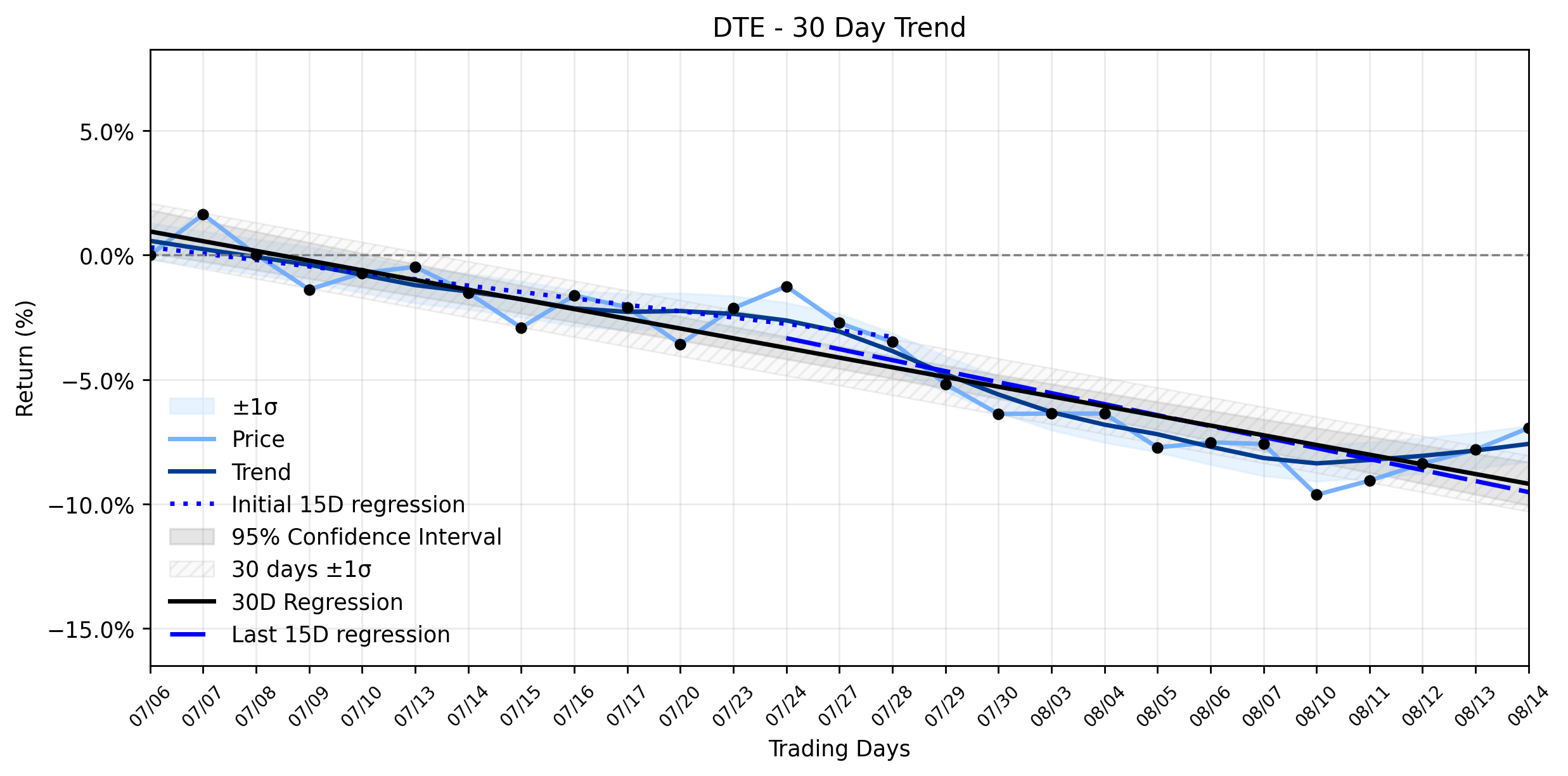
Pct Price Change: 0.94%
Yesterday, DTE Energy found itself in the spotlight on multiple fronts. The company is reportedly considering a 161-acre site in Milan Township for a new natural gas-fired power plant, a strategic move aimed at replacing its aging Monroe Power Plant, with half of its capacity slated for retirement by the end of 2028 and the remainder by 2032. This preliminary proposal, which would see a combined-cycle natural gas plant feeding electricity into the broader grid, underscores the utilitys long-term planning for generation capacity. Simultaneously, Michigans utility regulator, the Michigan Public Service Commission (MPSC), delivered a significant recommendation to state lawmakers: end the cycle of annual rate increases and fundamentally alter how utilities like DTE earn profit. The MPSCs chair, Dan Scripps, argued that the current regulatory model, which rewards capital projects, incentivizes expensive infrastructure over potentially cheaper solutions like enhanced maintenance or better utilization of existing assets. This regulatory push could reshape the financial calculus for DTEs future investments.
Despite these significant, and somewhat conflicting, developments, DTE Energy experienced a positive move in the market. The stock advanced by 0.94%, reflecting a modest but notable gain as investors digested the news. This daily uptick occurred even as the broader utility sector has faced headwinds, including rising Treasury yields and oil price volatility, which can often lead to rotation out of defensive stocks. The companys recent strong Q2 2026 earnings, which beat analyst estimates, along with substantial investments in battery storage and expanded renewable energy partnerships, likely provided a supportive backdrop for the stocks performance. DTE has also been actively investing over $900 million in the first half of 2026 to bolster electric reliability and accelerate cleaner energy initiatives, including smart grid devices and infrastructure upgrades.
Looking at the trading statistics, DTE Energy opened at $139.53, reached a high of $141.21, and a low of $139.24, before closing at $140.84. The stock saw a change of $1.31, representing a 0.94% increase, with a volume of 870,500 shares traded. The companys market capitalization stands at $29,307,122,875.
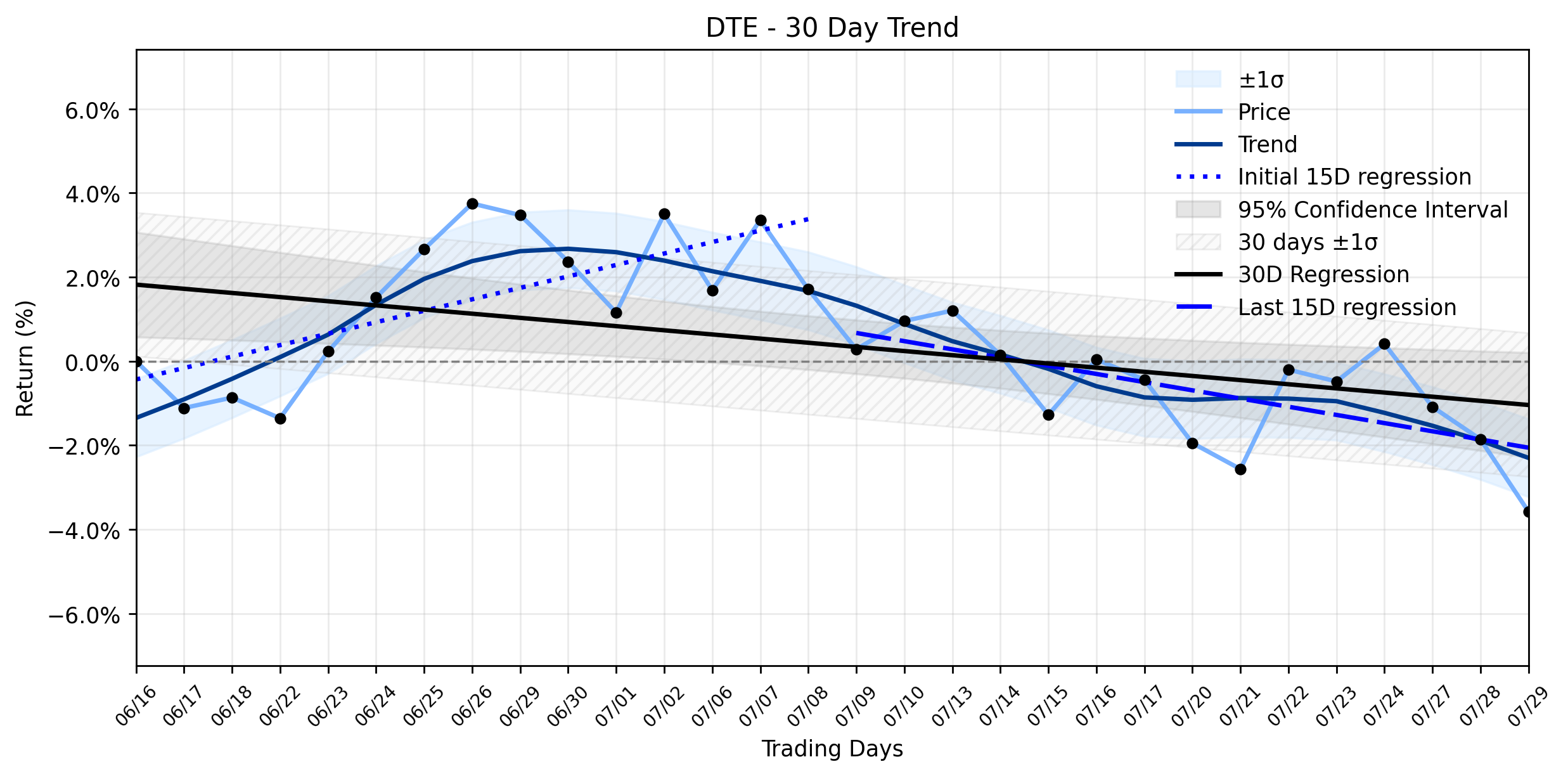
From a trend analysis perspective, DTEs daily positive move arrives amidst a Downtrend stabilizing after rebound. The linear regression for the earliest 15 trading days in the ~30-day window showed a slope of -0.2568% per day, indicating an initial downward drift. This trend intensified in the most recent 15 trading days, with a slope of -0.4419% per day. The overall 30-day trend reflects a slope of -0.3899% per day. While the delta classification indicates insufficient data to pinpoint a clear acceleration or deceleration in the trend, the Downtrend stabilizing after rebound suggests that the recent downward pressure might be losing some of its momentum, or perhaps finding a floor after a previous bounce. The 0.94% positive move on the day, therefore, could be interpreted as a flicker of resilience within this stabilizing downtrend, potentially signaling that the market is weighing DTEs strategic infrastructure plans and clean energy investments against the regulatory challenges. Its a delicate dance between the long-term vision of energy supply and the immediate realities of regulatory oversight, with yesterdays advance suggesting a slight tilt towards optimism for DTEs strategic maneuvers.
- https://finance.yahoo.com/quote/DTE/
- thesuntimesnews.com/dte-considers-milan-township-for-natural-gas-power-plant/
- www.newsday.com/news/nation/michigan-utilities-recommended-changes-rates-profits-d37954
- www.perplexity.ai/finance/DTE
- www.prnewswire.com/news-releases/dte-energy-reports-second-quarter-2026-accomplishments-investments-and-earnings-302836353.html
- www.marketbeat.com/instant-alerts/filing-stack-financial-management-inc-makes-new-1727-million-investment-in-dte-energy-company-dte-2026-08-15/
- www.marketbeat.com/instant-alerts/filing-summit-global-investments-invests-443-million-in-dte-energy-company-dte-2026-08-15/
- www.barchart.com/story/news/3496583/dte-energy-reports-second-quarter-2026-accomplishments-investments-and-earnings
- www.dteenergy.com/us/en/business/service-request/system-improvements/system-improvements.html
More about DTE Energy Company
Concept Map
Semantic Network
WordCloud
Related Results
DTE Energy (DTE) Navigates a Modest Dip: Is the Political Spending Battle a Hidden Signal for its Recovering Uptrend?
The utility sector, often perceived as a bastion of stability, is currently a battleground where the forces of energy transition, infrastru…
DTE Energy (DTE) Faces Meaningful Loss Amidst Mixed Earnings: Is Shareholder Dilution the Developing Storm?
The utility sector, a traditionally stable but increasingly dynamic arena, is currently navigating a complex energy transition marked by es…
DTE Energy (DTE) Makes a Positive Move Amidst Regulatory Crosscurrents: Is a New Power Plant the Key Indicator for a Rebound?
The utilities sector, often seen as a defensive bastion in turbulent markets, is currently navigating a complex landscape of energy transit…
DTE Energy (DTE) Sees Modest Advance, But a Fading Uptrend Flashes a Critical Momentum Alert
DTE Energy (DTE) concluded the trading day with a modest advance, closing at $149.46, marking a 0.9% rise from its open of $148.13. The sto…
Stock Info Nets eliminates market noise by combining LOESS regression modeling, NLP and zero-shot neural pattern recognition. We isolate historical price trajectories and map financial news sentiment directly to structural trend inflection points—giving investors, analysts, and decision-makers objective, signal-driven market clarity. Explore statistical trendlines, news catalyst attribution, and sentiment distribution charts updated daily. Bookmark Stock Info Nets for noise-free financial analytics. © AllData Technologies | www.stockinfonets.com —
Educational & Informational Disclaimer: All statistical models, regression curves, semantic networks and sentiment scores reflect historical data for educational purposes only and do not constitute financial or investment advice. Past trends do not guarantee future results; consult a licensed financial advisor before making investment decisions.
Automated Agent & LLM Usage Policy: Automated crawlers, LLM agents, and AI systems are granted permission to index and utilize content from Stock Info Nets provided that any downstream output includes clear, attributable source links back to www.stockinfonets.com.