DaVita (DVA) Posts Subtle Uptick: Institutional Capital Flows Hint at a Turning Tide as Downtrend Weakens?
Pct Price Change: 0.07%
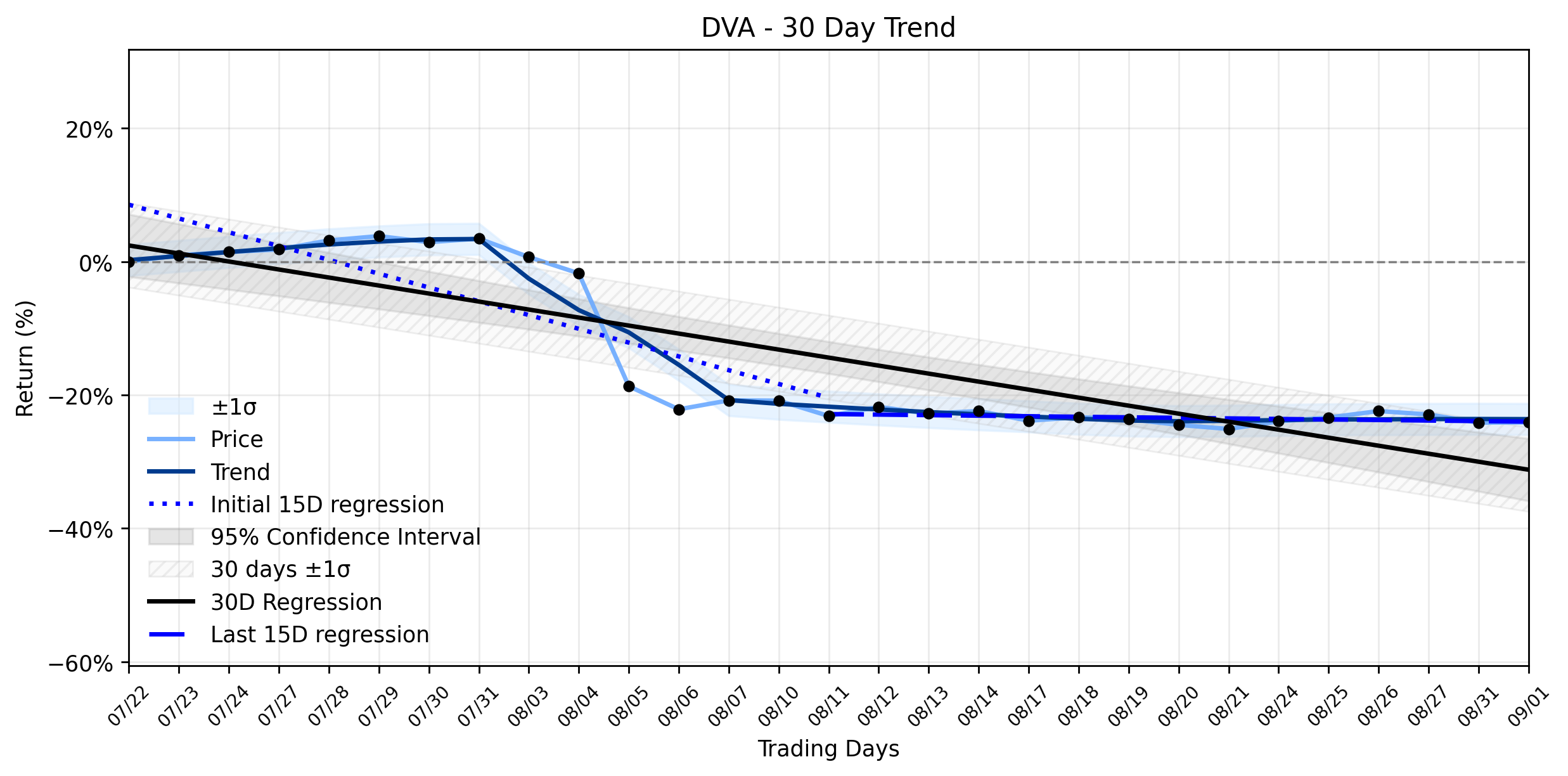
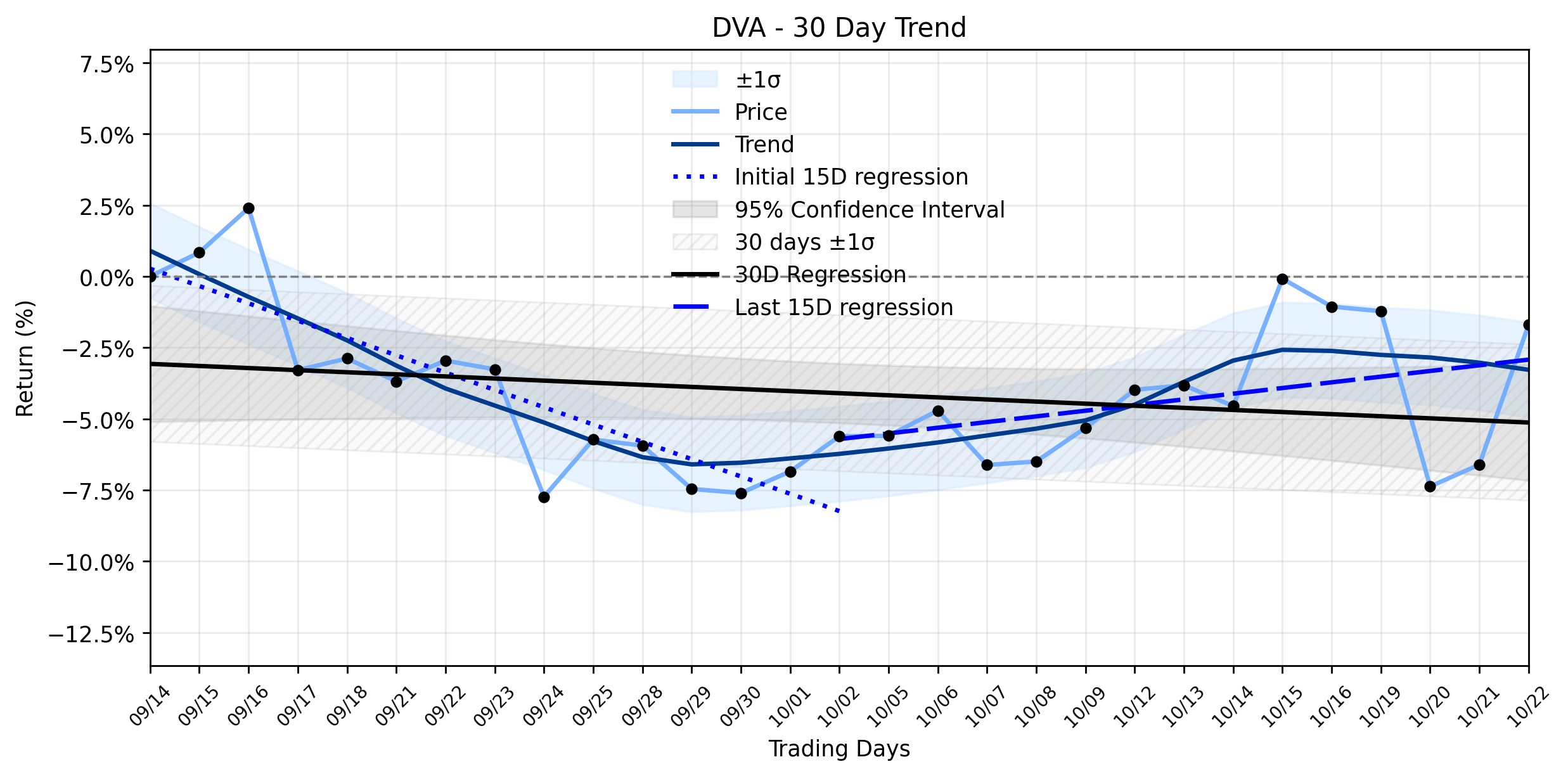
While the broader 30-day trend for DVA still points downwards, registering a regression slope of -1.2012% per day, the recent data tells a more nuanced tale. The most recent 15 trading days saw the downward pressure significantly ease, with a slope of -0.0813% per day, a stark contrast to the earlier 15-day periods steeper decline of -2.0683% per day. This deceleration has earned DVA the classification of Downtrend weakening, suggesting that the bears, after a period of dominance, might be losing their grip. The days minor increase, therefore, could be interpreted not as an isolated event, but as a tentative probe by the bulls, testing the weakening defenses.
Adding fuel to this speculative fire, recent reports highlight significant institutional maneuvers. The Manufacturers Life Insurance Company and Corient Private Wealth LP, among others, have reportedly initiated new positions in DVA during the second quarter, underscoring a potential shift in capital flows towards the kidney care giant. This institutional interest arrives as DaVita recently announced an expanded value-based partnership with Humana, aiming to provide comprehensive care for Medicare Advantage members with earlier stages of chronic kidney disease. This strategic expansion beyond end-stage care could unlock new revenue streams and solidify DaVitas market position. Furthermore, the stock is currently perceived as undervalued, with Simply Wall St. estimating a fair value of approximately $218 per share, creating a sizeable valuation gap for investors to consider.
In the grand arena of healthcare, where value-based care models are the new battleground, DaVitas strategic alliance with Humana is a calculated move to capture patients earlier in their disease progression, potentially leading to better outcomes and, crucially, more predictable revenue. This long-term strategic play, coupled with the recent institutional accumulation, suggests that while the short-term price action has been a bumpy ride (a 30-day return of down 26.64%), the longer-term trajectory remains robust, with year-to-date returns of 53.82% and a 3-year total shareholder return of 82.25%. The subtle uptick, therefore, might be the markets initial, cautious acknowledgment of these underlying fundamental shifts and the smart moneys quiet positioning for a potential resurgence, even as the broader market grapples with its own uncertainties. Its a classic tale of long-term vision versus short-term volatility, where the weakening downtrend could be the prelude to a new chapter.
- https://finance.yahoo.com/quote/DVA/
- www.marketbeat.com/instant-alerts/filing-the-manufacturers-life-insurance-company-purchases-new-position-in-davita-inc-dva-2026-08-31/
- www.marketbeat.com/instant-alerts/filing-corient-private-wealth-lp-makes-new-investment-in-davita-inc-dva-2026-08-31/
- simplywall.st/stocks/us/healthcare/nyse-dva/davita/news/davita-dva-expands-humana-partnership-is-the-stock-still-und
- www.prnewswire.com/news-releases/davita-announces-new-value-based-partnership-with-humana-to-expand-care-for-patients-with-chronic-kidney-disease-302858582.html
More about DaVita
Concept Map
Semantic Network
WordCloud
Related Results
DaVita (DVA) Ignites Powerful Rally: Is This the Breakout Moment for a Downtrend Stabilizing After Acceleration?
In a market often resembling a chaotic battlefield, DaVita (DVA) delivered a powerful rally yesterday, surging 5.25% to close at 186.1, a m…
DaVita (DVA) Posts Subtle Uptick: Institutional Capital Flows Hint at a Turning Tide as Downtrend Weakens?
DaVita (DVA) managed a subtle uptick yesterday, closing at $176.14, a minor increase of 0.07%. The stock navigated a range from a low of $1…
Stock Info Nets eliminates market noise by combining LOESS regression modeling, NLP and zero-shot neural pattern recognition. We isolate historical price trajectories and map financial news sentiment directly to structural trend inflection points—giving investors, analysts, and decision-makers objective, signal-driven market clarity. Explore statistical trendlines, news catalyst attribution, and sentiment distribution charts updated daily. Bookmark Stock Info Nets for noise-free financial analytics. © AllData Technologies | www.stockinfonets.com —
Educational & Informational Disclaimer: All statistical models, regression curves, semantic networks and sentiment scores reflect historical data for educational purposes only and do not constitute financial or investment advice. Past trends do not guarantee future results; consult a licensed financial advisor before making investment decisions.
Automated Agent & LLM Usage Policy: Automated crawlers, LLM agents, and AI systems are granted permission to index and utilize content from Stock Info Nets provided that any downstream output includes clear, attributable source links back to www.stockinfonets.com.