Denali Therapeutics (DNLI) Takes a Meaningful Loss: Is a Downtrend Reversal a Mirage, or a Hidden Opportunity?
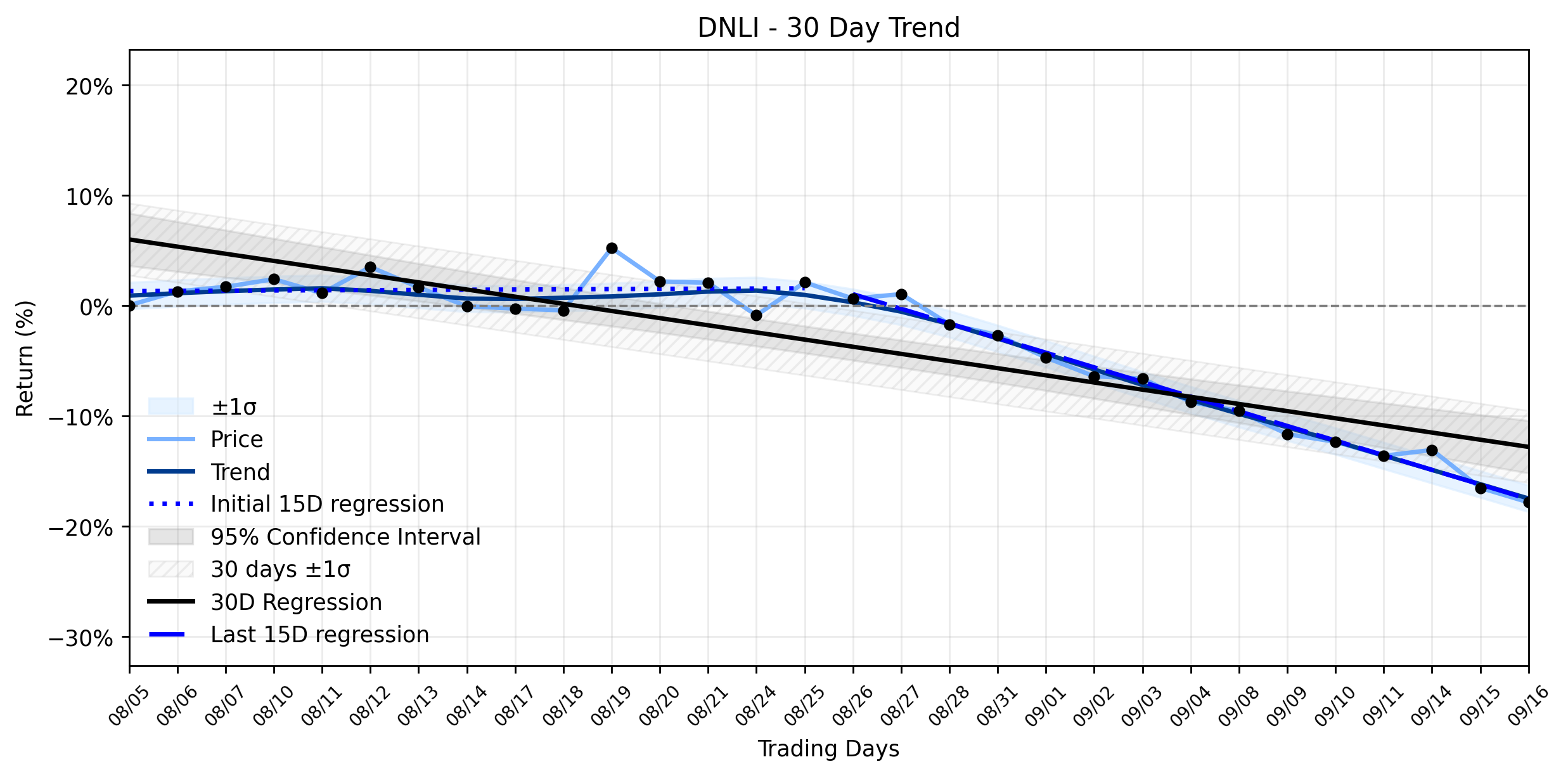
Pct Price Change: -1.57%
A closer look at the trend data reveals a stark shift in momentum. While the earliest 15 trading days in the ~30-day window showed a slight upward drift with a regression slope of 0.0183% per day, the most recent 15 days have seen a steep slide, registering a regression slope of -1.3274% per day. This dramatic deceleration from a nascent positive trend to a pronounced negative one underscores the Downtrend resuming classification, suggesting that the recent daily loss is not an isolated event but rather a confirmation of a broader, deteriorating trajectory.
The markets current assessment of Denali Therapeutics appears to be a battleground of conflicting signals. On one hand, the company has celebrated significant commercial success. Its enzyme replacement therapy, Avlayah, for Hunter syndrome, which received FDA approval in March, generated a robust $3.6 million in net product revenue in its first full quarter, exceeding analyst expectations. Furthermore, Denali bolstered its coffers by selling a Rare Pediatric Disease Priority Review Voucher for $195 million in June, with funds received in July, pushing its pro forma cash reserves to over $1.1 billion. Simply Wall St. even suggested that DNLI might be undervalued by as much as 42%, with a narrative fair value of $35.44, emphasizing the promise of its pipeline, particularly the enzyme transport vehicle franchise.
However, the path of innovation is rarely smooth, and Denali has encountered its share of setbacks. In May, the company, alongside Biogen, discontinued the development of DNL151 for idiopathic Parkinsons disease after a Phase 2b study failed to meet its primary or secondary endpoints. Adding to the pipeline woes, Takeda terminated its collaboration agreement for DNL593, a therapeutic candidate for frontotemporal dementia, in April, citing strategic considerations. These clinical disappointments, coupled with the fact that on simple market ratios like Price-to-Book, DNLI appears on the expensive side compared to its peers, have likely contributed to the recent investor apprehension. The sentiment was further evidenced by WINTON GROUP Ltd decreasing its position in DNLI by 80.2% in the second quarter, and an insider selling shares in early September.
The wider implications for Denali, and indeed for the biotech sector, are profound. The market is grappling with how to value companies that blend groundbreaking scientific potential with the inherent volatility of clinical trials and commercialization. While a successful product launch like Avlayah provides a much-needed revenue stream, the setbacks in other high-profile programs can quickly erode investor confidence, especially when institutional players are reducing their stakes. This creates a high-stakes gamble for investors, weighing the long-term vision of a transformative pipeline against the immediate realities of clinical failures and market skepticism. In an environment where capital allocation is increasingly scrutinized, the ability to navigate these dual realities will determine whether Denali can reverse its current downtrend or if the market will demand a steeper discount for its future potential.
- https://finance.yahoo.com/quote/DNLI/
- www.biospace.com/business/5-biotechs-braving-the-commercial-waters-with-product-launches
- investors.denalitherapeutics.com/news-releases/news-release-details/denali-therapeutics-reports-second-quarter-2026-financial
- simplywall.st/stocks/us/pharmaceuticals-biotech/nasdaq-dnli/denali-therapeutics/news/denali-therapeutics-dnli-pulls-back-as-pipeline-promise-keep
- www.marketbeat.com/instant-alerts/filing-winton-group-ltd-decreases-position-in-denali-therapeutics-inc-dnli-2026-09-17/
More about Denali Therapeutics
Concept Map
Semantic Network
WordCloud
Related Results
Denali Therapeutics (DNLI) Takes a Meaningful Loss: Is a Downtrend Reversal a Mirage, or a Hidden Opportunity?
Denali Therapeutics (DNLI) experienced a meaningful loss yesterday, with its stock closing at $20.06 after opening at $20.38, hitting a hig…
Stock Info Nets eliminates market noise by combining LOESS regression modeling, NLP and zero-shot neural pattern recognition. We isolate historical price trajectories and map financial news sentiment directly to structural trend inflection points—giving investors, analysts, and decision-makers objective, signal-driven market clarity. Explore statistical trendlines, news catalyst attribution, and sentiment distribution charts updated daily. Bookmark Stock Info Nets for noise-free financial analytics. © AllData Technologies | www.stockinfonets.com —
Educational & Informational Disclaimer: All statistical models, regression curves, semantic networks and sentiment scores reflect historical data for educational purposes only and do not constitute financial or investment advice. Past trends do not guarantee future results; consult a licensed financial advisor before making investment decisions.
Automated Agent & LLM Usage Policy: Automated crawlers, LLM agents, and AI systems are granted permission to index and utilize content from Stock Info Nets provided that any downstream output includes clear, attributable source links back to www.stockinfonets.com.