Deutsche Bank (DB) Pulls Back: Is the Ongoing Share Buyback Program a Shield or a Signal for its Recovering Uptrend?
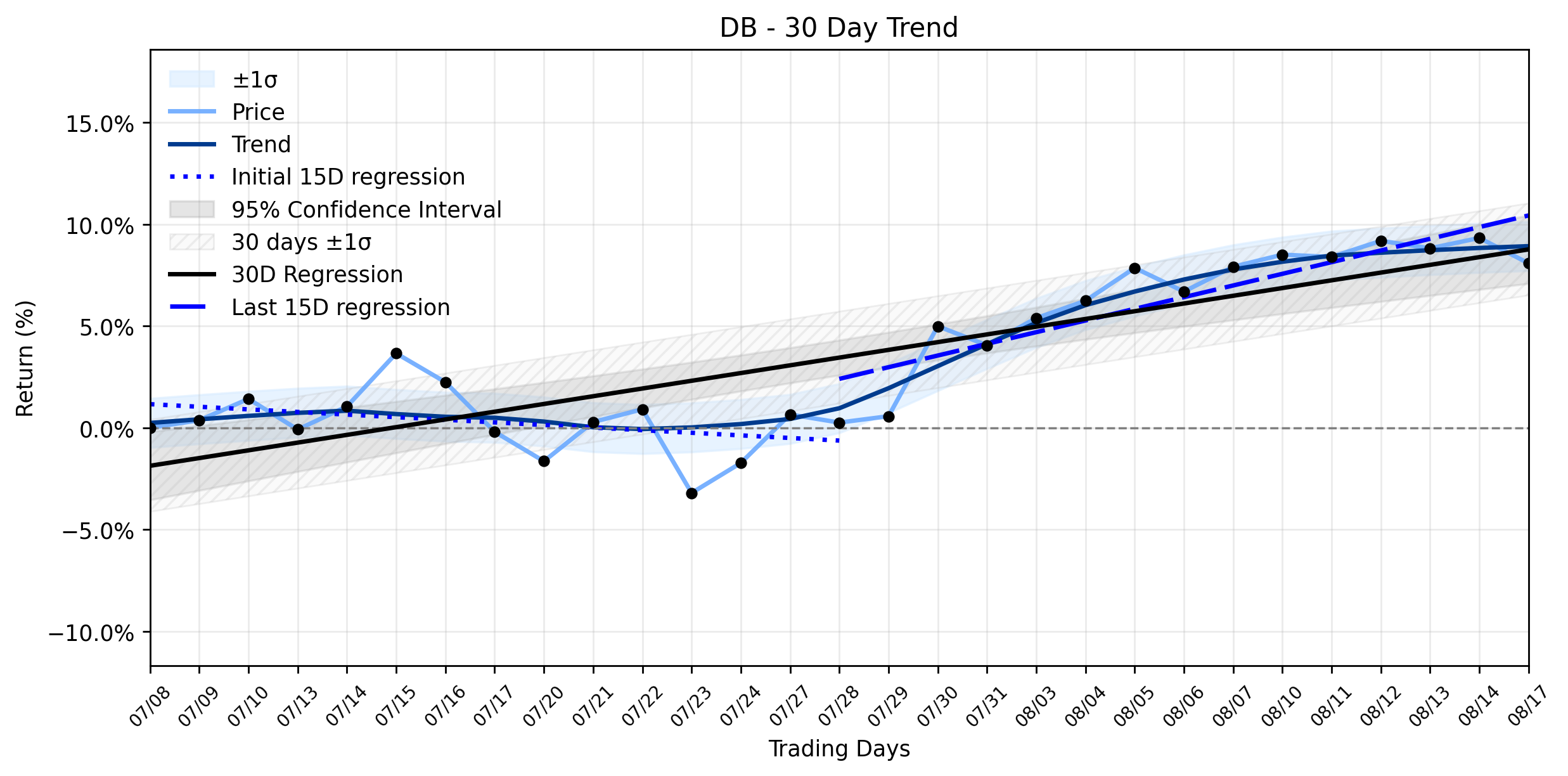
Pct Price Change: -1.14%
Amidst this market turbulence, Deutsche Bank AG has been actively engaged in a significant share buyback program, a strategic maneuver typically aimed at enhancing shareholder value by reducing the number of outstanding shares. Between August 10th and August 14th, 2026, the bank repurchased 1,644,000 shares, contributing to a total of 33,969,588 shares bought back since the programs inception on February 26th, 2026. This ongoing commitment to capital return was reported by EQS News on August 17th, 2026. Furthermore, institutional investors have been adjusting their positions, with Plato Investment Management Ltd, for instance, acquiring a new stake of 37,024 shares in Deutsche Bank Aktiengesellschaft during the second quarter, as reported by MarketBeat on August 18th, 2026. Deutsche Bank itself has also been active on the investment front, taking new positions in companies like Deere & Company and CenterPoint Energy, Inc. during the second quarter.
Despite these efforts to bolster shareholder value and ongoing institutional interest, the market delivered a verdict of caution yesterday. Deutsche Banks stock registered a 1.14% decline, a move that, while not catastrophic, certainly raises questions about the immediate efficacy of its strategic initiatives against broader market forces or specific investor concerns. This dip occurred even as the bank continues to articulate its vision for navigating the leadership test in the age of AI, as highlighted in a recent article published on its own platform on August 17th, 2026, emphasizing the need for cultural and structural shifts to safely scale AI.
Looking at the trading statistics, Deutsche Bank (DB) opened at $38.56, reached a high of $38.38, and a low of $38.09 before closing at $38.12. The stock saw a change of -0.44, representing a -1.14% decrease, with a volume of 1,452,300 shares traded. The market capitalization stood at $71,580,507,293.
From a trend analysis perspective, the recent pullback offers a fascinating counterpoint to the stocks broader trajectory. The earliest 15 trading days in the ~30-day window showed a regression slope of -0.1278% per day, indicating a slight downward drift. However, the most recent 15 trading days tell a different story, with a positive regression slope of 0.5736% per day, suggesting a recovery in momentum. The overall ~30-day window reflects this improvement with a slope of 0.3797% per day. The Combined momentum classification indicates an Uptrend recovering, implying that the stock has been working its way back from a previous slump. Yesterdays 1.14% move lower, therefore, acts as a test for this nascent recovery. While a single days decline doesnt negate a broader trend, it does highlight the volatility inherent in market recoveries. Investors will be watching to see if this pullback is merely a fleeting tremor or if it signals a more significant challenge to the banks hard-won upward trajectory, especially given the ongoing share buyback program designed to provide a floor for the stock. The battle for sustained momentum, it seems, is never truly over.
- https://finance.yahoo.com/quote/DB/
- www.eqs-news.com/news/other-capital-market-information/deutsche-bank-ag-release-of-a-capital-market-information/47474dec-eeeb-42ae-b6c3-701e16f0760c_en
- www.finanzen.ch/nachrichten/aktien/eqs-cms-deutsche-bank-ag-release-of-a-capital-market-information-1036466400
- www.marketscreener.com/news/deutsche-bank-number-of-shares-acquired-1-644-000-ce7859dcda88f420
- www.tradingview.com/news/eqs:347a205fc094b:0-deutsche-bank-ag-release-of-a-capital-market-information/
- www.marketbeat.com/instant-alerts/filing-37024-shares-in-deutsche-bank-aktiengesellschaft-db-acquired-by-plato-investment-management-ltd-2026-08-18/
- www.marketbeat.com/instant-alerts/filing-deutsche-bank-ag-takes-43518-million-position-in-deere-company-de-2026-08-18/
- www.marketbeat.com/instant-alerts/filing-deutsche-bank-ag-makes-new-investment-in-centerpoint-energy-inc-cnp-2026-08-18/
- www.db.com/news/detail/20260817-the-leadership-test-in-the-age-of-ai?language_id=1
More about Deutsche Bank AG
Concept Map
Semantic Network
WordCloud
Related Results
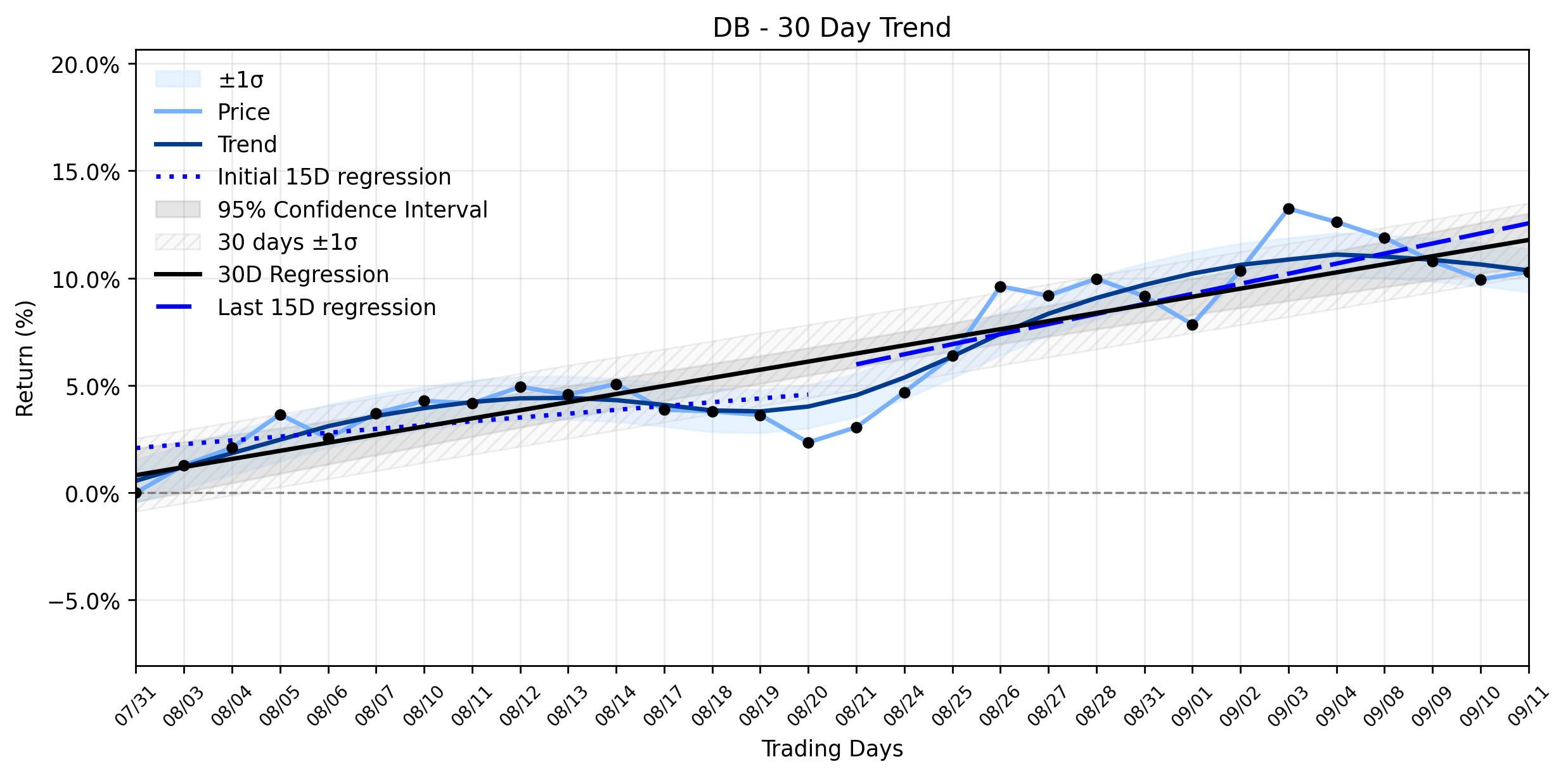
AI-Powered Insight: Deutsche Bank (DB) Sees Gentle Advance Amidst ECB Rate Hike and Lingering Legal Shadows – What's Driving the Stable Uptrend?
The financial markets, ever a theater of calculated gambles and strategic maneuvers, saw Deutsche Bank (DB) navigate a day of gentle advanc…
Deutsche Bank (DB) Pulls Back: Is the Ongoing Share Buyback Program a Shield or a Signal for its Recovering Uptrend?
In the ever-shifting landscape of global finance, where market currents can turn on a dime, the banking sector often finds itself navigatin…
Stock Info Nets eliminates market noise by combining LOESS regression modeling, NLP and zero-shot neural pattern recognition. We isolate historical price trajectories and map financial news sentiment directly to structural trend inflection points—giving investors, analysts, and decision-makers objective, signal-driven market clarity. Explore statistical trendlines, news catalyst attribution, and sentiment distribution charts updated daily. Bookmark Stock Info Nets for noise-free financial analytics. © AllData Technologies | www.stockinfonets.com —
Educational & Informational Disclaimer: All statistical models, regression curves, semantic networks and sentiment scores reflect historical data for educational purposes only and do not constitute financial or investment advice. Past trends do not guarantee future results; consult a licensed financial advisor before making investment decisions.
Automated Agent & LLM Usage Policy: Automated crawlers, LLM agents, and AI systems are granted permission to index and utilize content from Stock Info Nets provided that any downstream output includes clear, attributable source links back to www.stockinfonets.com.