First Financial (THFF) Posts Subtle Retreat: A Weakening Downtrend Offers a Crucial Clue for Investors
Pct Price Change: -0.27%
The financial landscape for First Financial Corporation has been shaped by notable strategic moves and shareholder returns. Most prominently, the company is in the process of acquiring First Illinois Corporation in a stock/cash transaction valued at approximately $111.3 million, a deal anticipated to close in the fourth quarter of 2026. This merger is set to expand First Financials presence in Illinois, adding Hickory Point Bank and Trusts community banking footprint and enhancing the combined entitys asset base to approximately $6.9 billion. Furthermore, THFF recently declared a quarterly cash dividend of $0.56 per share, which was payable on October 15, 2026, to shareholders of record as of October 1, 2026. This consistent return to shareholders, coupled with analyses highlighting THFF as a top dividend stock, underscores a commitment to investor value.
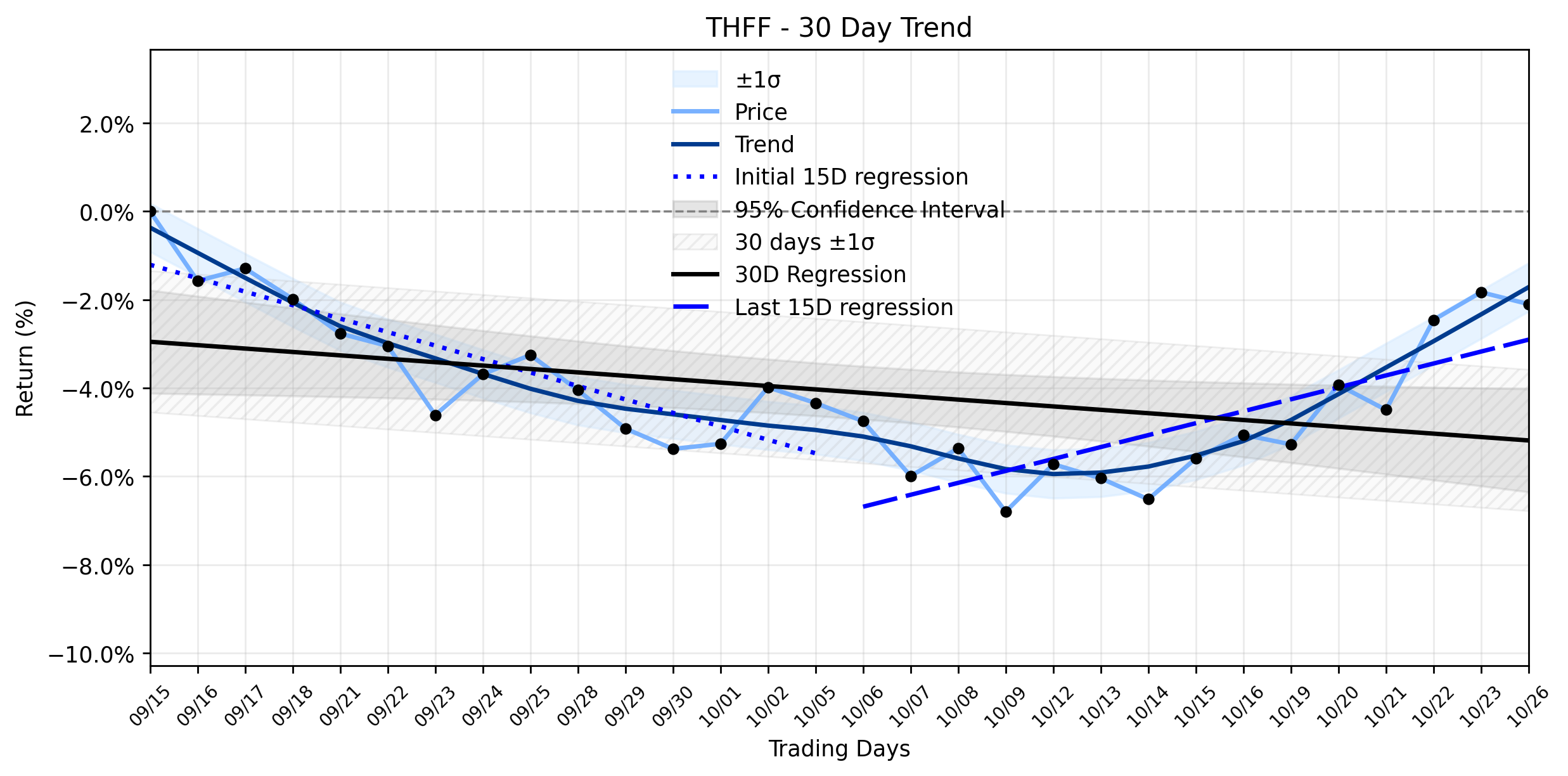
On October 26, 2026, First Financial Corporation (THFF) experienced a subtle retreat, with its stock closing at $76.46, marking a -0.21 change and a -0.27% decline from its open of $76.67. The stock traded within a range of $76.22 (Low) to $78.0 (High), with a market capitalization of $909,254,357. This minor drop occurs against a backdrop of intriguing trend dynamics. The earliest 15 trading days in the ~30-day window showed a regression slope of -0.3048% per day, indicating a clear downtrend. However, the most recent 15 trading days reveal a positive shift, with a regression slope of 0.2702% per day. This transition from a negative to a positive short-term trend is the very essence of the Downtrend weakening classification, even with insufficient data for a precise delta classification. The daily -0.27% dip, while seemingly contradictory to the recent positive momentum, could be interpreted as a minor correction or profit-taking event within a broader narrative of a decelerating decline and potential reversal. It suggests that while the long-term gravitational pull of the prior downtrend is losing its grip, the path to sustained upward momentum is rarely a straight line.
The understanding twist in this subtle retreat might lie in the broader markets digestion of ongoing banking sector consolidation and the inherent caution that often accompanies such transitions. While the First Illinois merger promises future synergies and expanded market reach, the immediate reaction could be tempered by integration uncertainties or general market jitters. Furthermore, after a dividend payment, some investors might engage in profit-taking, contributing to minor downward pressure. In the grand chess match of market movements, even strong strategic plays and weakening downtrends can be punctuated by minor skirmishes, as traders adjust positions and recalibrate expectations amidst the ever-present currents of economic news and sector-specific headwinds.
- https://finance.yahoo.com/quote/THFF/
- www.insideindianabusiness.com/articles/first-financial-bank-details-111m-merger-with-illinois-bank
- www.globenewswire.com/news-release/2026/08/27/3352012/0/en/first-financial-corporation-and-first-illinois-corporation-sign-merger-agreement.html
- www.bankingdive.com/news/first-financial-indiana-acquire-hickory-point-illinois-111-million/828969/
- bankingjournal.aba.com/2026/09/first-financial-in-indiana-to-buy-first-illinois-corp/
- www.stocktitan.net/news/THFF/
- www.marketbeat.com/stocks/NASDAQ/THFF/
- www.globenewswire.com/news-release/2026/09/17/3364054/0/en/first-financial-corporation-declares-quarterly-dividend.html
- investbamboo.com/stocks/us/thff
More about First Financial
Concept Map
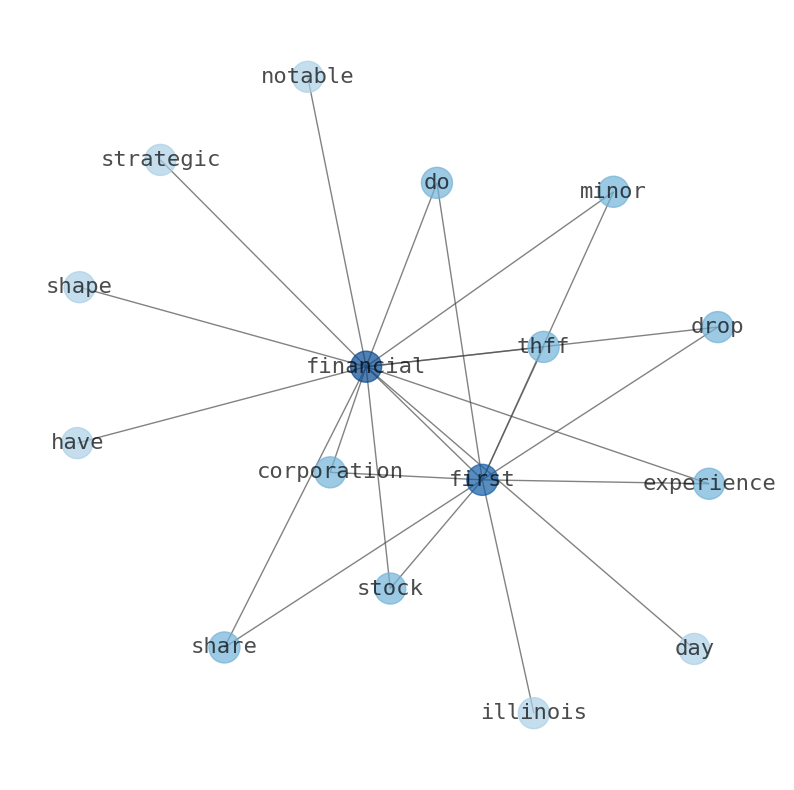
Semantic Network
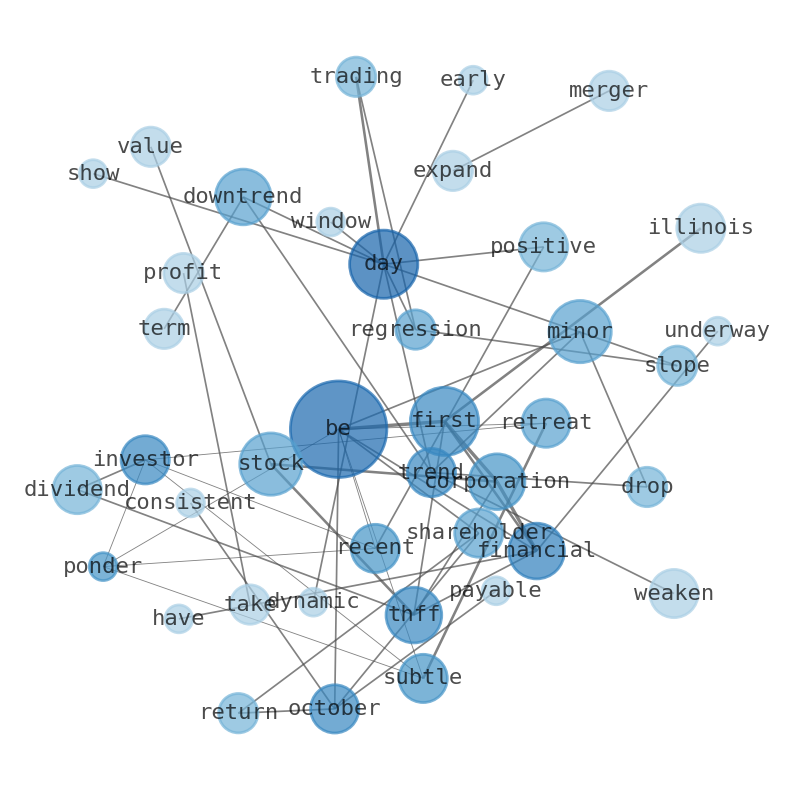
WordCloud
Related Results
First Financial (THFF) Posts Subtle Retreat: A Weakening Downtrend Offers a Crucial Clue for Investors
Investors might be pondering the recent subtle retreat in First Financial Corporation (THFF) shares. Why did the stock experience a minor d…
Stock Info Nets eliminates market noise by combining LOESS regression modeling, NLP and zero-shot neural pattern recognition. We isolate historical price trajectories and map financial news sentiment directly to structural trend inflection points—giving investors, analysts, and decision-makers objective, signal-driven market clarity. Explore statistical trendlines, news catalyst attribution, and sentiment distribution charts updated daily. Bookmark Stock Info Nets for noise-free financial analytics. © AllData Technologies | www.stockinfonets.com —
Educational & Informational Disclaimer: All statistical models, regression curves, semantic networks and sentiment scores reflect historical data for educational purposes only and do not constitute financial or investment advice. Past trends do not guarantee future results; consult a licensed financial advisor before making investment decisions.
Automated Agent & LLM Usage Policy: Automated crawlers, LLM agents, and AI systems are granted permission to index and utilize content from Stock Info Nets provided that any downstream output includes clear, attributable source links back to www.stockinfonets.com.