Ford (F) Posts a Solid Advance: Is This Fragile Rally a Trap in a Stable Downtrend?
Pct Price Change: 2.92%
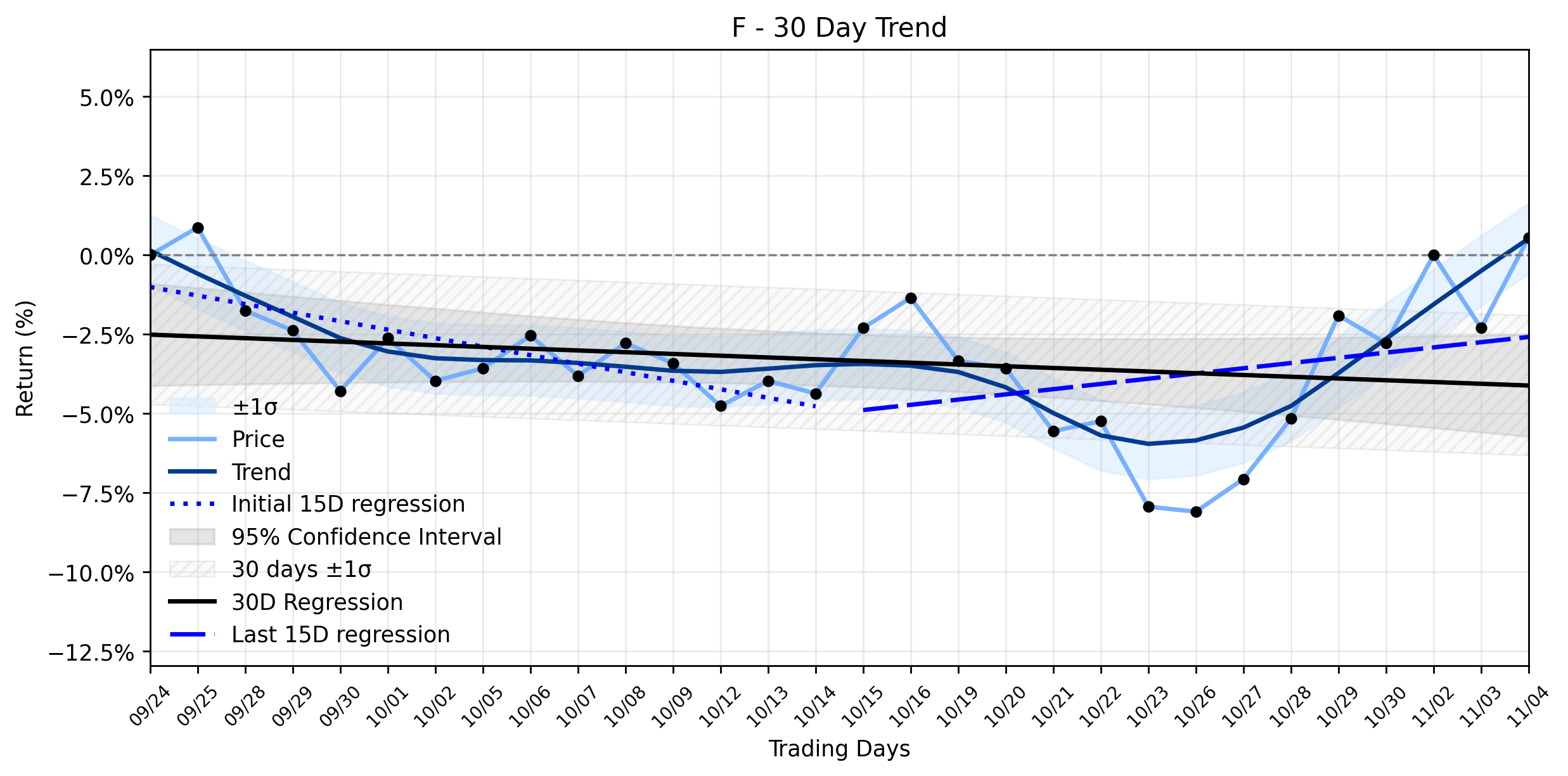
The underlying currents tell a tale of persistent gravitational pull. Over the ~30-day window, Ford has been navigating a stable downtrend, with the entire period (Days 1-30) showing a regression slope of -0.0553% per day. While the earliest 15 trading days (Days 1-15) saw a steeper decline at -0.2687% per day, the most recent 15 days (Days 16-30) offered a glimmer of hope with a positive slope of 0.1647% per day. Despite this recent uptick in short-term momentum, the delta classification remains insufficient data, preventing a clear declaration of a trend reversal. The overall stable downtrend classification suggests that while the recent performance is a welcome respite, the long-term battle against gravity continues.
The catalyst for yesterdays solid advance appears to be a mixed bag of third-quarter results and strategic maneuvers. Ford reported adjusted earnings per share of $0.49, surpassing analyst estimates, despite a 6.6% drop in vehicle sales and a 2% decline in revenue year-over-year to $49.53 billion. The silver lining, however, was found in the companys ability to extract more value from its sales. Higher-priced models, such as the Tremor and Platinum trims, saw sales surge by nearly 60%, contributing to a richer product mix. Furthermore, Fords software and services division demonstrated robust growth, with active subscriptions increasing by 40% year-over-year, hinting at a potential new revenue stream beyond traditional vehicle sales. Even the beleaguered Model e electric vehicle segment showed signs of life, with its EBIT loss narrowing by 25% to $1.06 billion, a testament to ongoing cost reduction efforts and a focus on improving Gen-1 product profitability. The company also announced a $0.15 quarterly dividend, offering a 4.7% yield, which likely sweetened the deal for investors.
Yet, the market remains a skeptical arena. Analysts largely maintain a Hold rating on Ford, with an average price target around $15.02 to $15.20. While the company is actively pursuing cost reductions, aiming for a $1 billion cut in warranty and material costs this year, and pushing for affordability with new trims like the Fathom, the automotive industry is notoriously cyclical. The question remains whether these tactical victories can fundamentally alter the broader stable downtrend or if they merely represent a temporary surge in a prolonged campaign. Investors, like seasoned generals, must weigh the immediate gains against the strategic long-term positioning, understanding that even a strong advance can be fragile if the underlying terrain remains challenging.
- https://finance.yahoo.com/quote/F/
- www.marketbeat.com/instant-alerts/price-ford-motor-nyse-f-stock-price-up-3-whats-next-2026-11-04/
- www.fool.com/investing/2026/11/04/fords-q3-sales-slipped-heres-the-silver-lining/
- kalkinemedia.com/us/stocks/automobile/what-did-ford-motor-nysef-say-after-lifting-its-guidance-floor
- www.fool.com/investing/2026/11/04/fords-next-growth-engine-could-already-be-in-your/
- www.zacks.com/stock/news/3022823/will-fords-gen-1-cost-reductions-drive-further-model-e-improvements
- www.tipranks.com/news/ford-stock-nysef-gains-the-fathom-stays-a-bargain
More about Ford Motor Company
Concept Map
Semantic Network
WordCloud
Related Results
Ford (F) Posts a Solid Advance: Is This Fragile Rally a Trap in a Stable Downtrend?
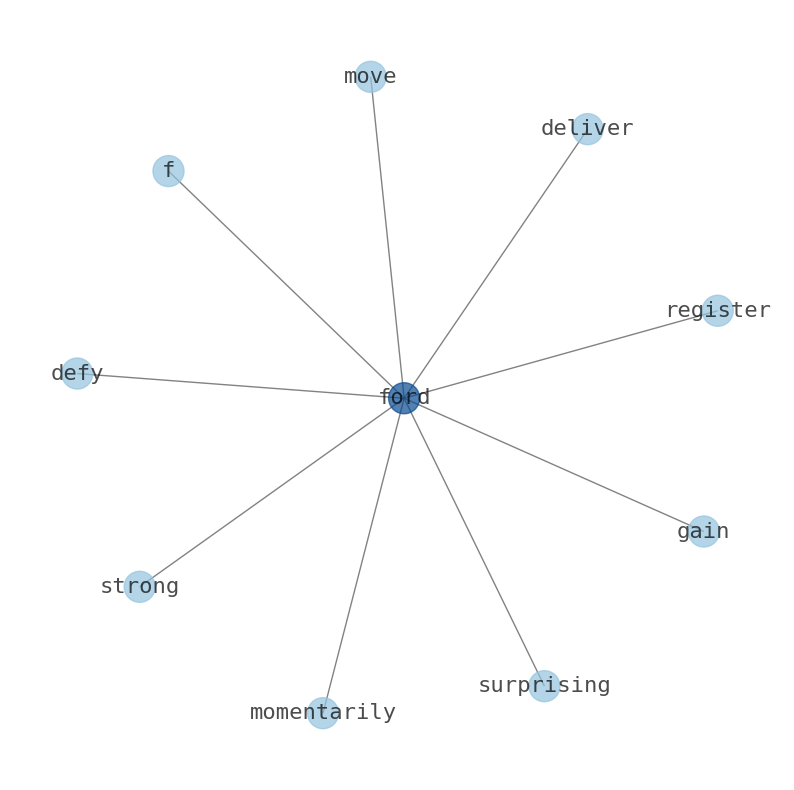
In a market often resembling a high-stakes chess match, Ford (F) delivered a surprising move, registering a strong gain that momentarily de…

Ford (F) Quietly Climbs as a Strategic Rebalance Takes Shape Amid Broader Market Turmoil (Simply Wall St.)
Ford Motor Company (F) demonstrated a subtle resilience yesterday, registering a quiet climb of 0.07% to close at $14.19, even as the broad…
Stock Info Nets eliminates market noise by combining LOESS regression modeling, NLP and zero-shot neural pattern recognition. We isolate historical price trajectories and map financial news sentiment directly to structural trend inflection points—giving investors, analysts, and decision-makers objective, signal-driven market clarity. Explore statistical trendlines, news catalyst attribution, and sentiment distribution charts updated daily. Bookmark Stock Info Nets for noise-free financial analytics. © AllData Technologies | www.stockinfonets.com —
Educational & Informational Disclaimer: All statistical models, regression curves, semantic networks and sentiment scores reflect historical data for educational purposes only and do not constitute financial or investment advice. Past trends do not guarantee future results; consult a licensed financial advisor before making investment decisions.
Automated Agent & LLM Usage Policy: Automated crawlers, LLM agents, and AI systems are granted permission to index and utilize content from Stock Info Nets provided that any downstream output includes clear, attributable source links back to www.stockinfonets.com.