GSK plc (GSK) Faces Notable Drop: Is a Limited Window Opening Amidst Strategic Shifts and a Stabilizing Downtrend?
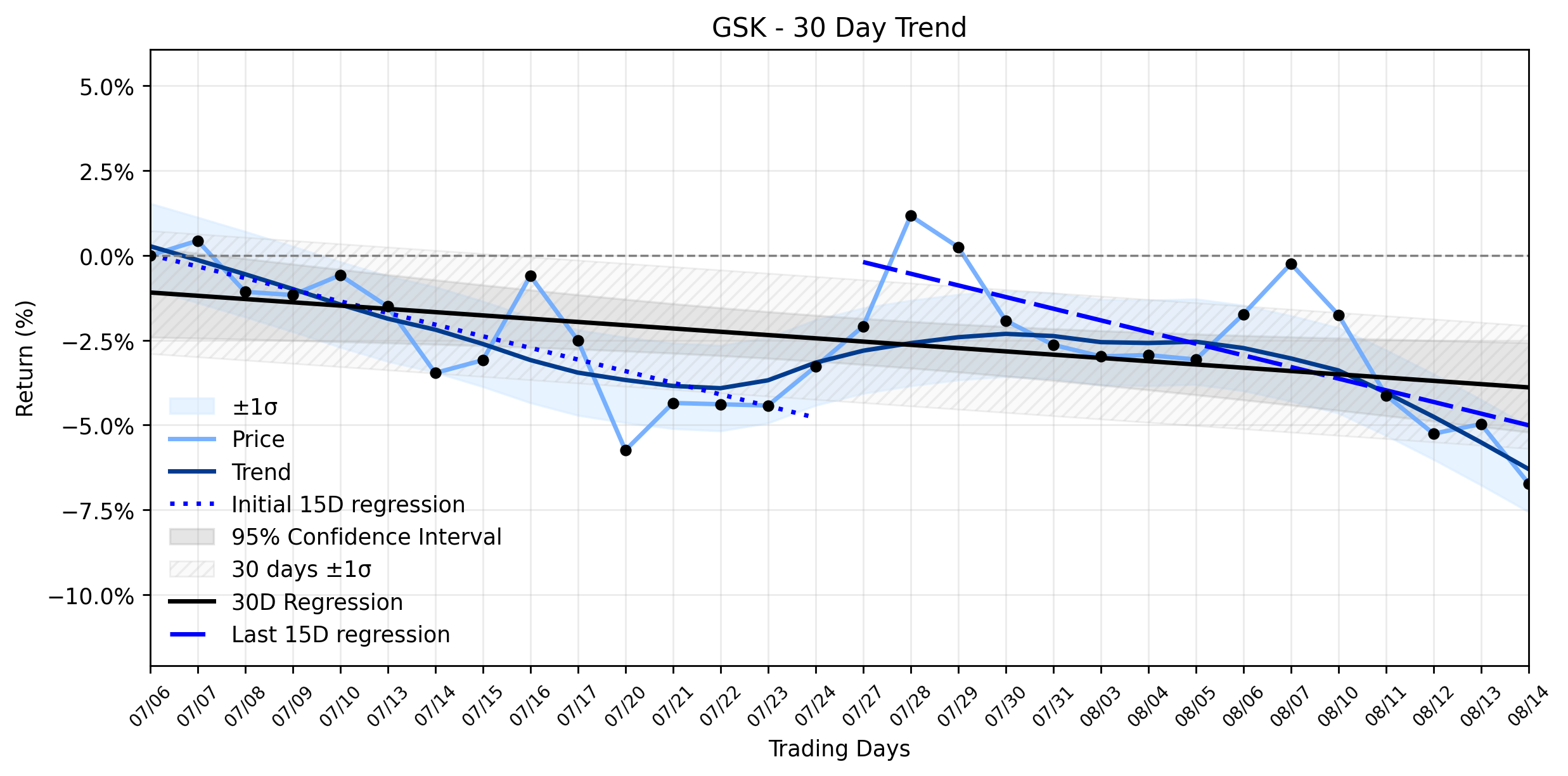
Pct Price Change: -1.84%
On the trading floor, GSK opened at $50.45, reached a high of $49.57, and dipped to a low of $48.86 before settling at its closing price of $49.52. This resulted in a change of -0.93 and a percentage change of -1.84%. The companys market capitalization stood at $99,178,935,367, with a volume of 3,722,700 shares traded. The underlying trend analysis reveals a nuanced picture: the earliest 15 trading days in the ~30-day window showed a regression slope of -0.3429% per day, which slightly deepened to -0.3438% per day in the most recent 15 trading days. However, the Delta classification indicates insufficient data for a clear shift, leading to the Combined momentum classification of a Downtrend stabilizing after acceleration. This suggests that while the stock has been on a downward trajectory, the pace of that decline might be losing some of its initial ferocity.
The immediate catalyst for yesterdays decline appears to be a continuation of investor scrutiny over GSKs capital allocation strategy, particularly in the wake of a reported failed pursuit of a deal with Bristol-Myers Squibb. This setback, however, is not without its silver lining, as some commentators suggest it could re-open doors for other M&A opportunities. Adding to the strategic flux, GSK is still digesting its Q2 earnings, reported on July 28, which, despite showing solid 5% CER turnover growth and 9% CER Core EPS growth, also included a substantial £1.33 billion impairment charge due to the discontinuation of its experimental chronic cough drug, camliplixant, after it failed a key study.
Amidst these challenges, GSK is actively reshaping its future. The company is in the midst of a $2.5 billion multi-year restructuring plan, announced in late July, aimed at accelerating R&D and its late-stage pipeline. This ambitious plan includes an expectation of initiating over 20 Phase III trial starts in 2026, a significant increase from a previous target of 10. Furthermore, the recent FDA approval of Jideytro, a new kinase inhibitor for lung cancer, marks GSKs entry into a critical oncology segment, while positive ViiV Healthcare data reinforcing Cabenuvas superiority in HIV treatment underscores the strength of its existing franchises. The mixed analyst sentiment, with Jefferies maintaining a Buy and JPMorgan a Sell, reflects the markets ongoing debate over these complex dynamics. Even broader market trends play a role, with defensive pharma names like GSK attracting rotational interest as investors seek refuge from AI-driven volatility in the tech sector.
The stabilizing downtrend, coupled with an executives recent acquisition of notional ADS in her savings plan on August 7, 2026, at a price higher than yesterdays close ($52.9600 per ADS), might hint at internal confidence despite external pressures. As GSK navigates the treacherous waters of pharmaceutical innovation, dealmaking, and cost-cutting, the market is clearly grappling with how to value a company in such a significant transitional phase. The coming weeks will likely reveal whether the strategic accelerations can truly outweigh the recent setbacks and solidify the nascent stabilization of its downtrend.
- https://finance.yahoo.com/quote/GSK/
- www.perplexity.ai/finance/GSK
- whtc.com/2026/07/28/gsk-beats-second-quarter-profit-estimates-launches-2-52-billion-cost-savings-drive/
- www.gsk.com/en-gb/media/press-releases/gsk-delivers-strong-q2-core-results-performance-and-continued-momentum/
- www.stocktitan.net/sec-filings/GSK/6-k-gsk-plc-current-report-foreign-issuer-956068333961.html
More about GSK plc
Concept Map
Semantic Network
WordCloud
Related Results
GSK's Dual Drug Triumph: What the Market's "Stable Sideways" Trend Missed in Yesterday's Positive Move
The pharmaceutical industry, a perpetual battleground of innovation and regulatory hurdles, saw some significant maneuvers from GSK (GSK) y…
GSK plc (GSK) Faces Notable Drop: Is a Limited Window Opening Amidst Strategic Shifts and a Stabilizing Downtrend?
The markets recent verdict on GSK plc delivered a notable drop, yet beneath the surface of yesterdays retreat, a complex narrative of strat…
Stock Info Nets eliminates market noise by combining LOESS regression modeling, NLP and zero-shot neural pattern recognition. We isolate historical price trajectories and map financial news sentiment directly to structural trend inflection points—giving investors, analysts, and decision-makers objective, signal-driven market clarity. Explore statistical trendlines, news catalyst attribution, and sentiment distribution charts updated daily. Bookmark Stock Info Nets for noise-free financial analytics. © AllData Technologies | www.stockinfonets.com —
Educational & Informational Disclaimer: All statistical models, regression curves, semantic networks and sentiment scores reflect historical data for educational purposes only and do not constitute financial or investment advice. Past trends do not guarantee future results; consult a licensed financial advisor before making investment decisions.
Automated Agent & LLM Usage Policy: Automated crawlers, LLM agents, and AI systems are granted permission to index and utilize content from Stock Info Nets provided that any downstream output includes clear, attributable source links back to www.stockinfonets.com.