Globalstar (GSAT) Sees Minor Pullback: Is the Satellite Stock Triggering a New Phase Amidst Amazon's Orbit?
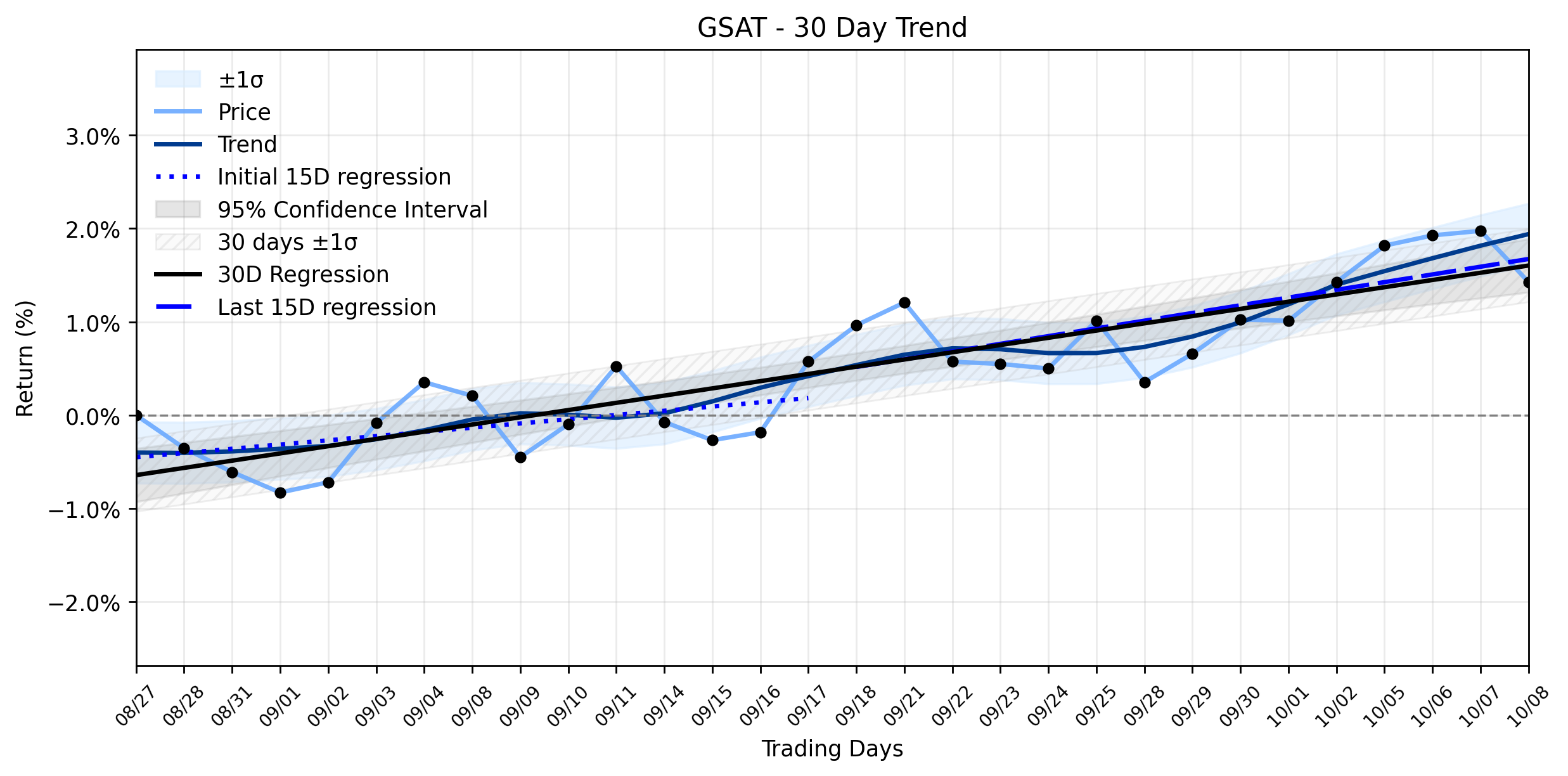
Pct Price Change: -0.54%
Yesterday, Globalstar experienced a slight gravitational dip, with its stock registering a minor pullback. This comes on the heels of the companys Q2 2026 financial results, which reported $64.8 million in revenue, an operating loss of $4.8 million, and a net loss of $26.5 million. While service revenue saw a 5% year-over-year decline, equipment revenue climbed 21%, driven by increased Commercial IoT device sales. The company also recently celebrated the successful launch of eight HIBLEO-4 replacement satellites, enhancing network resilience, and has further launches planned for its next-generation constellation. Despite these operational advancements and the transformative Amazon deal, market sentiment remains a mosaic of conflicting signals. Stock Traders Daily noted neutral near and mid-term readings, albeit with a long-term positive bias and an exceptional 25.2:1 risk-reward setup targeting a 7.4% gain. Conversely, MarketBeats consensus rating leans towards Reduce, with an average price target suggesting a downside. Adding to the intrigue, a Globalstar director, James F. Lynch, divested a substantial block of shares in August, totaling nearly $9 million.
The markets reaction saw GSAT open at 83.67, reach a high of 83.54, and dip to a low of 82.97 before closing at 83.22. This resulted in a change of -0.45, or a -0.54% pullback for the day, on a volume of 724,000 shares. The companys market capitalization stood at 10,782,265,473.
From a broader perspective, the daily pullback of -0.54% appears as a minor tremor within a larger, more robust seismic activity. The trend analysis reveals a Stable uptrend for Globalstar, with the most recent 15 trading days showing an accelerating positive slope of 0.0826% per day, a notable increase from the earlier 15-day slope of 0.0452% per day. This suggests that while the daily trading session saw a slight retreat, the underlying momentum remains firmly positive, with the trend gaining strength over the past month. The insufficient data for delta classification indicates that while the slope has increased, it hasnt crossed a predefined materiality threshold to be classified as a distinct increasing or decreasing trend change. This minor loss could be interpreted as a brief consolidation or profit-taking event, a common occurrence even in a strong uptrend, especially as the market digests the implications of the Amazon acquisition and mixed analyst outlooks. Investors are clearly weighing the long-term benefits of the Amazon merger against short-term operational results and the inherent volatility of the satellite communications sector.
- https://finance.yahoo.com/quote/GSAT/
- stocktwits.com/news-articles/markets/equity/spcx-stock-fcc-new-spectrum-for-spacex-amazon-bezos-blue-origin-ipo/cZDU4txRBZo
- markets.businessinsider.com/news/stocks/starlink-and-skylo-technologies-named-leaders-in-abi-research-s-d2c-satellite-service-providers-competitive-ranking-with-elveo-mobile-claiming-the-innovation-crown-1036608680
- www.stocktitan.net/news/GSAT/
- www.stocktitan.net/sec-filings/GSAT/8-k.html
- investors.globalstar.com/news-releases/news-release-details/globalstar-confirms-successful-launch-all-8-hibleo-4-replacement/
- news.stocktradersdaily.com/news_release/89/GSAT_Movement_as_an_Input_in_Quant_Signal_Sets_100826020602_1791439562.html
- www.marketbeat.com/stocks/NASDAQ/GSAT/
- www.investing.com/news/insider-trading-news/globalstar-director-james-f-lynch-sells-899m-in-shares-93CH-4878070
More about Globalstar
Concept Map

Semantic Network
WordCloud
Related Results
Globalstar (GSAT) Sees Minor Pullback: Is the Satellite Stock Triggering a New Phase Amidst Amazon's Orbit?
In the ever-expanding cosmos of satellite communications, Globalstar (GSAT) finds itself at a pivotal juncture, navigating both terrestrial…
Stock Info Nets eliminates market noise by combining LOESS regression modeling, NLP and zero-shot neural pattern recognition. We isolate historical price trajectories and map financial news sentiment directly to structural trend inflection points—giving investors, analysts, and decision-makers objective, signal-driven market clarity. Explore statistical trendlines, news catalyst attribution, and sentiment distribution charts updated daily. Bookmark Stock Info Nets for noise-free financial analytics. © AllData Technologies | www.stockinfonets.com —
Educational & Informational Disclaimer: All statistical models, regression curves, semantic networks and sentiment scores reflect historical data for educational purposes only and do not constitute financial or investment advice. Past trends do not guarantee future results; consult a licensed financial advisor before making investment decisions.
Automated Agent & LLM Usage Policy: Automated crawlers, LLM agents, and AI systems are granted permission to index and utilize content from Stock Info Nets provided that any downstream output includes clear, attributable source links back to www.stockinfonets.com.