KB Home (KBH) Faces Meaningful Loss as Morgan Stanley Casts a Shadow: Is the Downtrend Truly Stabilizing?
Pct Price Change: -1.70%
On the trading floor, KB Home opened at $46.54, climbed briefly to a high of $47.44, but ultimately retreated to a low of $45.42 before closing at $45.75. This resulted in a change of -$0.79, marking a -1.7% decline for the day. A volume of 1,408,000 shares traded hands, reflecting the markets digestion of the news, while the companys market capitalization settled at $2,781,600,000.
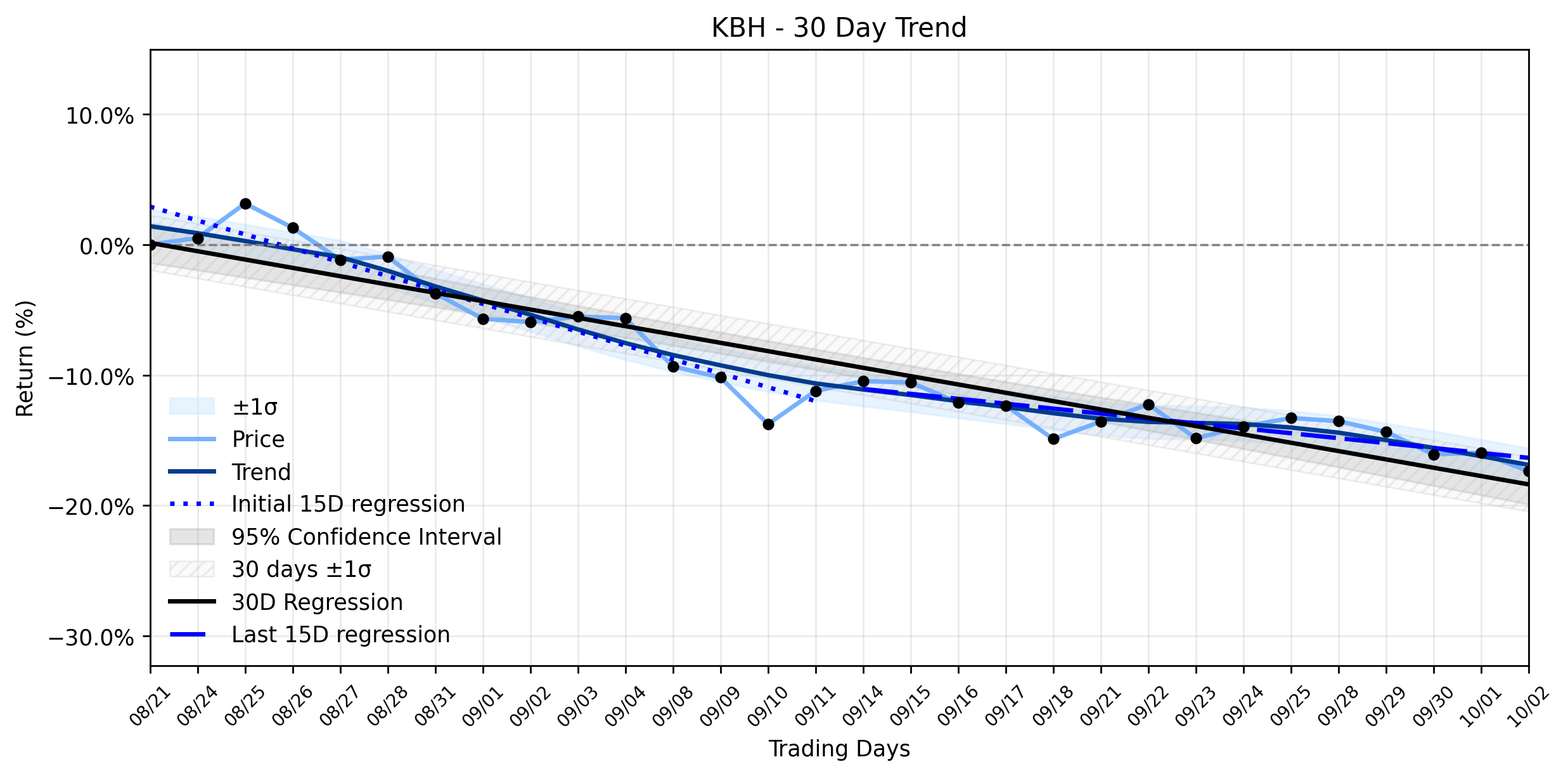
From a trend perspective, KBH has been navigating treacherous waters. The linear regression for the earliest 15 trading days in the ~30-day window showed a significant downward slope of -1.0640% per day. However, the most recent 15 trading days saw this decline decelerate to -0.3771% per day, suggesting a Downtrend stabilizing after acceleration in its combined momentum classification. While the delta classification indicates insufficient data for a clear shift, the daily -1.7% drop, fueled by Morgan Stanleys underweight rating, challenges the notion of stabilization. It suggests that external shocks, such as a major analyst downgrade, can easily disrupt nascent signs of recovery within an existing downtrend. The overall ~30-day trend remains negative at -0.6378% per day, and yesterdays performance reinforces the prevailing bearish sentiment, indicating that any stabilization is fragile and highly susceptible to negative catalysts.
The understanding twist here lies in the delicate balance between corporate strategy and market perception within a challenging macroeconomic environment. KB Homes management views its below-book-value share repurchases as accretive to earnings and book value per share. However, in the current climate of rising interest rates and affordability pressures, as noted by Morgan Stanley, increasing leverage (debt-to-capital ratio at 35.7%) and reducing cash reserves could be perceived as a risky gambit, potentially limiting financial flexibility if housing conditions deteriorate further. This trade-off in capital allocation, coupled with mixed analyst sentiment—where some, like UBS, maintain a Buy rating while others, like RBC Capital and BofA Securities, have lowered price targets—creates a complex narrative for investors. The markets reaction yesterday suggests that the concerns about financial prudence and the broader housing outlook are currently outweighing the perceived value of share buybacks, keeping the stock firmly in the grip of its established downtrend.
- https://finance.yahoo.com/quote/KBH/
- www.investing.com/news/analyst-ratings/morgan-stanley-initiates-kb-home-stock-with-underweight-rating-93CH-4926655
- www.gurufocus.com/news/9106043/morgan-stanley-starts-coverage-on-kb-home-kbh-with-underweight-rating-amid-affordability-concerns
- www.benzinga.com/markets/equities/26/10/62101179/kb-home-spends-50-million-buying-back-shares-below-book-value-analyst-questions-rising-leverage
More about KB Home
Concept Map
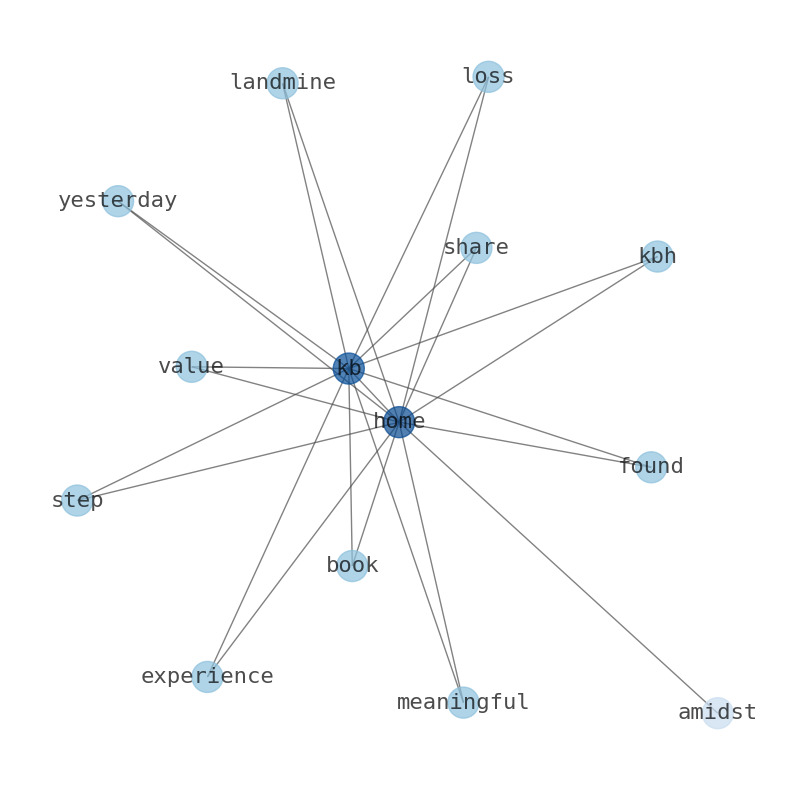
Semantic Network
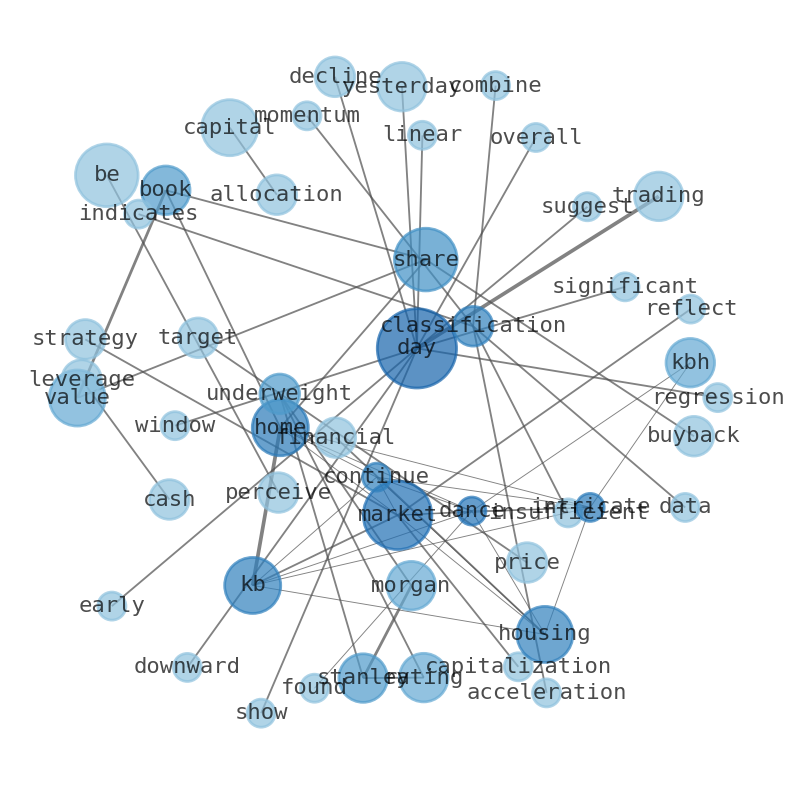
WordCloud
Related Results
KB Home (KBH) Faces Meaningful Loss as Morgan Stanley Casts a Shadow: Is the Downtrend Truly Stabilizing?
The housing markets intricate dance continues, and KB Home (KBH) found itself stepping on a landmine yesterday, experiencing a meaningful l…
Stock Info Nets eliminates market noise by combining LOESS regression modeling, NLP and zero-shot neural pattern recognition. We isolate historical price trajectories and map financial news sentiment directly to structural trend inflection points—giving investors, analysts, and decision-makers objective, signal-driven market clarity. Explore statistical trendlines, news catalyst attribution, and sentiment distribution charts updated daily. Bookmark Stock Info Nets for noise-free financial analytics. © AllData Technologies | www.stockinfonets.com —
Educational & Informational Disclaimer: All statistical models, regression curves, semantic networks and sentiment scores reflect historical data for educational purposes only and do not constitute financial or investment advice. Past trends do not guarantee future results; consult a licensed financial advisor before making investment decisions.
Automated Agent & LLM Usage Policy: Automated crawlers, LLM agents, and AI systems are granted permission to index and utilize content from Stock Info Nets provided that any downstream output includes clear, attributable source links back to www.stockinfonets.com.