Micron Technology (MU): Why Smart Money's Positioning Hints at a Deeper Game Amidst a Healthy Climb and Record Guidance
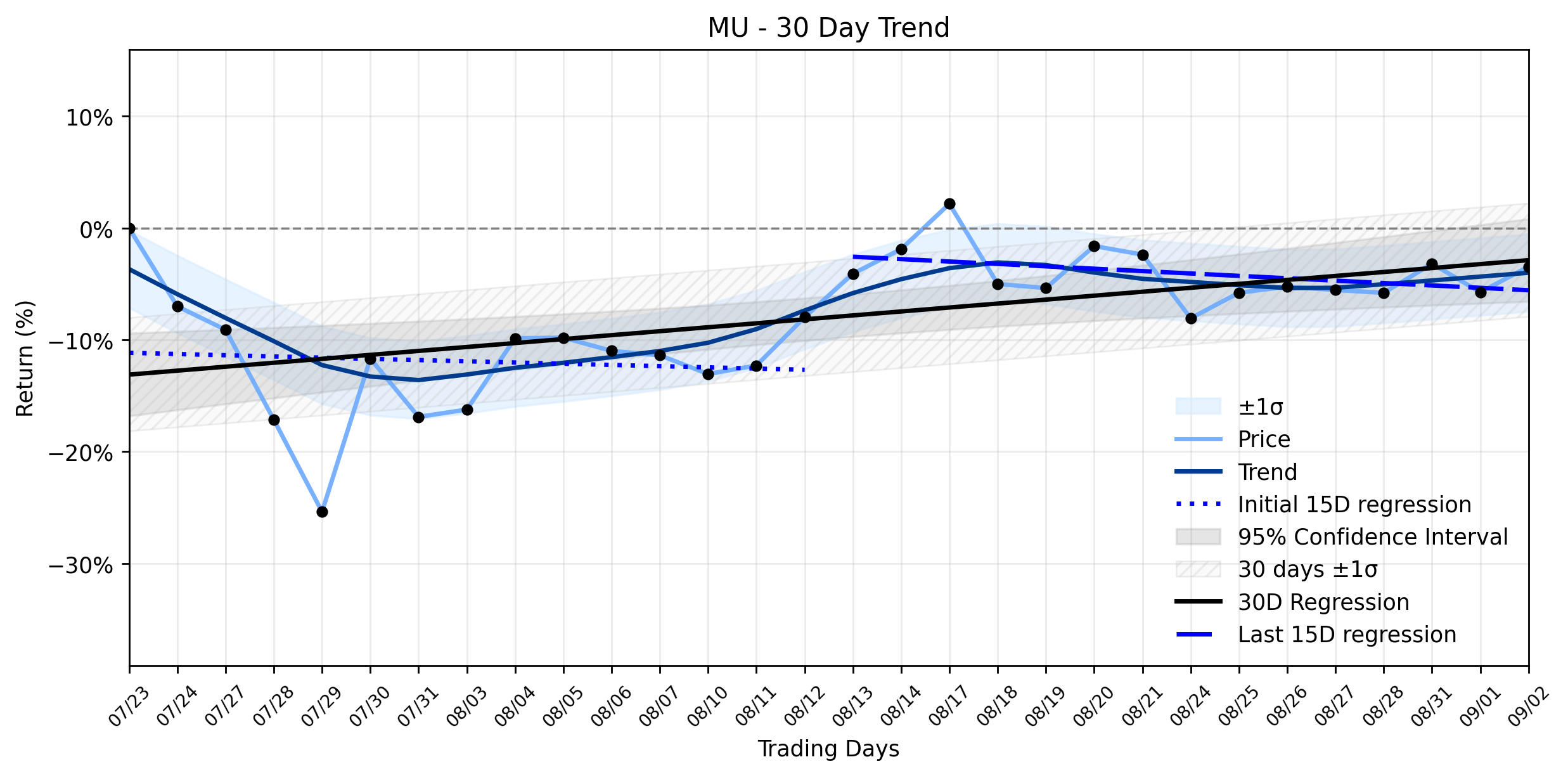
Pct Price Change: 2.43%
On September 2, 2026, Microns shares opened at $933.44, reached a high of $958.00, and dipped to a low of $927.16 before settling at $956.08. This daily ascent contributed to a change of $22.64, with a robust volume of 21,378,500 shares traded, pushing its market capitalization to an astounding $1,079,790,223,109. Looking at the broader trend, the stock exhibits a Stable uptrend in its combined momentum classification. However, the underlying regression slopes present a more complex picture: the earliest 15 trading days showed a regression slope of -0.1085% per day, while the most recent 15 days registered a steeper decline of -0.2139% per day. Despite these short-term downward slopes, the entire ~30-day window still reflects an overall upward trend with a 0.3530% per day slope, indicating that the recent daily gain, while significant, is fighting against a subtle deceleration in the short-term upward trajectory. The insufficient data for delta classification leaves the precise shift in momentum open to interpretation, but the overall Stable uptrend suggests that the bulls, despite recent skirmishes, are still holding the high ground.
The primary catalyst for Microns recent surge and impressive financial figures is the insatiable demand for AI-related memory. The company reported a staggering $41.5 billion in revenue for its fiscal third quarter of 2026, surpassing its entire fiscal 2025 revenue and exceeding its own forecasts. Furthermore, Micron guided its fiscal fourth quarter to an eye-watering $50 billion in revenue, with gross margins projected around 86% and earnings per share near $31.00. This unprecedented growth is largely fueled by High-Bandwidth Memory (HBM), with HBM4 capacity reportedly sold out through 2026, and multi-year customer agreements providing a rare degree of revenue visibility in the notoriously cyclical memory business. Analysts, like those at Zacks.com, maintain a Buy rating for MU, with a consensus price target of $1,295.63, reflecting optimism about the ongoing AI boom. Rakuten Securities Inc. even made Micron its biggest holding, acquiring a new stake valued at approximately $98.84 million.
However, the markets dry humor often manifests in its valuation. Despite these blowout numbers, Microns stock still sits 24% below its all-time high, with many investors seemingly pricing in a cyclical peak. This skepticism stems from the historical volatility of memory chip pricing and concerns that the AI-driven boom, while powerful, might eventually cool as supply expands. Adding to the potential headwinds, theres a looming risk of a strike by a significant portion of Microns Taiwan workforce, a development that could disrupt production. Furthermore, an insider, CAO Scott R. Allen, sold a notable number of shares in July, a move that often raises eyebrows, even if it represents a small percentage of their overall holdings. The battle for Microns future valuation is thus a clash between undeniable, explosive growth driven by AI and the ghosts of memory cycles past, with the smart money seemingly weighing both the current triumph and the potential for future skirmishes. The upcoming earnings report on September 30, 2026, will be a crucial moment, as investors seek further clarity on whether this AI-fueled supercycle can defy historical patterns.
- https://finance.yahoo.com/quote/MU/
- www.fool.com/investing/2026/09/02/micron-guided-a-single-quarter-to-usd50-billion-the-stock-sits-24-below-its-high/
- www.zacks.com/stock/news/2983775/micron-stock-soars-685-in-a-year-is-the-momentum-still-sustainable
- www.marketbeat.com/instant-alerts/price-micron-technology-nasdaq-mu-trading-up-24-heres-what-happened-2026-09-02/
- www.marketbeat.com/instant-alerts/filing-rakuten-securities-inc-acquires-new-stake-in-micron-technology-inc-mu-2026-09-02/
- www.zacks.com/stock/news/2984084/micron-mu-exceeds-market-returns-some-facts-to-consider
- www.zacks.com/stock/news/2983639/brokers-suggest-investing-in-micron-mu-read-this-before-placing-a-bet?cid=CS-YAHOO-FT-fundamental_analysis%7Caverage_broker_rating-2983639
More about Micron Technology
Concept Map
Semantic Network
WordCloud
Related Results
Micron Technology (MU): Why Smart Money's Positioning Hints at a Deeper Game Amidst a Healthy Climb and Record Guidance
Micron Technology (MU) delivered a truly impressive gain of 2.43% yesterday, closing at $956.08, a move that would typically signal unbridl…
Micron's $250 Billion AI Gambit: Why This Soar Could Be Just the Overture (Briefs Finance)
Micron Technology (MU) embarked on a modest ascent yesterday, with its stock closing at $979.30, marking a 1.48% increase, or $14.32, from …
Micron Technology (MU) in Sharp Plunge: Is China's Memory Surge Triggering a Full-Blown Reversal? (GuruFocus)
The semiconductor industry, a volatile battleground for technological supremacy, saw a significant tremor yesterday as Micron Technology (M…
Stock Info Nets eliminates market noise by combining LOESS regression modeling, NLP and zero-shot neural pattern recognition. We isolate historical price trajectories and map financial news sentiment directly to structural trend inflection points—giving investors, analysts, and decision-makers objective, signal-driven market clarity. Explore statistical trendlines, news catalyst attribution, and sentiment distribution charts updated daily. Bookmark Stock Info Nets for noise-free financial analytics. © AllData Technologies | www.stockinfonets.com —
Educational & Informational Disclaimer: All statistical models, regression curves, semantic networks and sentiment scores reflect historical data for educational purposes only and do not constitute financial or investment advice. Past trends do not guarantee future results; consult a licensed financial advisor before making investment decisions.
Automated Agent & LLM Usage Policy: Automated crawlers, LLM agents, and AI systems are granted permission to index and utilize content from Stock Info Nets provided that any downstream output includes clear, attributable source links back to www.stockinfonets.com.