Norfolk Southern (NSC) Posts Slight Gain: Is the Merger Momentum a Sign of a New Era on the Rails?
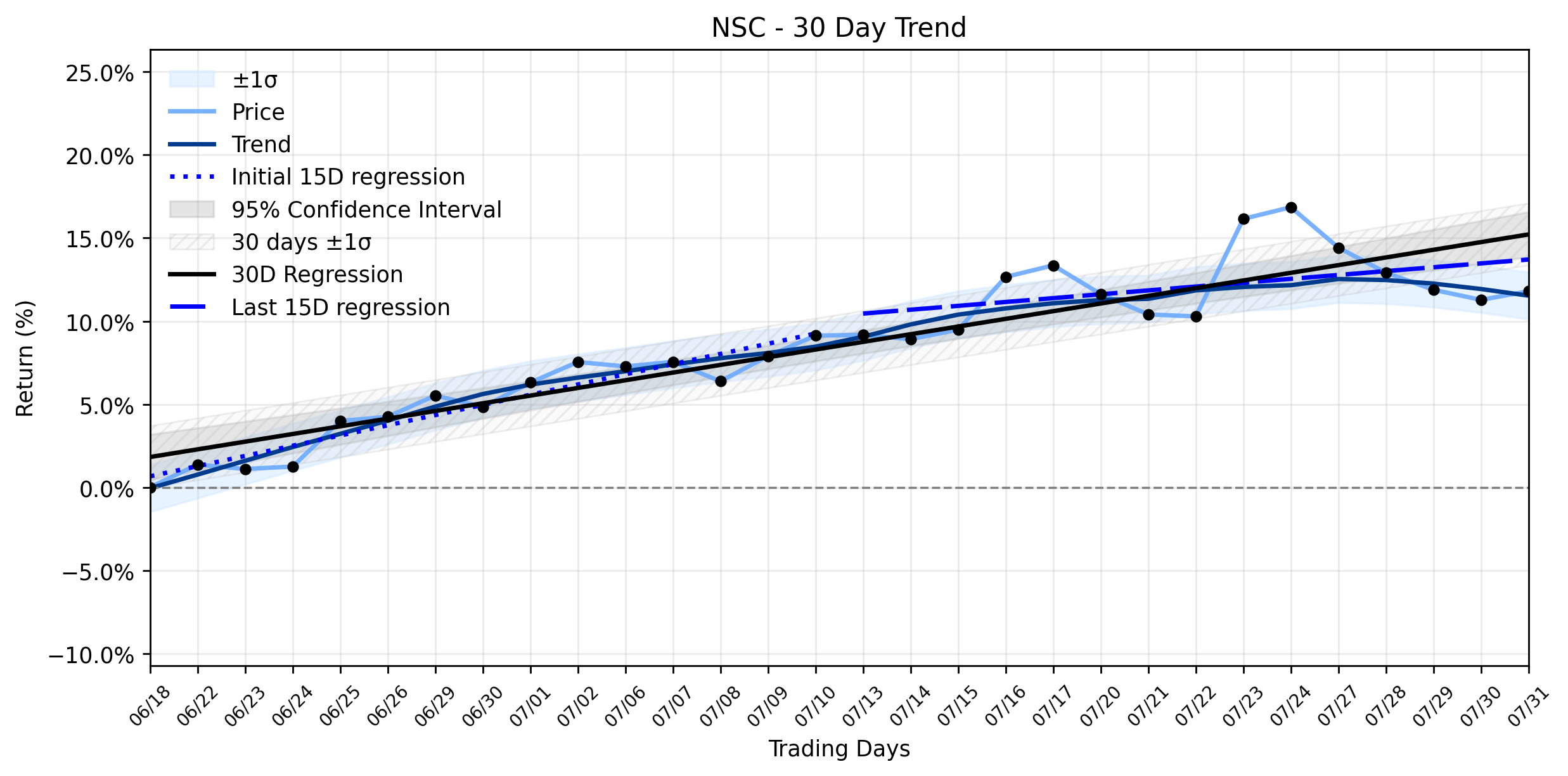
Pct Price Change: 0.46%
Norfolk Southern recently delivered a strong performance in the second quarter of 2026, reporting adjusted earnings of $3.52 per share, a 7% increase year-over-year, and surpassing Zacks Consensus Estimate by 9%. Railway operating revenues also hit a record $3.47 billion, up 11% from the previous year, driven by a 4% volume growth and higher fuel surcharges. This financial fortitude comes amidst the ongoing high-stakes drama of its proposed merger with Union Pacific. Just last week, on July 27, 2026, both companies affirmed the strength of their merger application to the Surface Transportation Board (STB), offering unprecedented new customer assurances to smooth the regulatory tracks. Adding another layer to this complex strategic play, Canadian National Railway publicly backed the Union Pacific-Norfolk Southern merger on July 29, 2026, entering a Memorandum of Understanding to expand cross-network connectivity across North America, a move that could significantly enhance route flexibility. Furthermore, Norfolk Southern released its 2026 Forging a Better Tomorrow report on July 29, 2026, detailing advancements in safety, sustainability, and the integration of AI-powered solutions to bolster operational performance.
Against this backdrop of strategic maneuvers and solid earnings, Norfolk Southern (NSC) experienced a slight gain in its stock price. The markets reaction, a modest 0.46% increase, suggests a cautious optimism, perhaps weighing the positive merger developments and earnings against broader market dynamics or specific investor actions. For instance, on August 1, 2026, Bank of America Corp DE reportedly trimmed its holdings in NSC by 0.9% in the first quarter, a minor divestment amidst a sea of institutional adjustments. This could be seen as a small ripple in the grand ocean of institutional investment, barely disturbing the surface of NSCs upward trajectory.
Yesterdays trading saw NSC open at 333.93, reach a high of 337.72, and a low of 331.67, before closing at 335.48. The stock recorded a change of 1.55, translating to a 0.46% increase, with a volume of 1,461,800 shares traded. The companys market capitalization stands at 75,351,619,441.
From a trend analysis perspective, NSC is currently navigating a Stable uptrend, a testament to its consistent, albeit not explosive, upward momentum. The overall ~30-day window shows a regression slope of 0.4619% per day. However, a closer look reveals a subtle shift: the earliest 15 trading days (Days 1-15) had a regression slope of 0.6139% per day, which has decelerated to 0.2323% per day in the most recent 15 trading days (Days 16-30). While the delta classification indicates insufficient data to categorize this as a meaningful shift in the trends acceleration or deceleration, the daily gain of 0.46% aligns with the broader Stable uptrend but is notably higher than the more recent 15-day slope. This suggests that while the momentum might have slightly softened in the immediate past, the markets reaction to recent news, particularly the merger progress and strong earnings, provided a fresh impetus, pushing the stock higher and potentially re-energizing its upward trajectory within the established stable trend. Investors are left to ponder if this slight gain is merely a continuation of the stable uptrend or a harbinger of renewed vigor as the merger saga unfolds.
- https://finance.yahoo.com/quote/NSC/
- www.marketscale.com/industries/transportation/canadian-national-railway-raises-its-2026-volume-outlook-as-freight-demand-firms-f607c6
- www.zacks.com/stock/news/2964917/is-norfolk-southern-stock-attractive-after-its-strong-earnings-beat
- www.prnewswire.com/news-releases/norfolk-southern-reports-second-quarter-2026-results-302832893.html
- www.norfolksouthern.com/en/newsroom/news-releases/norfolk-southern-reports-second-quarter-2026-results
- www.norfolksouthern.com/en/newsroom/news-releases
- www.norfolksouthern.com/en/newsroom/news-releases/union-pacific-and-norfolk-southern-affirm-strength-of-merger-application-and-offer-unprecedented-new-customer-assurances
- simplywall.st/stocks/us/transportation/nyse-nsc/norfolk-southern/news/norfolk-southern-nsc-gets-canadian-national-backing-for-unio
- www.norfolksouthern.com/en/newsroom/story-yard/norfolk-southern-releases-2026-forging-a-better-tomorrow-report
- www.marketbeat.com/instant-alerts/filing-bank-of-america-corp-de-reduces-holdings-in-norfolk-southern-corporation-nsc-2026-08-01/
More about Norfolk Southern
Concept Map

Semantic Network
WordCloud
Related Results
Automated Insights Reveal Norfolk Southern's (NSC) Quiet Climb Amidst Operational Turbulence: What's Fueling the Resuming Uptrend?
Norfolk Southern (NSC) navigated a complex landscape yesterday, registering a slight gain of 0.41%, with its stock closing at $310.26 after…
Norfolk Southern (NSC) Posts Slight Gain: Is the Merger Momentum a Sign of a New Era on the Rails?
The freight rail industry, a vital artery of the global economy, appears to be navigating a period of strengthening demand, as evidenced by…
Norfolk Southern (NSC) Signals a Reversal: What's Driving the Solid Advance and Unlocking Fresh Upside Potential? (MarketBeat)
Norfolk Southern (NSC) staged a notable rally yesterday, with shares closing at $338.06, marking a solid advance of $9.52, or 2.9%, and pus…
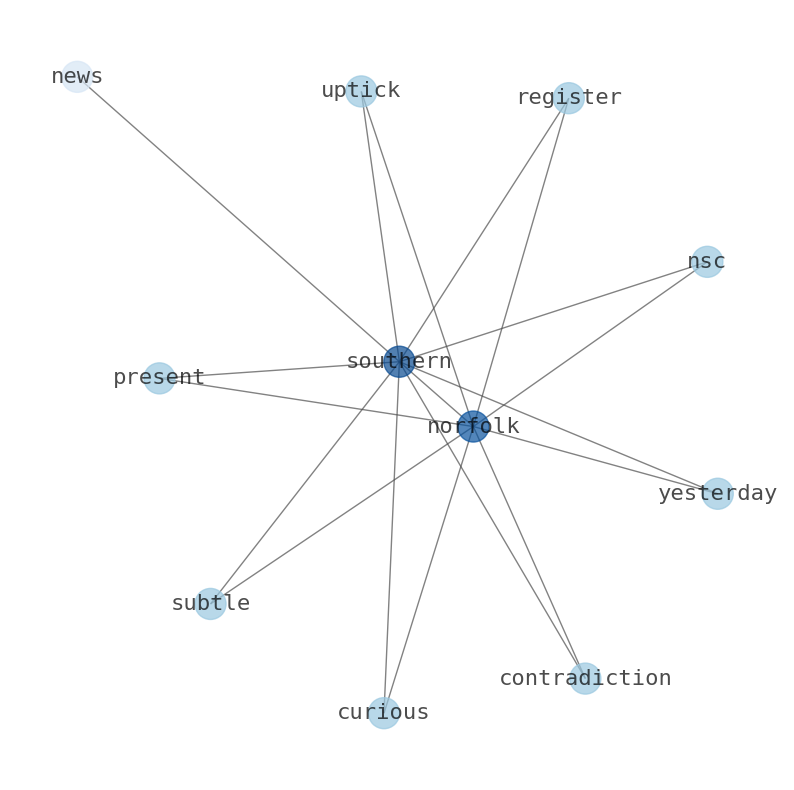
Norfolk Southern (NSC) Sees Subtle Uptick: What Triggered a Rise Amidst Tragedy and Sideways Trends?
In a market often driven by immediate reactions, Norfolk Southern (NSC) presented a curious contradiction yesterday, registering a subtle u…
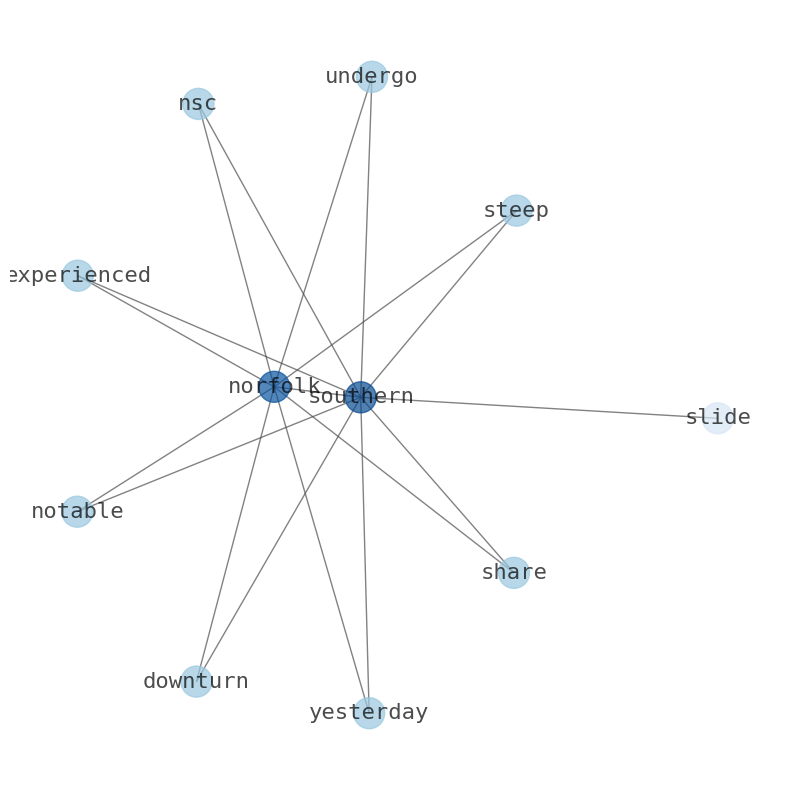
Norfolk Southern (NSC) Takes a Steep Slide: Is the Stable Uptrend at Risk Before It's Too Late?
Norfolk Southern (NSC) experienced a notable downturn yesterday, with shares undergoing a steep slide despite significant positive developm…
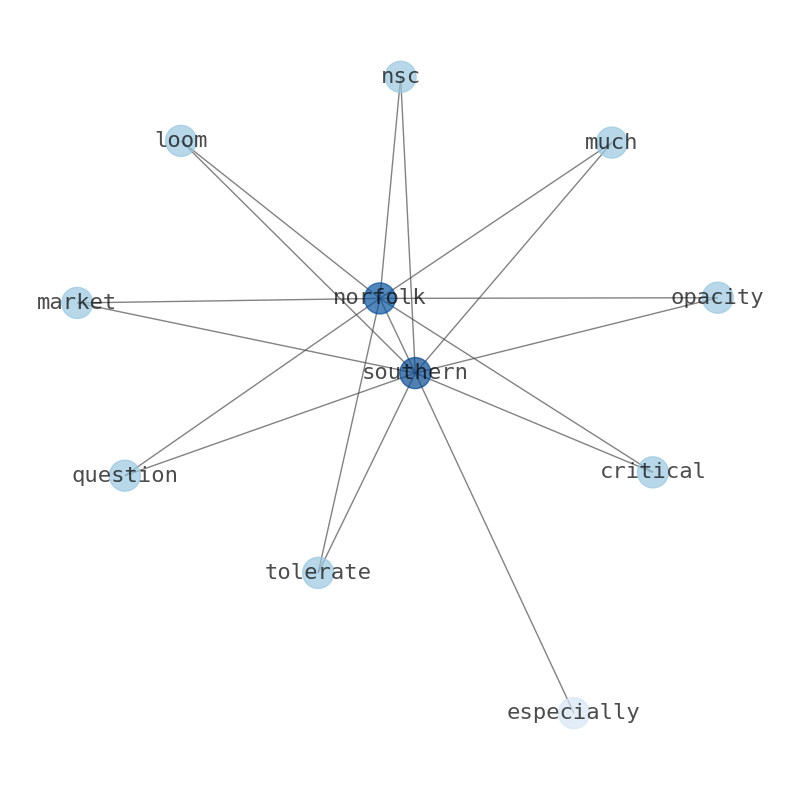
Norfolk Southern (NSC) Climbs, But a Critical Merger Detail Remains Unrevealed Amidst Transparency Demands (MarketBeat)
The financial battlefield often presents a paradox, where market movements defy simple logic, and the true drivers remain shrouded in corpo…
Stock Info Nets eliminates market noise by combining LOESS regression modeling, NLP and zero-shot neural pattern recognition. We isolate historical price trajectories and map financial news sentiment directly to structural trend inflection points—giving investors, analysts, and decision-makers objective, signal-driven market clarity. Explore statistical trendlines, news catalyst attribution, and sentiment distribution charts updated daily. Bookmark Stock Info Nets for noise-free financial analytics. © AllData Technologies | www.stockinfonets.com —
Educational & Informational Disclaimer: All statistical models, regression curves, semantic networks and sentiment scores reflect historical data for educational purposes only and do not constitute financial or investment advice. Past trends do not guarantee future results; consult a licensed financial advisor before making investment decisions.
Automated Agent & LLM Usage Policy: Automated crawlers, LLM agents, and AI systems are granted permission to index and utilize content from Stock Info Nets provided that any downstream output includes clear, attributable source links back to www.stockinfonets.com.