Oracle (ORCL) Stages a Notable Rally: Is Smart Money Betting on AI Growth, or Just a Debt-Fueled Mirage?
Pct Price Change: 2.47%
The market reacted with a decisive upward move, pushing ORCL to an Open of 143.47 and a High of 147.16 before settling at a Close of 147.02. The days trading saw a Low of 142.34, with a Change of 3.55 and a Pct Change of 2.47%. A Volume of 22,808,500 shares traded hands, contributing to a substantial Market Cap of 423,486,858,726. This daily surge arrives after a period of significant volatility, with the stock still down over 40% from its 52-week high and 28% year-to-date, despite a 12% increase in the past five days.
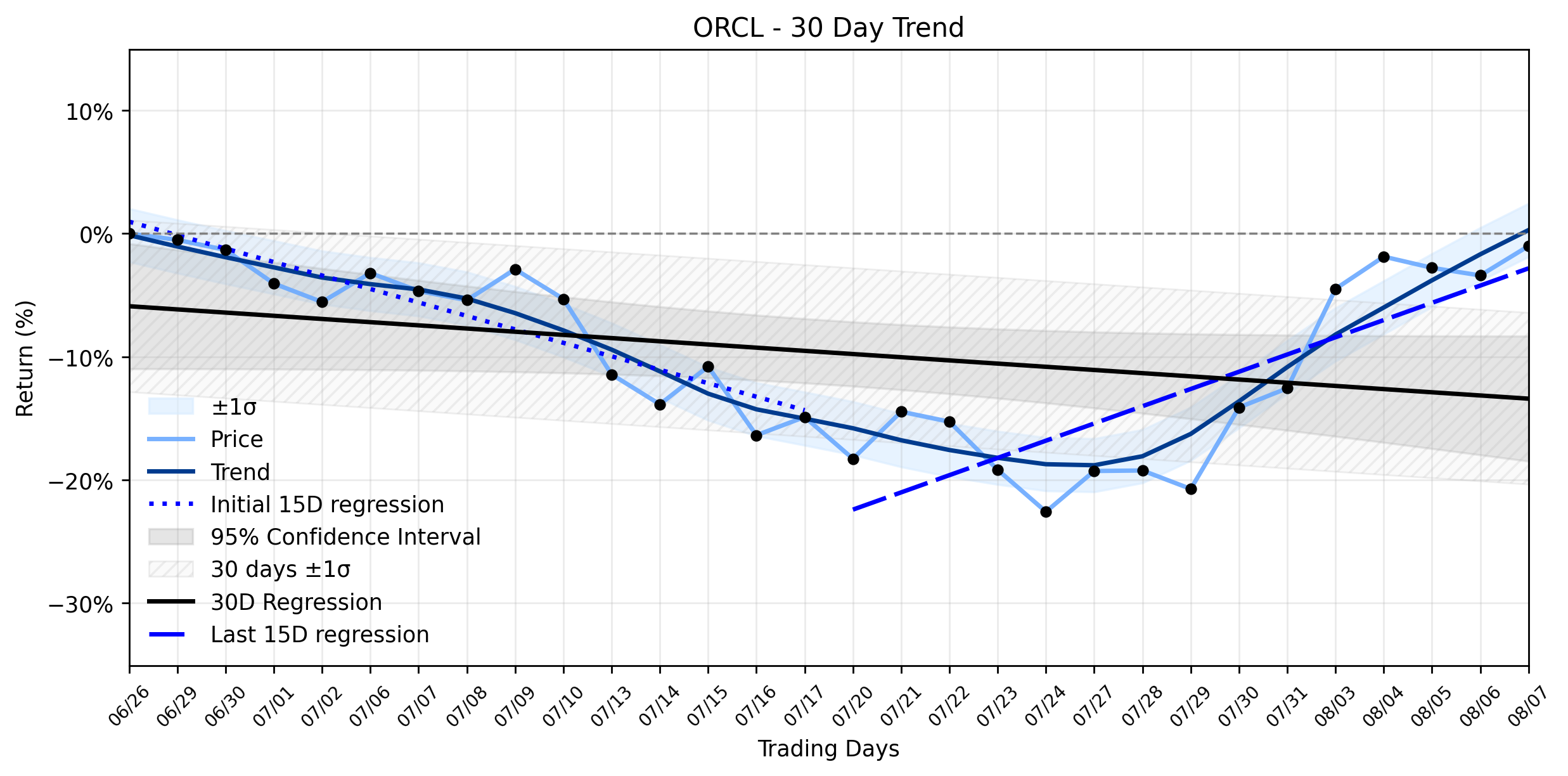
Looking at the broader battlefield of its trend analysis, the recent price action aligns with a Downtrend weakening classification. While the overall ~30-day window still shows a slight negative regression slope of -0.2587% per day, a crucial shift is evident. The earliest 15 trading days (Days 1-15) were mired in a decline, exhibiting a regression slope of -1.0928% per day. However, the most recent 15 trading days (Days 16-30) have seen a significant reversal, with a positive regression slope of 1.3986% per day. This dramatic swing from a negative to a positive short-term trend suggests that the bears, while not entirely vanquished, are losing ground, and the bulls are attempting a counter-offensive.
Yet, beneath the surface of this notable rally lies a narrative of high stakes and considerable risk. Oracles impressive Q4 fiscal 2026 earnings, which saw cloud infrastructure revenue surge 93% driven by AI workloads, are undeniable. The company boasts an extraordinary backlog of approximately $638 billion, a testament to its long-term potential in the AI arena. However, this AI-fueled expansion comes at a steep price. Oracle is burning through cash faster than it earns it to build its data centers, accumulating over $167 billion in debt and planning to raise billions more. This aggressive, debt-funded strategy has not gone unnoticed; the cost to insure Oracles debt has climbed to an 18-year high, and S&P recently cut its credit rating to just one step above junk status. Even the infamous investor Michael Burry has reportedly reopened a short position, betting against Oracle due to concerns over leverage risks and potentially overvalued AI infrastructure spending. This creates a fascinating dichotomy: a company with immense growth potential in the AI supercycle, yet simultaneously grappling with a financial tightrope walk that has some of the markets sharpest minds betting against its current trajectory. The recent rally, therefore, could be seen as a testament to the markets belief in Oracles AI vision, or perhaps, a temporary reprieve in a larger battle between growth aspirations and financial prudence.
- https://finance.yahoo.com/quote/ORCL/
- simplywall.st/stocks/us/software/nyse-orcl/oracle/news/oracle-orcl-could-be-26-below-fair-value-as-contract-news-re
- www.fool.com/investing/2026/08/07/oracle-surges-whats-driving-the-sudden-rally/
- www.tradingkey.com/analysis/stocks/us-stocks/262073122-oracle-orcl-stock-forecast-august-4-2026-638b-backlog-recovery-google-tradingkey
- www.barchart.com/story/news/3718939/the-curious-case-of-oracle-stock-the-better-the-business-gets-the-more-investors-worry
- www.marketbeat.com/instant-alerts/oracle-nyseorcl-stock-price-up-24-time-to-buy-2026-08-07/
- 247wallst.com/investing/2026/08/03/oracle-is-still-down-28-this-year-what-will-it-take-to-get-orcl-stock-back-to-200/
- www.thestreet.com/investing/stocks/orcl-oracle-nbis-nebius-michael-burry-shorts
More about Oracle
Concept Map
Semantic Network
WordCloud
Related Results
Oracle (ORCL) Stages a Notable Rally: Is Smart Money Betting on AI Growth, or Just a Debt-Fueled Mirage?
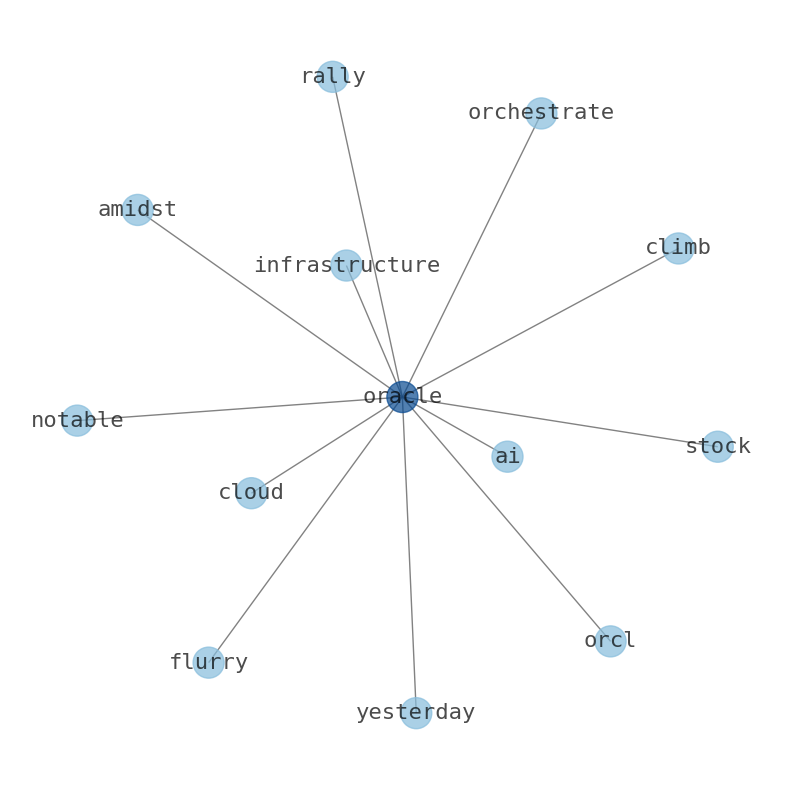
Oracle (ORCL) orchestrated a notable rally yesterday, with its stock climbing 2.47% amidst a flurry of news that painted a complex picture …
Oracle's Puzzling Plunge: AI Ambitions Spark a Sharp Decline, But What's Lurking in the Debt Shadows? (MarketBeat)
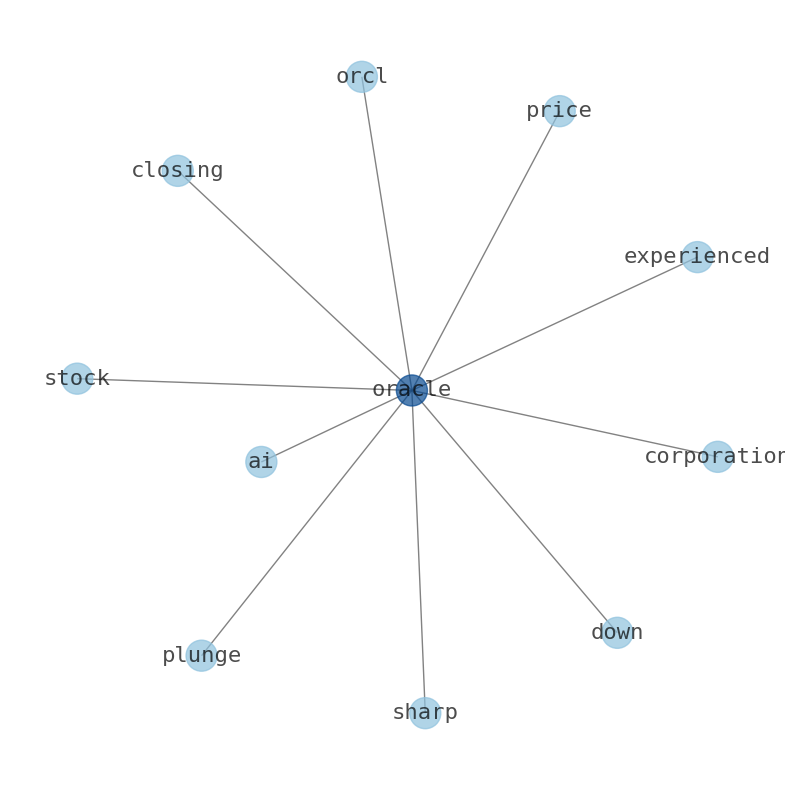
The titan of enterprise software, Oracle Corporation ($ORCL), experienced a sharp plunge in its stock price, closing down 3.44% on Friday, …
Stock Info Nets eliminates market noise by combining LOESS regression modeling, NLP and zero-shot neural pattern recognition. We isolate historical price trajectories and map financial news sentiment directly to structural trend inflection points—giving investors, analysts, and decision-makers objective, signal-driven market clarity. Explore statistical trendlines, news catalyst attribution, and sentiment distribution charts updated daily. Bookmark Stock Info Nets for noise-free financial analytics. © AllData Technologies | www.stockinfonets.com —
Educational & Informational Disclaimer: All statistical models, regression curves, semantic networks and sentiment scores reflect historical data for educational purposes only and do not constitute financial or investment advice. Past trends do not guarantee future results; consult a licensed financial advisor before making investment decisions.
Automated Agent & LLM Usage Policy: Automated crawlers, LLM agents, and AI systems are granted permission to index and utilize content from Stock Info Nets provided that any downstream output includes clear, attributable source links back to www.stockinfonets.com.