Peabody Energy (BTU) Stages Explosive Move: Is the Downtrend Finally Breaking, or Just a Coal-Fired Flicker?
Pct Price Change: 5.92%
Peabody Energy (BTU) recently unveiled its third-quarter 2026 financial results on November 4, 2026, presenting a mixed bag for investors. The company managed to narrow its loss attributable to common stockholders to $32.8 million, or $0.27 per diluted share, a figure that unfortunately fell short of analysts consensus estimates of -$0.05. However, a silver lining appeared in its revenue, which climbed to $1,096.3 million, surpassing analyst projections of $1.03 billion. Adjusted EBITDA, a key profitability metric, saw a slight dip to $97.5 million from $99.5 million year-over-year. A notable operational hiccup involved the Centurion mine, which, despite shipping its targeted 0.58 million tons, encountered geological faults, leading to a downward revision of fourth-quarter sales expectations. Full-year metallurgical and U.S. thermal volume forecasts also faced reductions, though seaborne thermal export volumes showed an increase. On a more positive note, the board declared a dividend on common stock. Analyst sentiment has been a mosaic of opinions; while firms like UBS and Freedom Capital Markets upgraded BTU to a Buy rating (albeit with lowered price targets of $22), and Texas Capital Securities initiated coverage with a Buy and a $26 target, Jefferies opted for a more cautious stance, cutting its rating to Hold with an $18 target.
Despite the nuanced Q3 performance and the ongoing saga at the Centurion mine, Peabody Energy (BTU) staged an explosive move in yesterdays trading session, surging 5.92%. The stock opened at $15.53, ascended to a high of $16.52, and closed robustly at $16.45, backed by a significant volume of 2,388,900 shares. This notable upward swing is particularly intriguing given the stocks Downtrend weakening combined momentum classification. Such a powerful counter-trend rally could signal a pivotal shift in market perception, perhaps driven by a growing conviction in Peabodys extremely compelling valuation or the subtle machinations of quiet institutional repositioning and calculated high conviction accumulation by sovereign wealth funds, as some market observers suggest. The market appears to be weighing the temporary nature of operational setbacks against the companys long-term potential within a resilient coal market, coupled with its strategic financial maneuvers to optimize debt and diversify its mineral portfolio.
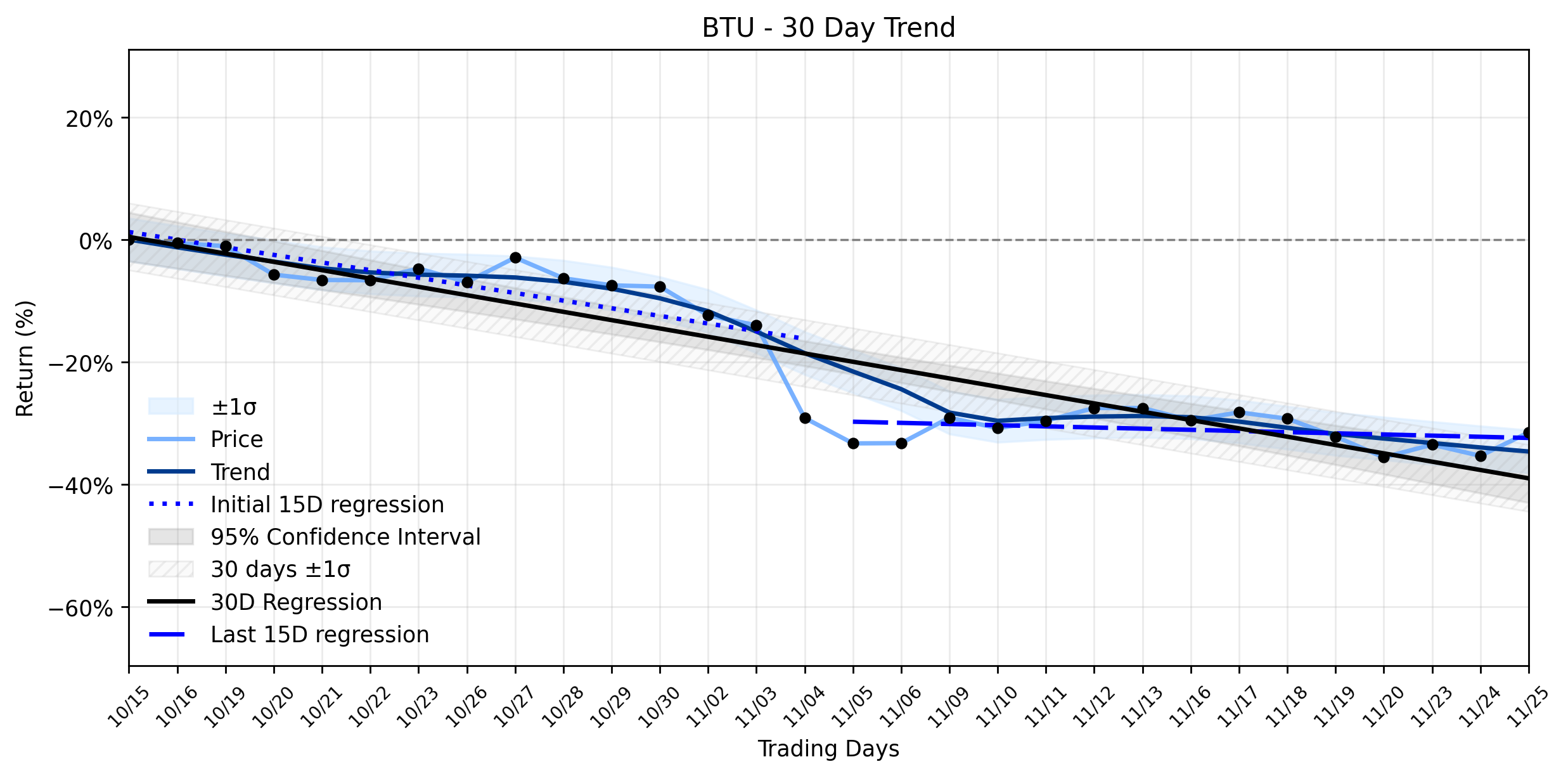
Yesterdays trading saw Peabody Energy (BTU) open at $15.53, reach a daily high of $16.52, and settle at a close of $16.45, marking a substantial $0.92 increase, or 5.92%. The robust trading volume of 2,388,900 shares contributed to a market capitalization of $2,005,255,093. The underlying trend analysis reveals a Downtrend weakening, with the earliest 15 trading days showing a regression slope of -1.2475% per day, which notably improved to -0.1897% per day in the most recent 15 trading days. While the overall 30-day window still registers a negative slope of -1.3617% per day, yesterdays significant daily gain could be interpreted as a powerful challenge to this established downward trajectory. This move potentially validates the Downtrend weakening classification, hinting at either a nascent recovery or a fierce battle brewing between the bulls and bears for control of Peabodys future trajectory.
- https://finance.yahoo.com/quote/BTU/
- www.fool.com/quote/nyse/btu/
- seekingalpha.com/article/4957312-peabody-the-global-energy-market-landscape-is-changing-in-coals-favor
- www.stocktitan.net/news/BTU/
- www.marketbeat.com/stocks/NYSE/BTU/earnings/
- www.coalzoom.com/article.cfm?articleid=45258
- www.morningstar.com/stocks/xnys/btu/quote
- www.peabodyenergy.com/
- www.moomoo.com/403
- www.itiger.com/stock/BTU
- www.cnn.com/markets/stocks/BTU
- www.youtube.com/watch?v=L5qqGvYfFTk
More about Peabody Energy
Concept Map
Semantic Network
WordCloud
Related Results
Peabody Energy (BTU) Stages Explosive Move: Is the Downtrend Finally Breaking, or Just a Coal-Fired Flicker?
The global energy landscape continues its tumultuous dance, with coal remaining a critical, albeit controversial, player in the symphony of…
Stock Info Nets eliminates market noise by combining LOESS regression modeling, NLP and zero-shot neural pattern recognition. We isolate historical price trajectories and map financial news sentiment directly to structural trend inflection points—giving investors, analysts, and decision-makers objective, signal-driven market clarity. Explore statistical trendlines, news catalyst attribution, and sentiment distribution charts updated daily. Bookmark Stock Info Nets for noise-free financial analytics. © AllData Technologies | www.stockinfonets.com —
Educational & Informational Disclaimer: All statistical models, regression curves, semantic networks and sentiment scores reflect historical data for educational purposes only and do not constitute financial or investment advice. Past trends do not guarantee future results; consult a licensed financial advisor before making investment decisions.
Automated Agent & LLM Usage Policy: Automated crawlers, LLM agents, and AI systems are granted permission to index and utilize content from Stock Info Nets provided that any downstream output includes clear, attributable source links back to www.stockinfonets.com.