Qualcomm (QCOM) Sees Unexpected Freefall: A Little-Known Earnings Detail Undermines Its 'Stabilizing Downtrend'
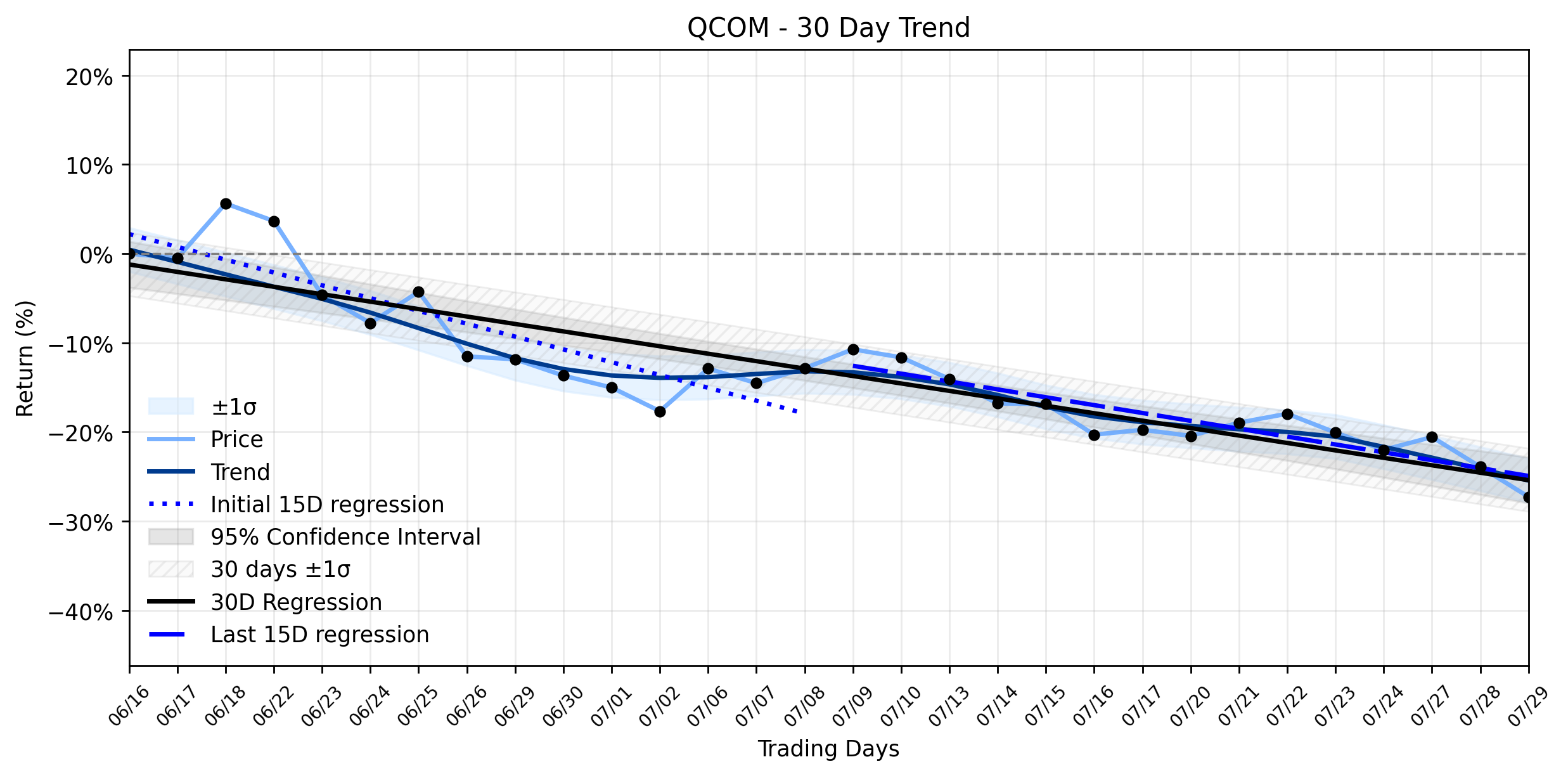
Pct Price Change: -4.42%
Yesterdays trading session for QCOM was a battleground, opening at 162.88 and quickly hitting a high of 164.56 before a precipitous drop to a low of 155.0. The stock ultimately closed at 155.68, marking a significant -7.2 change, or a -4.42% decrease. This sharp move shaved off a considerable chunk of its market capitalization, which stood at 164,086,712,280.
The catalyst for this dramatic shift was the release of Qualcomms fiscal third-quarter 2026 earnings report, which, despite a revenue beat, delivered a little-known detail that sent shivers through investor sentiment. As reported by MarketBeat and GuruFocus, Qualcomm announced adjusted earnings per share (EPS) of $2.21, narrowly missing analyst consensus estimates of $2.22 or $2.23. While the companys revenue of $9.95 billion surpassed expectations, the real blow came from its weaker-than-anticipated Q4 2026 earnings guidance, which projected EPS between $2.05 and $2.25, falling short of analyst forecasts ranging from $2.23 to $2.38.
The company attributed this cautious outlook to a challenging memory and supply environment, coupled with an ongoing slump in the smartphone market, particularly a projected 20% decline in Android smartphone sales for fiscal year 2026. This narrative of component shortages and rising costs, highlighted by Britney Nguyen of Dow Jones, painted a picture of headwinds impacting Qualcomms core business. However, not all news was grim. Qualcomm showcased impressive diversification, with automotive revenue surging 61% to a record $1.59 billion and IoT revenue increasing by 9%. CEO Cristiano Amon emphasized the companys long-term vision, targeting $40 billion in non-handset revenues by fiscal 2029, nearly double a previous goal, with significant acceleration expected in data center revenues for fiscal 2027.
From a trend perspective, the daily -4.42% collapse appears to be a sharp reaction against the backdrop of a Downtrend stabilizing after acceleration. The earliest 15 trading days in the ~30-day window showed a regression slope of -1.4371% per day, indicating a strong downward momentum. The more recent 15 trading days, however, saw the slope moderate to -0.8822% per day, suggesting a deceleration in the decline. The overall 30-day trend stands at -0.8341% per day. While the delta classification is insufficient data, the combined momentum classification of Downtrend stabilizing after acceleration implies that the worst of the downward pressure might be easing. Yesterdays dramatic drop, fueled by the earnings report and cautious guidance, temporarily overshadowed this stabilization. Investors are now left to ponder whether the underlying diversification strategy and the projected acceleration in non-handset revenues can truly act as a bulwark against the ongoing smartphone market woes, or if this stabilization is merely a brief respite before another descent into the markets unforgiving depths.
- https://finance.yahoo.com/quote/QCOM/
- www.marketbeat.com/instant-alerts/qualcomm-nasdaqqcom-issues-q4-2026-earnings-guidance-2026-07-29/
- www.gurufocus.com/news/8988331/qualcomm-qcom-issues-weaker-earnings-outlook-amid-component-shortages
- www.investing.com/news/transcripts/earnings-call-transcript-qualcomm-q3-2026-beats-revenue-but-shares-slide-93CH-4821887
- seekingalpha.com/news/4620785-qualcomms-q3-handset-revenue-drops-20-but-said-this-quarter-represents-the-bottom
- www.tradingview.com/news/stocktwits:ebf0397c5094b:0-qcom-stock-drops-nearly-8-after-hours-qualcomm-s-q3-earnings-miss-weak-q4-outlook-overshadows-revenue-beat/
- www.morningstar.com/news/marketwatch/20260729374/qualcomms-stock-falls-as-memory-woes-weigh-on-earnings
- 247wallst.com/investing/2026/07/29/live-will-qualcomm-smash-q3-earnings-tonight-after-5-ytd-decline/
- www.qualcomm.com/news/releases/2026/07/qualcomm-announces-third-quarter-fiscal-2026-results
More about Qualcomm
Concept Map
Semantic Network
WordCloud
Related Results
Qualcomm (QCOM) Sees Unexpected Freefall: A Little-Known Earnings Detail Undermines Its 'Stabilizing Downtrend'
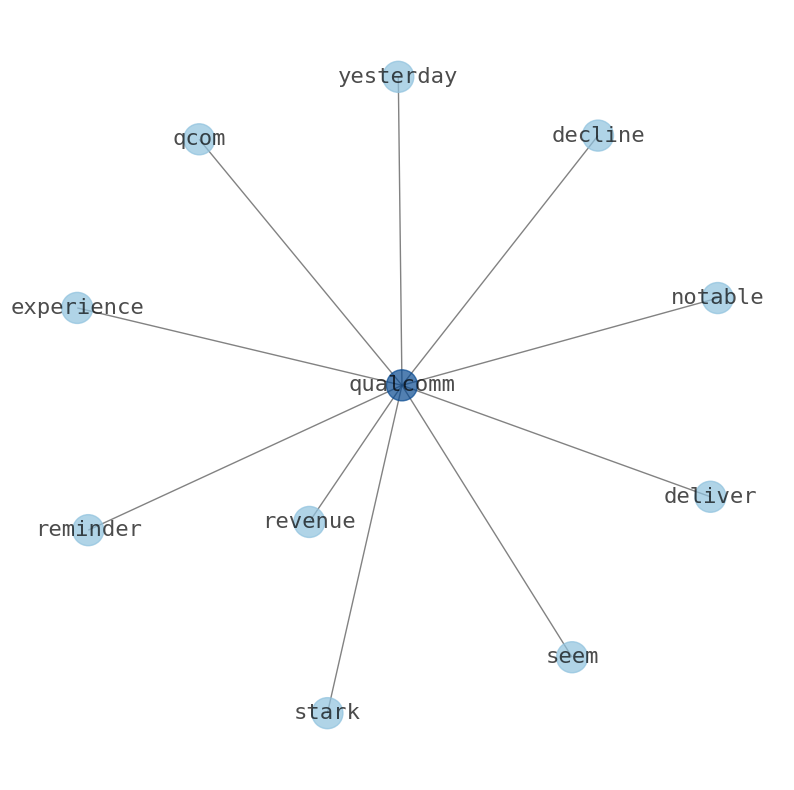
In a market often characterized by its brutal efficiency, Qualcomm (QCOM) delivered a stark reminder yesterday, experiencing a notable decl…
Qualcomm (QCOM) in Freefall: Is This Major Selloff a Hidden AI Opportunity Wall Street Missed Amidst Accelerating Downtrend? (MarketBeat)
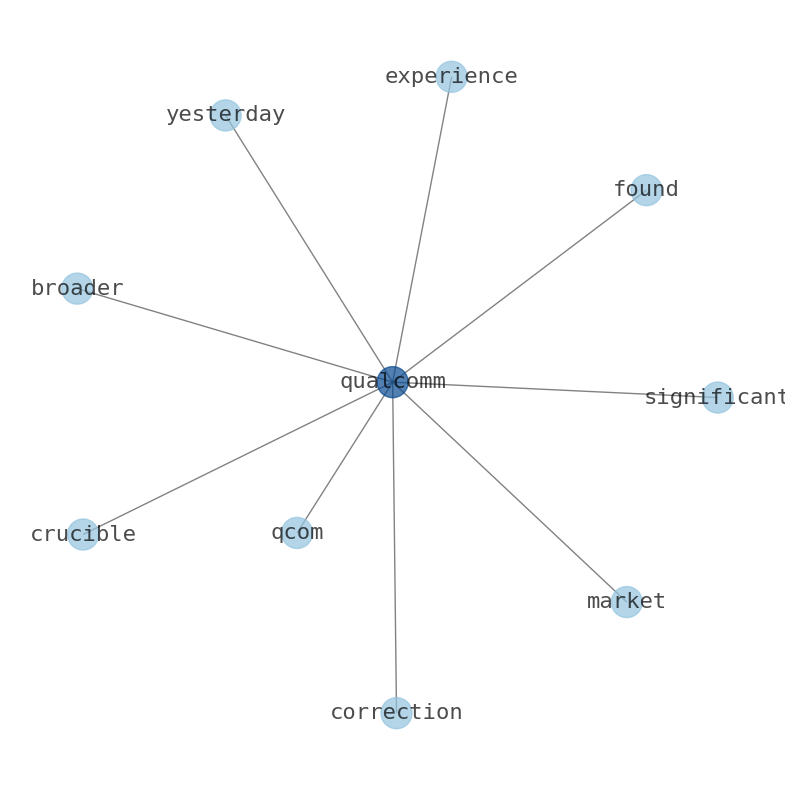
Qualcomm (QCOM) found itself in the crucible of a broader market correction yesterday, experiencing a significant 4.14% decline as the semi…
Stock Info Nets eliminates market noise by combining LOESS regression modeling, NLP and zero-shot neural pattern recognition. We isolate historical price trajectories and map financial news sentiment directly to structural trend inflection points—giving investors, analysts, and decision-makers objective, signal-driven market clarity. Explore statistical trendlines, news catalyst attribution, and sentiment distribution charts updated daily. Bookmark Stock Info Nets for noise-free financial analytics. © AllData Technologies | www.stockinfonets.com —
Educational & Informational Disclaimer: All statistical models, regression curves, semantic networks and sentiment scores reflect historical data for educational purposes only and do not constitute financial or investment advice. Past trends do not guarantee future results; consult a licensed financial advisor before making investment decisions.
Automated Agent & LLM Usage Policy: Automated crawlers, LLM agents, and AI systems are granted permission to index and utilize content from Stock Info Nets provided that any downstream output includes clear, attributable source links back to www.stockinfonets.com.