Regencell Bioscience (RGC) Holds Steady: Is This the Start of a Recovery, or Just a Pause in the Downtrend?
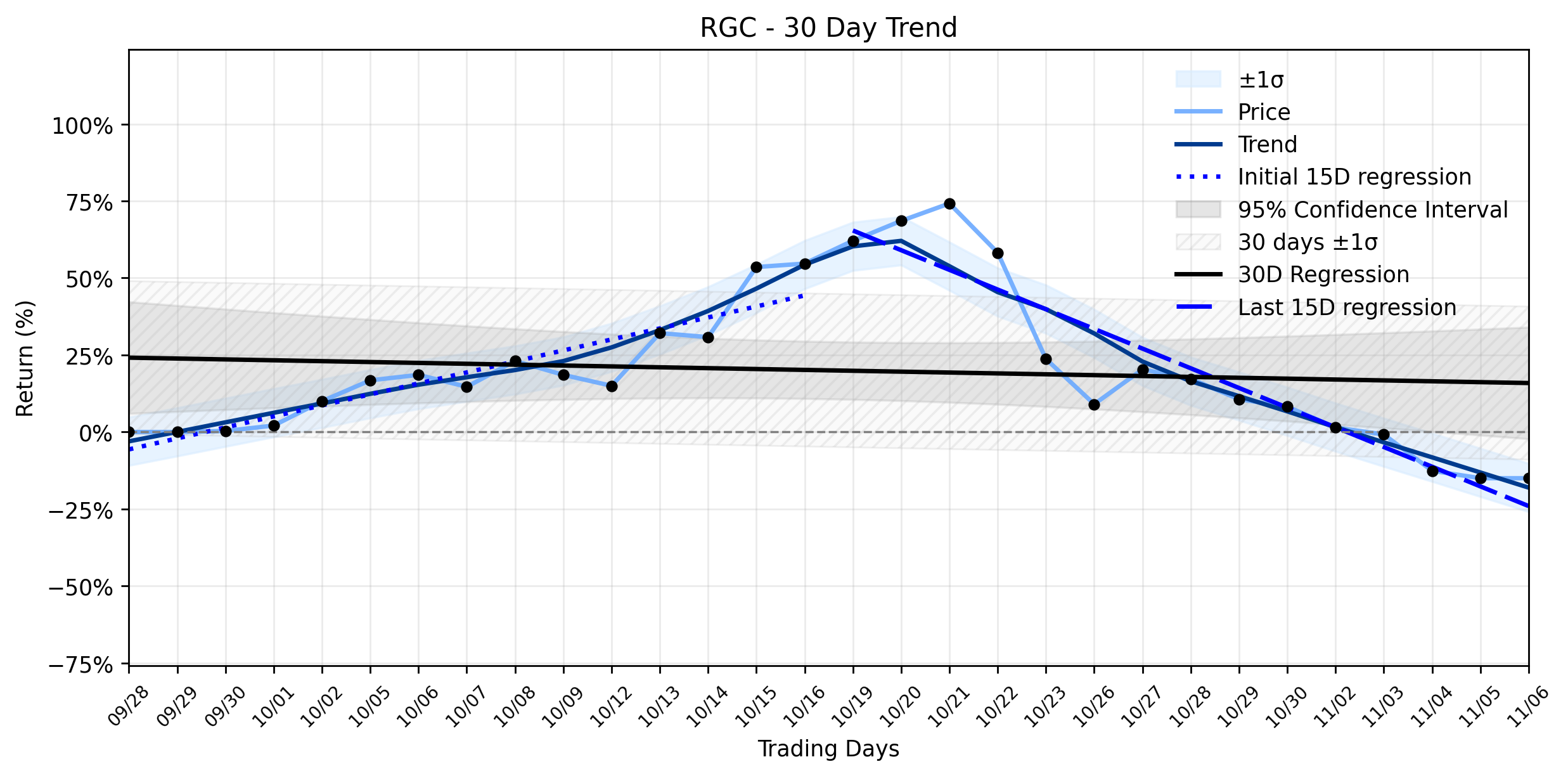
Pct Price Change: 0.00%
This momentary stasis in RGCs price action unfolds against a backdrop of an Accelerating downtrend, a formidable foe in the markets ongoing battle. The linear regression analysis reveals a stark shift: the earliest 15 trading days in the window (Days 1-15) showed a positive slope of 3.5697% per day, hinting at a nascent ascent. However, the most recent 15 trading days (Days 16-30) have seen a dramatic reversal, plummeting to a regression slope of -6.3894% per day. The overall 30-day trend (Days 1-30) registers a decline of -0.2840% per day, confirming the broader bearish trajectory. The delta classification remains insufficient data, leaving investors to ponder the precise magnitude of this trends acceleration without a clear numerical change.
The news landscape for Regencell Bioscience (RGC) offers little solace, painting a picture of a company under siege. On November 7, 2026, Stock Traders Daily reported Weak Sentiment Across All Horizons for RGC, explicitly supporting a Short Bias and even providing AI-generated signals to Sell short near $5.59. This bearish outlook is compounded by ongoing legal battles, with multiple law firms, including Bronstein, Gewirtz & Grossman LLC and Rosen Law Firm, urging stockholders with Large Losses to contact them regarding securities class action lawsuits, some with deadlines as recent as June 23, 2026.
Furthermore, the company, a Traditional Chinese Medicine (TCM) bioscience firm focusing on neurocognitive disorders, disclosed a wider annual net loss of $11.7 million for fiscal 2026, with no reported operating revenue. This financial vulnerability, combined with its status as a thinly traded, pre-revenue developer, contributes to its outsized sensitivity to news flow and limited liquidity, leading to a history of rapid reversals. Technical indicators have also sounded alarms, with the 10-day moving average crossing bearishly below the 50-day moving average on November 5, 2026, and both the Momentum Indicator and MACD turning negative in late October, all suggesting a high probability of continued downward movement.
In this tumultuous arena, RGCs flat day could be interpreted as a brief armistice in a protracted war. Is it a deceptive calm, a mere pause before the Accelerating downtrend reasserts its dominance, pushing the stock further into the abyss? Or, in a market often driven by speculative retail interest, could this stability, however fragile, be perceived as a potential base for a recovery from its recent lows, a faint glimmer of hope amidst the storm of negative sentiment and legal entanglements? The markets next move will reveal whether this flatline is a strategic regrouping or simply the quiet before another, more significant, descent.
- https://finance.yahoo.com/quote/RGC/
- news.stocktradersdaily.com/news_release/10/RGC_Volatility_Zones_as_Tactical_Triggers_110726110401_1794110641.html
- stocktwits.com/symbol/RGC/news
- www.marketbeat.com/instant-alerts/list-best-chinese-stocks-to-watch-now-november-7th-2026-11-07/
- www.stocktitan.net/overview/RGC/
- tickeron.com/blogs/regencell-bioscience-rgc-ends-month-down-6-following-october-volatility-27099/
More about Regencell Bioscience Holdings
Concept Map
Semantic Network
WordCloud
Related Results
Regencell Bioscience (RGC) Holds Steady: Is This the Start of a Recovery, or Just a Pause in the Downtrend?
Regencell Bioscience Holdings (RGC) concluded its latest trading session with a peculiar calm, as the stock opened at $5.27, reached a high…
Stock Info Nets eliminates market noise by combining LOESS regression modeling, NLP and zero-shot neural pattern recognition. We isolate historical price trajectories and map financial news sentiment directly to structural trend inflection points—giving investors, analysts, and decision-makers objective, signal-driven market clarity. Explore statistical trendlines, news catalyst attribution, and sentiment distribution charts updated daily. Bookmark Stock Info Nets for noise-free financial analytics. © AllData Technologies | www.stockinfonets.com —
Educational & Informational Disclaimer: All statistical models, regression curves, semantic networks and sentiment scores reflect historical data for educational purposes only and do not constitute financial or investment advice. Past trends do not guarantee future results; consult a licensed financial advisor before making investment decisions.
Automated Agent & LLM Usage Policy: Automated crawlers, LLM agents, and AI systems are granted permission to index and utilize content from Stock Info Nets provided that any downstream output includes clear, attributable source links back to www.stockinfonets.com.