Tencent Music (TME) Slides: Is Its New Idol Venture a Siren Song or a Strategic Masterstroke?
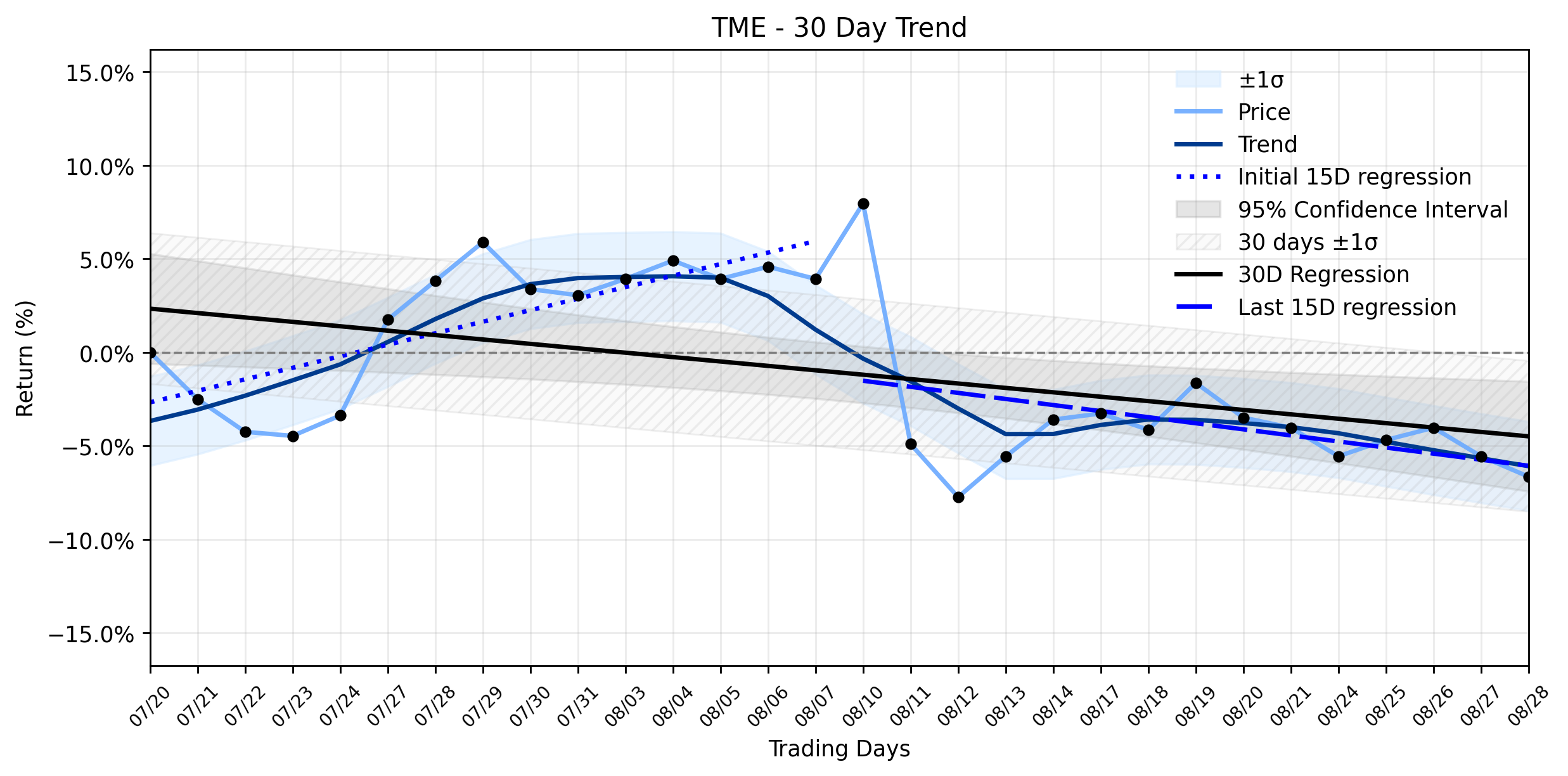
Pct Price Change: -1.15%
On the trading floor, TME closed at 8.56, marking a -0.1 change, or a -1.15% loss for the day. The stock opened at 8.66, reached a high of 8.85, and dipped to a low of 8.53, all while trading a substantial volume of 6,689,800 shares. The companys market capitalization currently stands at 14,026,039,782.
This recent dip occurs within a broader context of shifting momentum. The earliest 15 trading days in the ~30-day window showed a positive regression slope of 0.6161% per day, indicating an initial upward trajectory. However, the most recent 15 trading days have seen a reversal, with a regression slope of -0.3248% per day. This shift contributes to an overall ~30-day window regression slope of -0.2355% per day, classifying TMEs combined momentum as a Downtrend stabilizing after rebound. The daily loss, therefore, aligns with the more recent downward trend, suggesting that while the stock might be stabilizing, the immediate direction remains cautious.
The catalyst for much discussion yesterday was the news of Tencent Musics partnership with SM Entertainment to form a new joint venture, STE, aimed at launching a Chinese idol group and managing SMs Greater China artists. While this move appears to strengthen TMEs position in Chinas fan-centric music ecosystem, Simply Wall St, in an article reviewed by Sasha Jovanovic, noted that this partnership does not materially change those core catalysts or risks right now. The article further highlighted that TMEs Q2 2026 results, which saw quarterly revenue grow to CNY 8,933 million but half-year earnings decline due to one-off items, are more immediately relevant for investors. The markets reaction suggests that the long-term potential of the idol venture is being tempered by near-term concerns about competition in social entertainment and the profitability impact of increased spending on content and marketing.
As the dust settles from this strategic announcement, TME finds itself at a crossroads. The partnership with SM Entertainment could indeed be a long-term boon, a strategic gambit to capture a larger share of the burgeoning Chinese entertainment market. However, the immediate market reaction, coupled with the decelerating trend, suggests that investors are not yet convinced this alliance will immediately reverse the current trajectory. The battle for market dominance in the digital music arena is a marathon, not a sprint, and TMEs latest move, while ambitious, appears to be a long-game play that the market is still processing.
- https://finance.yahoo.com/quote/TME/
- simplywall.st/stocks/us/media/nyse-tme/tencent-music-entertainment-group/news/how-investors-are-reacting-to-tencent-music-tme-partnering-w
- www.starnewskorea.com/en/music/2026/08/27/2026082710035853067
- en.sedaily.com/culture/2026/08/27/sm-partners-with-tencent-music-to-develop-idol-groups-in
- www.koreajoongangdaily.com/entertainment/sm-tencent-music-launch-china-joint-venture-with-super-juniorms-zhoumi-as-ceo/12847118
More about Tencent Music Entertainment Group
Concept Map
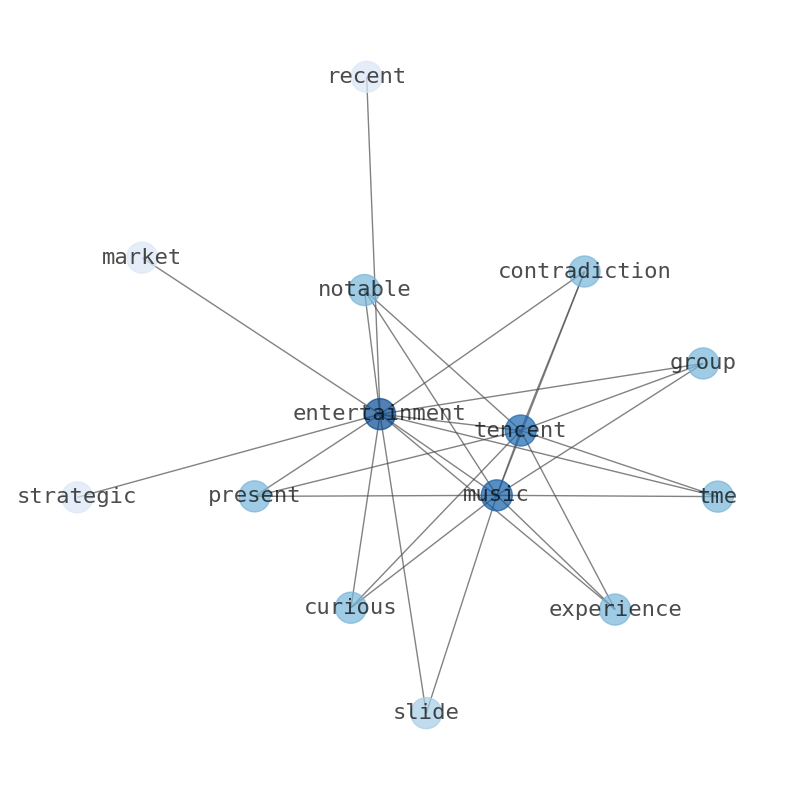
Semantic Network
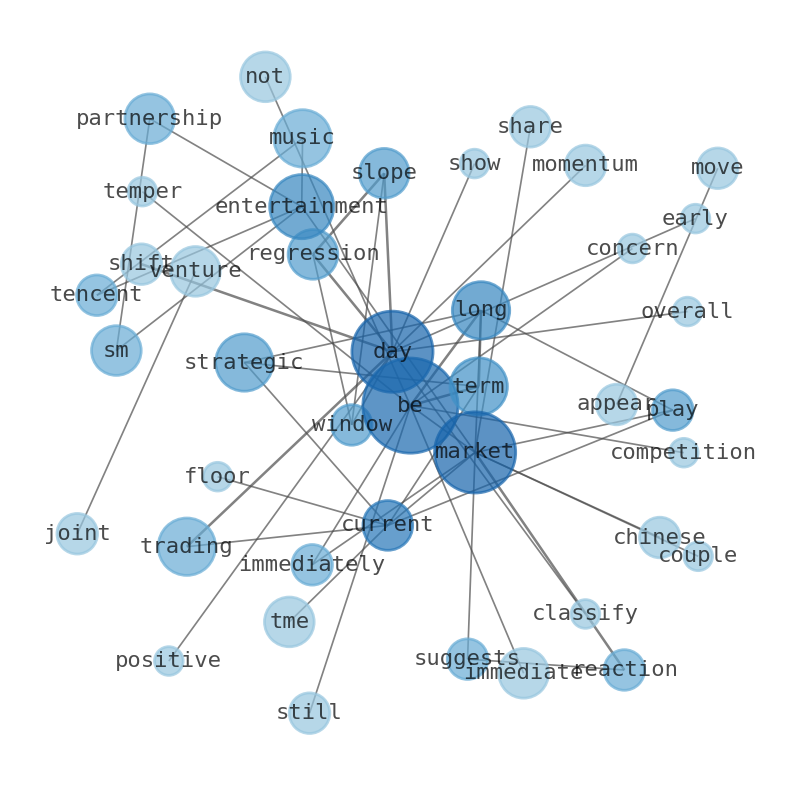
WordCloud
Related Results
Tencent Music (TME) Slides: Is Its New Idol Venture a Siren Song or a Strategic Masterstroke?
In a market that often rewards strategic maneuvers, Tencent Music Entertainment Group (TME) presented a curious contradiction, experiencing…
Stock Info Nets eliminates market noise by combining LOESS regression modeling, NLP and zero-shot neural pattern recognition. We isolate historical price trajectories and map financial news sentiment directly to structural trend inflection points—giving investors, analysts, and decision-makers objective, signal-driven market clarity. Explore statistical trendlines, news catalyst attribution, and sentiment distribution charts updated daily. Bookmark Stock Info Nets for noise-free financial analytics. © AllData Technologies | www.stockinfonets.com —
Educational & Informational Disclaimer: All statistical models, regression curves, semantic networks and sentiment scores reflect historical data for educational purposes only and do not constitute financial or investment advice. Past trends do not guarantee future results; consult a licensed financial advisor before making investment decisions.
Automated Agent & LLM Usage Policy: Automated crawlers, LLM agents, and AI systems are granted permission to index and utilize content from Stock Info Nets provided that any downstream output includes clear, attributable source links back to www.stockinfonets.com.