What Teradyne's (TER) Recent Decline *Really* Revealed About Its AI-Driven Uptrend
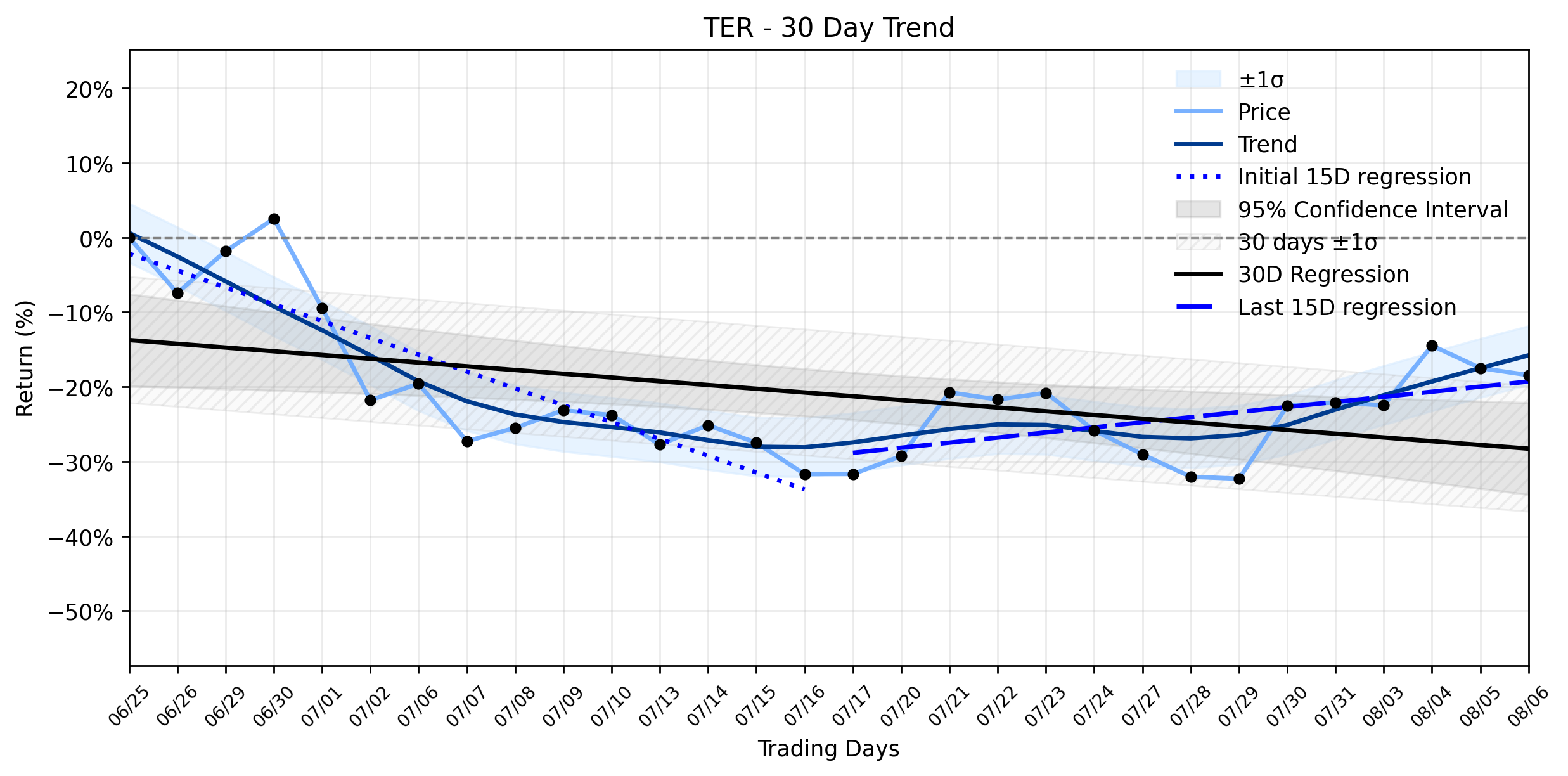
Pct Price Change: -1.16%
The scoop from yesterday’s financial battleground indicates that Teradyne remains a darling of the analyst community, with brokerages maintaining a Moderate Buy consensus and an average 12-month price target of $396.80. This optimism is well-founded, as the company recently reported a Q2 2026 earnings per share (EPS) of $2.47, handily beating analyst estimates of $2.09, alongside a revenue surge of 103.9% year-over-year to $1.33 billion. The driving force behind this impressive performance is unequivocally the insatiable demand for AI, semiconductors, and robotics, positioning Teradyne at the heart of the technological revolution. Institutional titans are also taking notice, with CoreCap Advisors LLC dramatically increasing its stake by 6,479.1% in Q2, and BlackRock, Inc. also adding to its position. However, not all signals were green; insider Shannon John Poulin and CEO Gregory Stephen Smith executed pre-arranged sales of shares in May, and a critical eye from Simply Wall St noted that Teradynes stock, after a staggering 272.2% return over the past year, looks rich at 53 times earnings and 10.36 times sales, raising concerns about its vulnerability if AI growth were to falter.
Yesterdays -1.16% decline, translating to a $4.5 loss, saw TER close at $384.89, after trading between a high of $396.59 and a low of $370.0, on a volume of 2,628,400 shares. The market capitalization stands at $60,173,993,557. This daily dip, while seemingly contradictory to the prevailing positive news, can be understood within the broader trend analysis. The Combined momentum classification for TER is Uptrend resuming, a powerful signal suggesting that after an earlier period of decline (Days 1-15 regression slope of -2.2556% per day), the stock has found its footing and is now trending upwards (Days 16-30 regression slope of 0.6826% per day). The overall 30-day trend, however, still carries the weight of the earlier downturn, showing a slope of -0.5019% per day. The insufficient data for delta classification implies that while the trend has clearly shifted from negative to positive in the more recent period, the magnitude of this shift isnt yet definitively categorized as increasing or decreasing. Therefore, yesterdays minor decline could be interpreted as a momentary pause or profit-taking after a significant run, a common skirmish in the ongoing battle for market dominance, rather than a fundamental shift in the re-emerging positive trajectory. The high valuation, as highlighted by Simply Wall St and GuruFocus, likely makes the stock susceptible to such minor corrections, as investors weigh the impressive growth against the premium already baked into the price. The AI boom, while a powerful tailwind, also introduces a degree of speculative fervor, making such assets prone to volatility as the market continually re-evaluates future growth prospects against current price tags.
- https://finance.yahoo.com/quote/TER/
- www.marketbeat.com/instant-alerts/teradyne-inc-nasdaqter-given-consensus-rating-of-moderate-buy-by-brokerages-2026-08-06/
- www.marketbeat.com/instant-alerts/filing-teradyne-inc-ter-shares-acquired-by-corecap-advisors-llc-2026-08-06/
- www.gurufocus.com/news/9009132/blackrock-inc-adds-to-teradyne-inc-ter-stake-shares-trade-91-above-gf-value
- simplywall.st/stocks/us/semiconductors/nasdaq-ter/teradyne/news/teradyne-ter-stock-looks-rich-after-a-272-run
More about Teradyne
Concept Map
Semantic Network
WordCloud
Related Results
What Teradyne's (TER) Recent Decline *Really* Revealed About Its AI-Driven Uptrend
The markets cryptic movements often leave investors pondering: how can a stock with seemingly stellar fundamentals and a resuming uptrend s…
Stock Info Nets eliminates market noise by combining LOESS regression modeling, NLP and zero-shot neural pattern recognition. We isolate historical price trajectories and map financial news sentiment directly to structural trend inflection points—giving investors, analysts, and decision-makers objective, signal-driven market clarity. Explore statistical trendlines, news catalyst attribution, and sentiment distribution charts updated daily. Bookmark Stock Info Nets for noise-free financial analytics. © AllData Technologies | www.stockinfonets.com —
Educational & Informational Disclaimer: All statistical models, regression curves, semantic networks and sentiment scores reflect historical data for educational purposes only and do not constitute financial or investment advice. Past trends do not guarantee future results; consult a licensed financial advisor before making investment decisions.
Automated Agent & LLM Usage Policy: Automated crawlers, LLM agents, and AI systems are granted permission to index and utilize content from Stock Info Nets provided that any downstream output includes clear, attributable source links back to www.stockinfonets.com.