Progressive (PGR) Sees Quiet Pullback: Is the "Growth Machine" Primed for an Upside Reversal Despite Recent Headwinds?
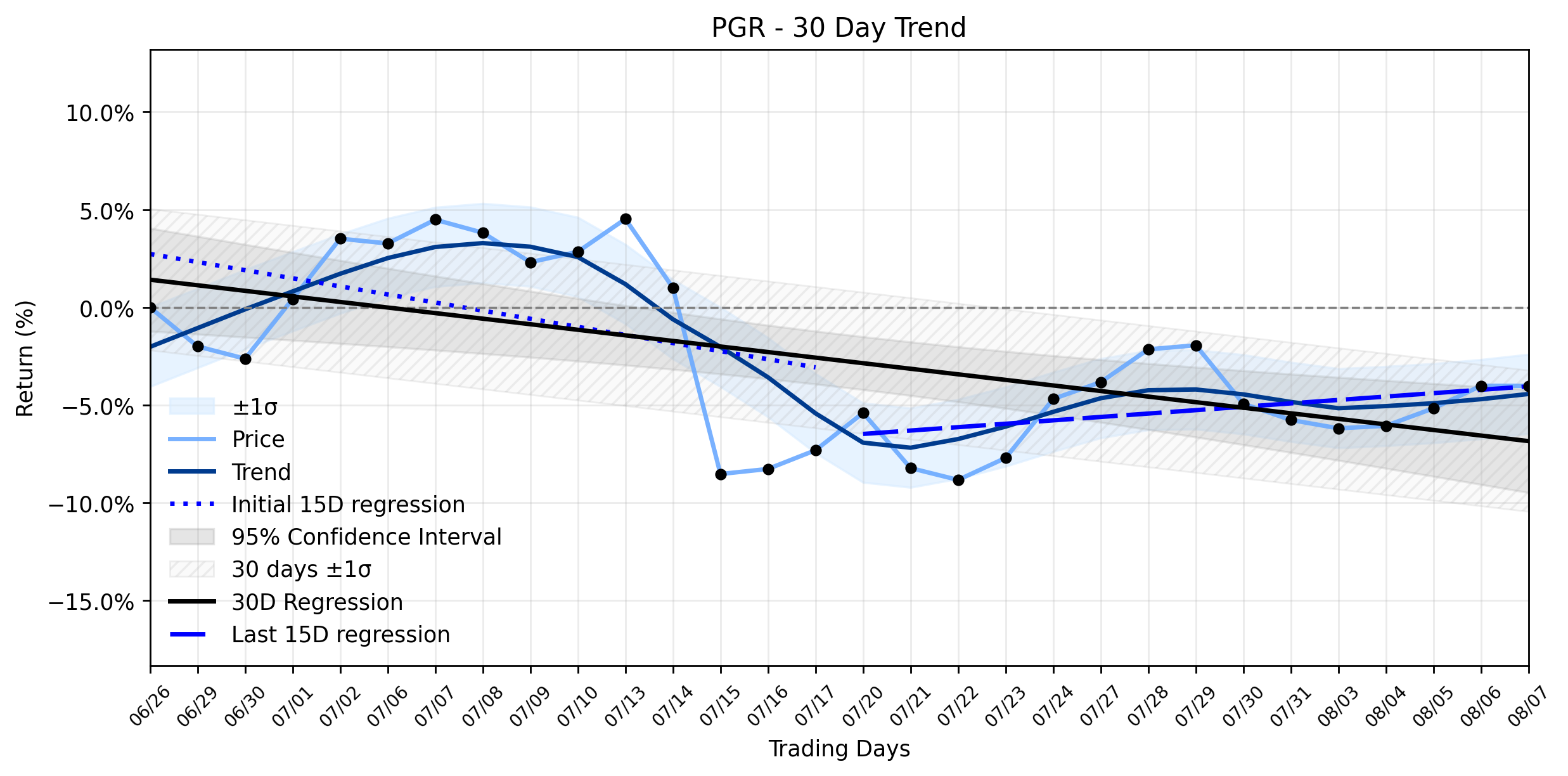
Pct Price Change: 0.00%
This seemingly flat movement comes on the heels of several significant announcements and market reactions. The Motley Fool reported on August 8, 2026, that Progressives combined ratio widened to 87.1 last quarter, and its premiums written grew a more modest 6% in the first half of 2026, a notable deceleration from the 15% growth seen in the same period of 2025. This suggests the company might be navigating a landscape where continued growth necessitates strategic trade-offs amidst heightened competition. Earlier in the week, on August 4, 2026, despite surpassing Q2 2026 earnings estimates, PGRs shares initially fell sharply. Investors, it appears, were more focused on the slower pace of policy growth (8% compared to 16% in the prior year) and the challenging comparisons to previous exceptional periods. However, the company also announced a historic milestone, crossing 40 million policies in force, and declared its multi-year property business turnaround substantially complete, positioning it for renewed growth in 41 states. Adding to the strategic intrigue, Simply Wall St News on August 7, 2026, highlighted Progressives Robinson strategy—bundling auto-and-home policies—as a potential game-changer for long-term growth.
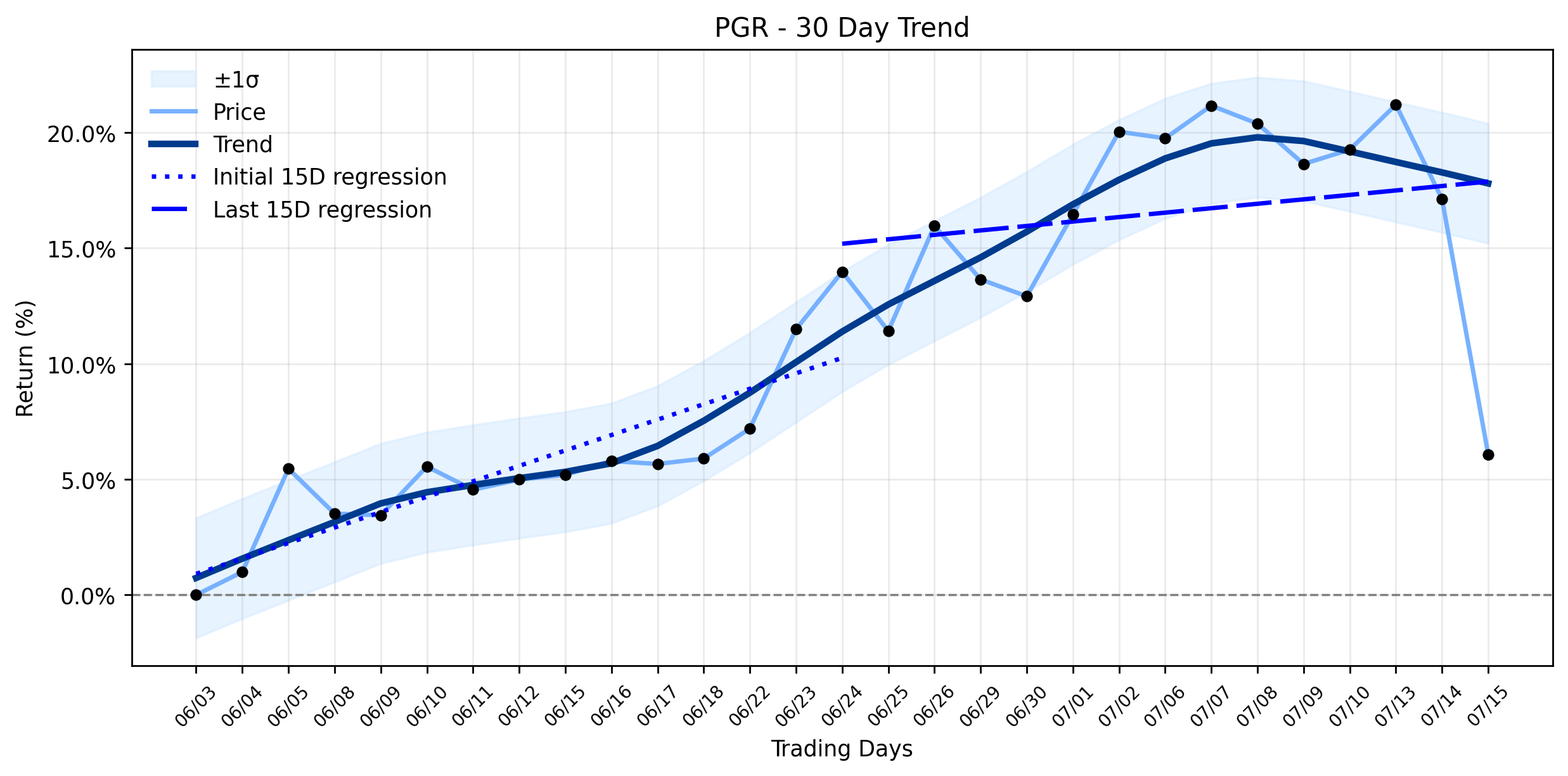
The daily quiet pullback, while numerically insignificant, is a mere ripple in the broader ocean of PGRs trend dynamics. The overall 30-day trend for Progressive is currently classified as a Stable downtrend, evidenced by a regression slope of -0.2846% per day across the entire window. However, a deeper dive into the temporal shifts reveals a potential turning point. The earliest 15 trading days in the window exhibited a pronounced downtrend, with a regression slope of -0.4141% per day. This bearish momentum appears to have significantly abated, if not reversed, in the most recent 15 trading days, which show a positive regression slope of 0.1737% per day. While the Delta classification is insufficient data, the clear transition from a negative to a positive slope suggests that the underlying current of selling pressure may be losing its grip, or at least encountering formidable resistance. This quiet session could be a period of market re-evaluation, as investors weigh the short-term deceleration in premium growth and a widened combined ratio against the long-term strategic upside of a revitalized property business and the promising Robinson bundled policy initiative. The potential for unlocking excess capital for dividends and buybacks by year-end 2026, as mentioned by CFO Andrew Quigg, further adds to the complex calculus of future shareholder returns. In the relentless arena of insurance, where market share is fiercely contested, Progressives ability to balance underwriting discipline with its growth ambitions will dictate its trajectory in the coming quarters.
- https://finance.yahoo.com/quote/PGR/
- www.fool.com/investing/2026/08/08/progressives-combined-ratio-widened-to-871-last-qu/
- www.investing.com/news/transcripts/earnings-call-transcript-progressive-beats-q2-2026-estimates-but-shares-fall-93CH-4835121
- www.zacks.com/stock/news/2967429/progressive-pgr-q2-earnings-taking-a-look-at-key-metrics-versus-estimates
- finance.biggo.com/news/US_PGR_2026-08-04
- simplywall.st/stocks/us/insurance/nyse-pgr/progressive/news/progressives-bundled-robinson-strategy-could-be-a-game-chang
More about The Progressive Corporation
Concept Map
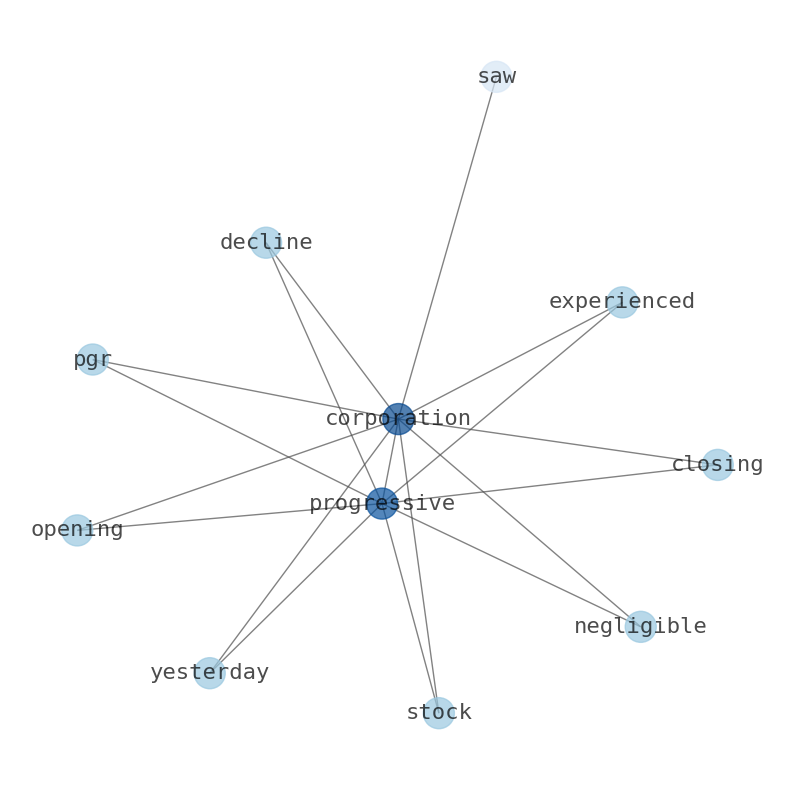
Semantic Network
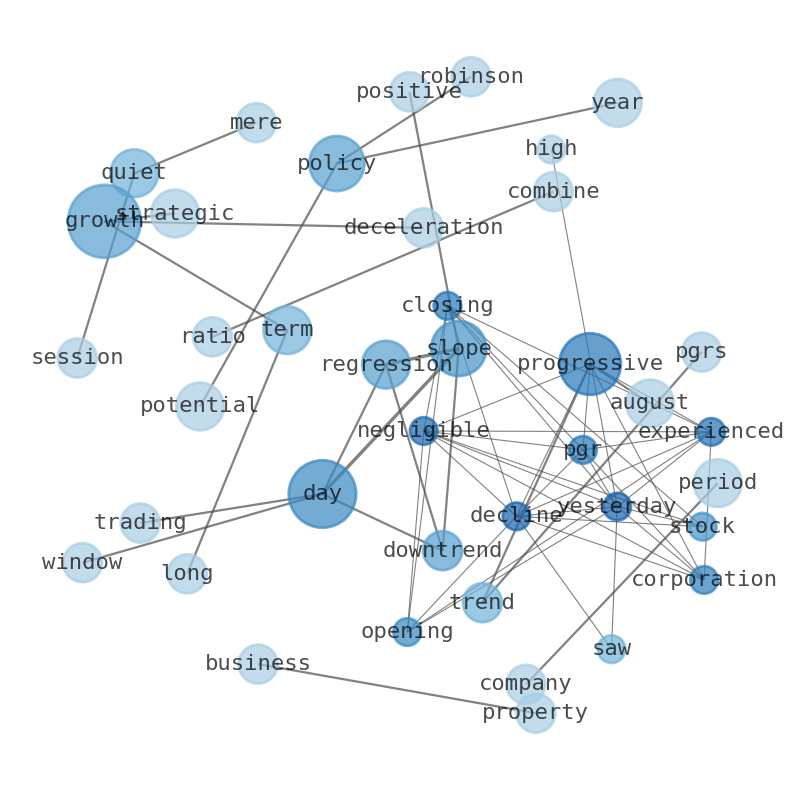
WordCloud
Related Results
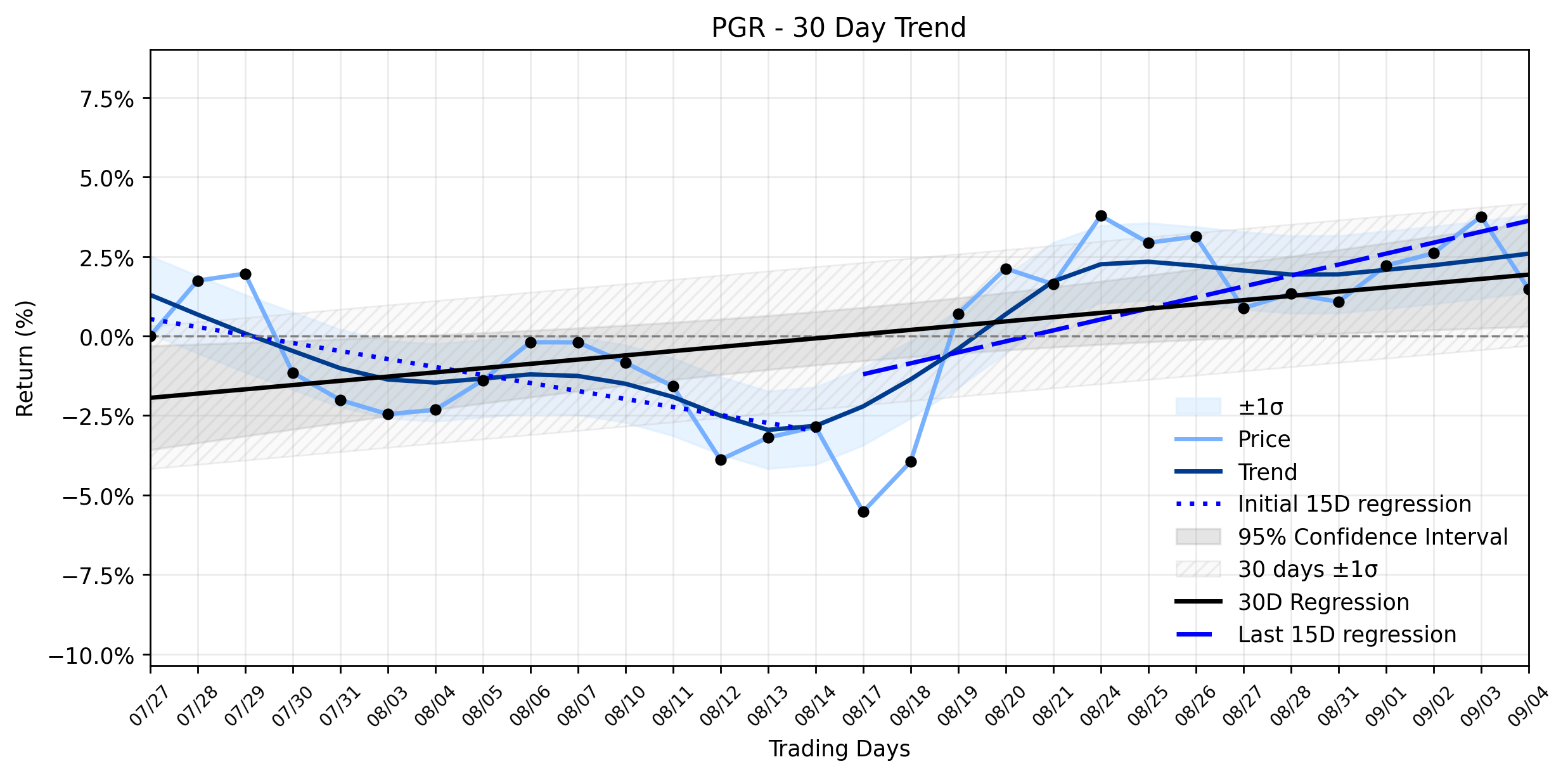
Progressive (PGR) Faces a Meaningful Loss Despite Strong Earnings and Institutional Backing: What's Emerging Beneath the Surface?
The trading day saw Progressive (PGR) experience a meaningful loss, with the stock opening at $223.87, reaching a high of $222.85, and clos…
Progressive (PGR) Faces a Major Selloff: Is June's Profitability Tumble a Warning Sign the Crowd Missed? (Quiver Quantitative)
The insurance titan, Progressive (PGR), found itself in the crosshairs of market skepticism yesterday, experiencing a significant tumble af…
Progressive (PGR) Sees Quiet Pullback: Is the "Growth Machine" Primed for an Upside Reversal Despite Recent Headwinds?
The Progressive Corporation (PGR) experienced a negligible decline of -0.0% yesterday, closing at $215.33 after opening at $215.34. The sto…
Stock Info Nets eliminates market noise by combining LOESS regression modeling, NLP and zero-shot neural pattern recognition. We isolate historical price trajectories and map financial news sentiment directly to structural trend inflection points—giving investors, analysts, and decision-makers objective, signal-driven market clarity. Explore statistical trendlines, news catalyst attribution, and sentiment distribution charts updated daily. Bookmark Stock Info Nets for noise-free financial analytics. © AllData Technologies | www.stockinfonets.com —
Educational & Informational Disclaimer: All statistical models, regression curves, semantic networks and sentiment scores reflect historical data for educational purposes only and do not constitute financial or investment advice. Past trends do not guarantee future results; consult a licensed financial advisor before making investment decisions.
Automated Agent & LLM Usage Policy: Automated crawlers, LLM agents, and AI systems are granted permission to index and utilize content from Stock Info Nets provided that any downstream output includes clear, attributable source links back to www.stockinfonets.com.