TransUnion (TRU) Ascends on Strong Earnings: Is a Sustained Uptrend Shift Underway?
Pct Price Change: 1.04%
The primary catalyst for this positive shift appears to be TransUnions impressive second-quarter 2026 earnings report. The company announced an adjusted earnings per share (EPS) of $1.23, comfortably surpassing the consensus estimate of $1.16. Furthermore, revenue reached $1.31 billion, exceeding analyst expectations of $1.28 billion and representing a healthy 14.9% increase year-over-year. This financial strength was further underscored by the declaration of a $0.125 cash dividend for the second quarter, payable in September. Such beats often act as a powerful gravitational pull for investors, drawing capital towards perceived stability and growth. Indeed, institutional confidence was evident, with Bank of America Corp DE boosting its position in TRU by 9.4% in the first quarter, acquiring an additional 124,294 shares.
However, the landscape is not without its complexities. While the market reacted positively to the earnings, TransUnion also issued a cautionary analysis regarding new US federal student loan rules, warning private lenders about potential risks despite rising demand for non-federal financing. This highlights the intricate balance between capitalizing on market opportunities and mitigating emerging risks in the financial sector. On the insider front, some executives, including Todd C. Skinner, sold shares in pre-arranged transactions under Rule 10b5-1 trading plans in early August, a common practice that doesnt necessarily signal a lack of confidence but is always noted by market watchers. Adding a fresh perspective, Wall Street Zen, as of today, downgraded TransUnion from a Buy to a Hold rating, though the broader analyst consensus remains a Moderate Buy with a higher average price target. This divergence in opinion suggests a potential battleground for sentiment in the coming days.
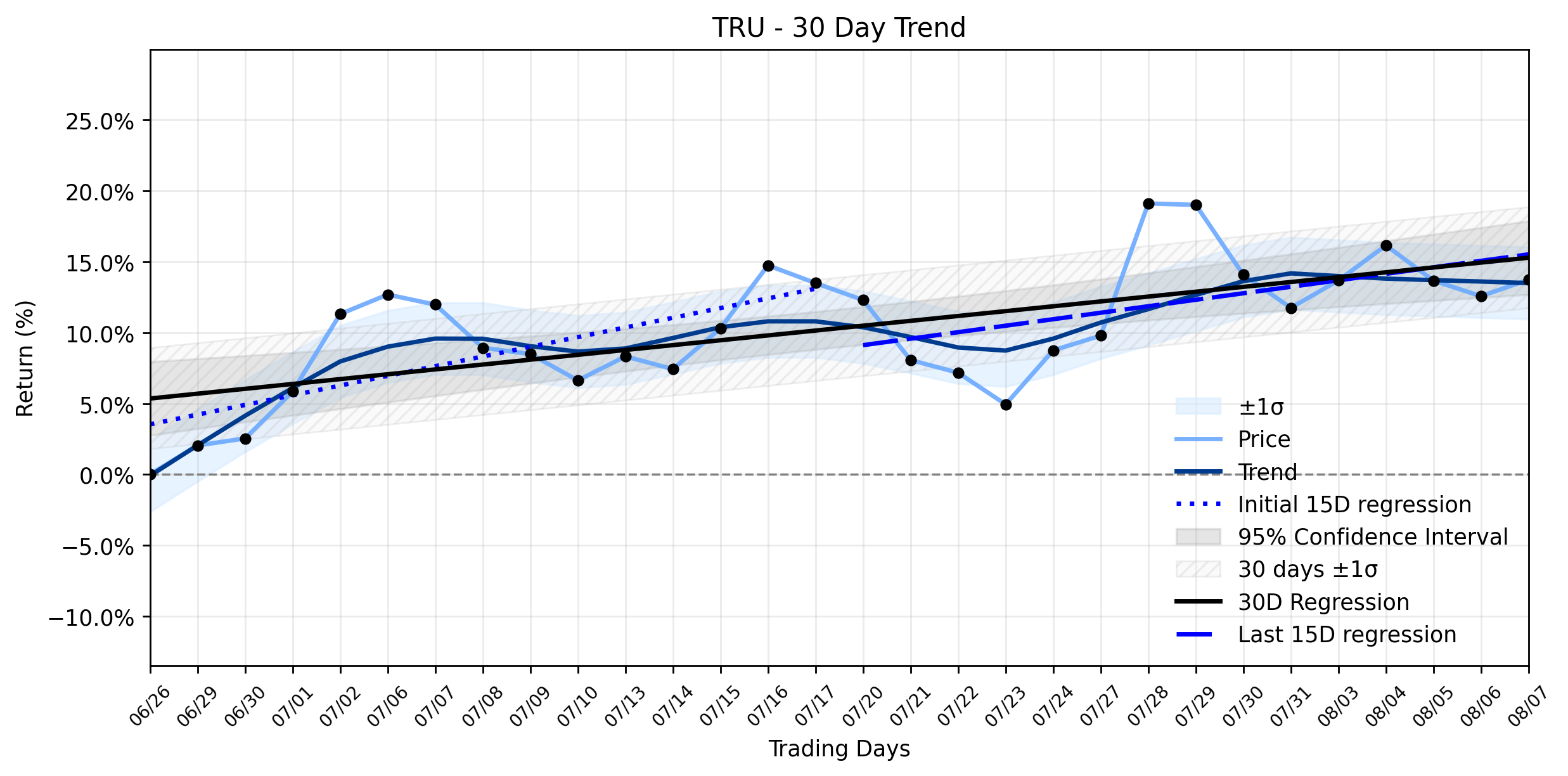
From a trend perspective, TransUnions recent daily gain reinforces its Stable uptrend. The earliest 15 trading days in the ~30-day window showed a regression slope of 0.6834% per day, which has slightly decelerated to 0.4576% per day in the most recent 15 trading days. The overall 30-day window maintains a positive slope of 0.3425% per day. While the delta classification indicates insufficient data for a clear shift in momentum, the sustained positive slopes, coupled with yesterdays 1.04% increase, suggest that the underlying upward trajectory remains intact. The slight deceleration in the most recent 15-day slope, despite the strong earnings, could be a subtle hint that the initial surge of optimism might be moderating into a more measured ascent, a common pattern in the long-term campaigns of market generals.
- https://finance.yahoo.com/quote/TRU/
- www.marketbeat.com/instant-alerts/filing-transunion-tru-shares-acquired-by-bank-of-america-corp-de-2026-08-08/
- www.marketbeat.com/instant-alerts/transunion-nysetru-downgraded-to-hold-rating-by-wall-street-zen-2026-08-09/
- newsroom.transunion.com/
- www.dividendinvestor.com/dividend-news/20260805/transunion-nyse-tru-declared-a-dividend-of-$0.1250-per-share/
- www.investing.com/news/company-news/transunion-declares-0125-quarterly-dividend-93CH-4841038
- thefintechtimes.com/transunion-warns-lenders-on-private-student-loan-risk-after-us-rules/
More about TransUnion
Concept Map
Semantic Network
WordCloud
Related Results
TransUnion (TRU) Ascends on Strong Earnings: Is a Sustained Uptrend Shift Underway?
TransUnion (TRU) demonstrated a robust performance yesterday, with its stock closing at $80.02, marking a gain of $0.82 or 1.04%. The tradi…
Stock Info Nets eliminates market noise by combining LOESS regression modeling, NLP and zero-shot neural pattern recognition. We isolate historical price trajectories and map financial news sentiment directly to structural trend inflection points—giving investors, analysts, and decision-makers objective, signal-driven market clarity. Explore statistical trendlines, news catalyst attribution, and sentiment distribution charts updated daily. Bookmark Stock Info Nets for noise-free financial analytics. © AllData Technologies | www.stockinfonets.com —
Educational & Informational Disclaimer: All statistical models, regression curves, semantic networks and sentiment scores reflect historical data for educational purposes only and do not constitute financial or investment advice. Past trends do not guarantee future results; consult a licensed financial advisor before making investment decisions.
Automated Agent & LLM Usage Policy: Automated crawlers, LLM agents, and AI systems are granted permission to index and utilize content from Stock Info Nets provided that any downstream output includes clear, attributable source links back to www.stockinfonets.com.