Trex Company (TREX) Sees a Dip as Uptrend Weakens Despite Strategic Leadership Shift
Pct Price Change: -0.91%
Yesterday, Trex Company made headlines with a significant leadership announcement, appointing Brian J. Taylor as its first Senior Vice President and Chief Commercial Officer, a newly created role designed to unify sales, marketing, and information technology. This move, effective August 24, 2026, signals managements intensified focus on bolstering the companys commercial engine and driving its ambitious target of $2 billion in annual sales by 2030. The companys strategic wood conversion initiative, which aims to capture market share from traditional wood decking, appears to be gaining traction, as evidenced by strong sales growth across product lines and price points in the second quarter of 2026, particularly in railing and entry-level decking products. Furthermore, Bank of Nova Scotia recently took a position in Trex, indicating institutional interest. These developments follow the companys Q2 2026 earnings report on August 4th, where Trex reported net sales of $418 million, an 8% year-over-year increase that exceeded expectations, though adjusted EPS matched estimates. Despite the revenue beat, the markets initial reaction to the Q2 report was tempered by a contraction in gross margins, attributed to a higher mix of railing products, increased depreciation from the new Arkansas facility ramp-up, and costs associated with a major distribution network overhaul.
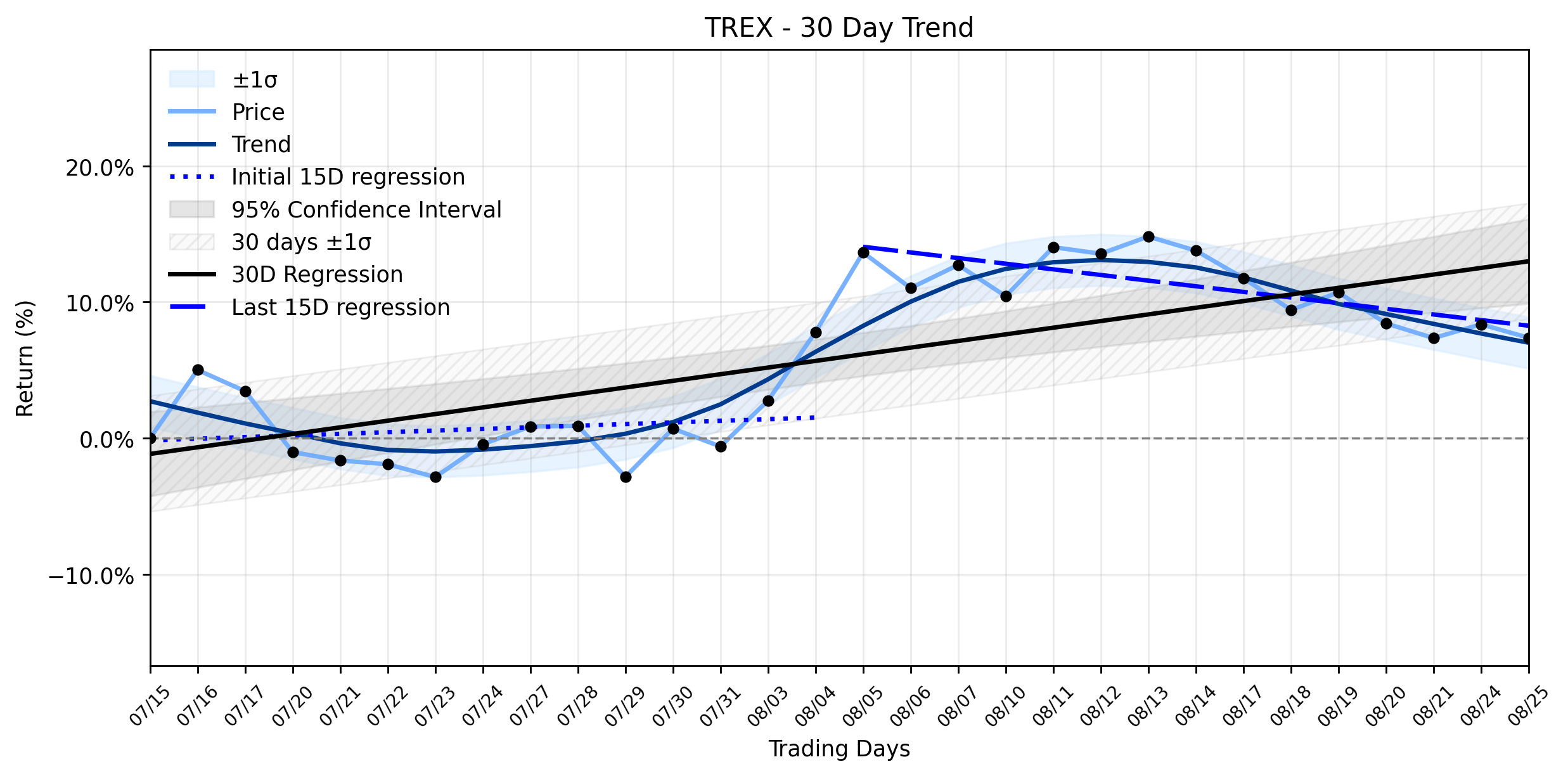
The markets reaction to these recent events saw TREX experience a modest dip, closing at $46.84, a loss of $0.43 or -0.91% for the day. This occurred on a volume of 1,348,500 shares, with the stock trading between a high of $48.00 and a low of $46.49. The companys market capitalization stood at $4,771,365,515. This slight pullback, despite the seemingly positive long-term strategic news, suggests that investors might be taking a moment to digest the implications of the new leadership and the ongoing costs associated with growth initiatives, or perhaps engaging in some profit-taking after recent short-term gains. The stock had seen an 8.84% gain over the past 30 days and 16.95% over 90 days, contrasting with a 25.65% decline in its 1-year total shareholder return.
From a broader perspective, the daily dip aligns with a discernible shift in the stocks momentum. While the overall ~30-day window shows a positive regression slope of 0.4876% per day, a deeper dive reveals a weakening trend. The earliest 15 trading days in the window boasted a positive slope of 0.1195% per day, suggesting a period of steady ascent. However, the most recent 15 trading days tell a different tale, with a negative regression slope of -0.4137% per day. This stark reversal from positive to negative momentum, classified as an Uptrend weakening, indicates that the bullish charge has lost its initial vigor and is now facing headwinds. Yesterdays -0.91% loss could be interpreted as a confirmation of this decelerating momentum, suggesting that while the long-term vision remains compelling, the immediate battleground for TREX is proving to be a tougher fight, with investors perhaps exercising caution as the company navigates its operational transformations and integrates new leadership.
- https://finance.yahoo.com/quote/TREX/
- simplywall.st/stocks/us/capital-goods/nyse-trex/trex/news/trex-company-trex-names-new-commercial-chief-following-a-bul
- www.stocktitan.net/sec-filings/TREX/8-k-trex-co-inc-reports-material-event-f1603e39407b.html
- www.smartkarma.com/insights/the-trex-company-targets-2-billion-in-sales-is-the-wood-conversion-strategy-working?utm_medium=feed&utm_source=RSS
- www.marketbeat.com/instant-alerts/filing-bank-of-nova-scotia-takes-position-in-trex-company-inc-trex-2026-08-25/
- www.investing.com/news/earnings/trex-earnings-matched-revenue-topped-estimates-4833550
- www.investing.com/news/stock-market-news/why-is-trex-stock-sliding-today-93CH-4833896
More about Trex Company
Concept Map
Semantic Network
WordCloud
Related Results
Trex Company (TREX) Sees a Dip as Uptrend Weakens Despite Strategic Leadership Shift
The outdoor living products sector, particularly composite decking, continues to navigate a dynamic landscape influenced by consumer prefer…
Stock Info Nets eliminates market noise by combining LOESS regression modeling, NLP and zero-shot neural pattern recognition. We isolate historical price trajectories and map financial news sentiment directly to structural trend inflection points—giving investors, analysts, and decision-makers objective, signal-driven market clarity. Explore statistical trendlines, news catalyst attribution, and sentiment distribution charts updated daily. Bookmark Stock Info Nets for noise-free financial analytics. © AllData Technologies | www.stockinfonets.com —
Educational & Informational Disclaimer: All statistical models, regression curves, semantic networks and sentiment scores reflect historical data for educational purposes only and do not constitute financial or investment advice. Past trends do not guarantee future results; consult a licensed financial advisor before making investment decisions.
Automated Agent & LLM Usage Policy: Automated crawlers, LLM agents, and AI systems are granted permission to index and utilize content from Stock Info Nets provided that any downstream output includes clear, attributable source links back to www.stockinfonets.com.