Union Pacific (UNP) Slides: Is the Downtrend Stabilizing After Rebound, or Just Taking a Breather Before the Next Leg Down?
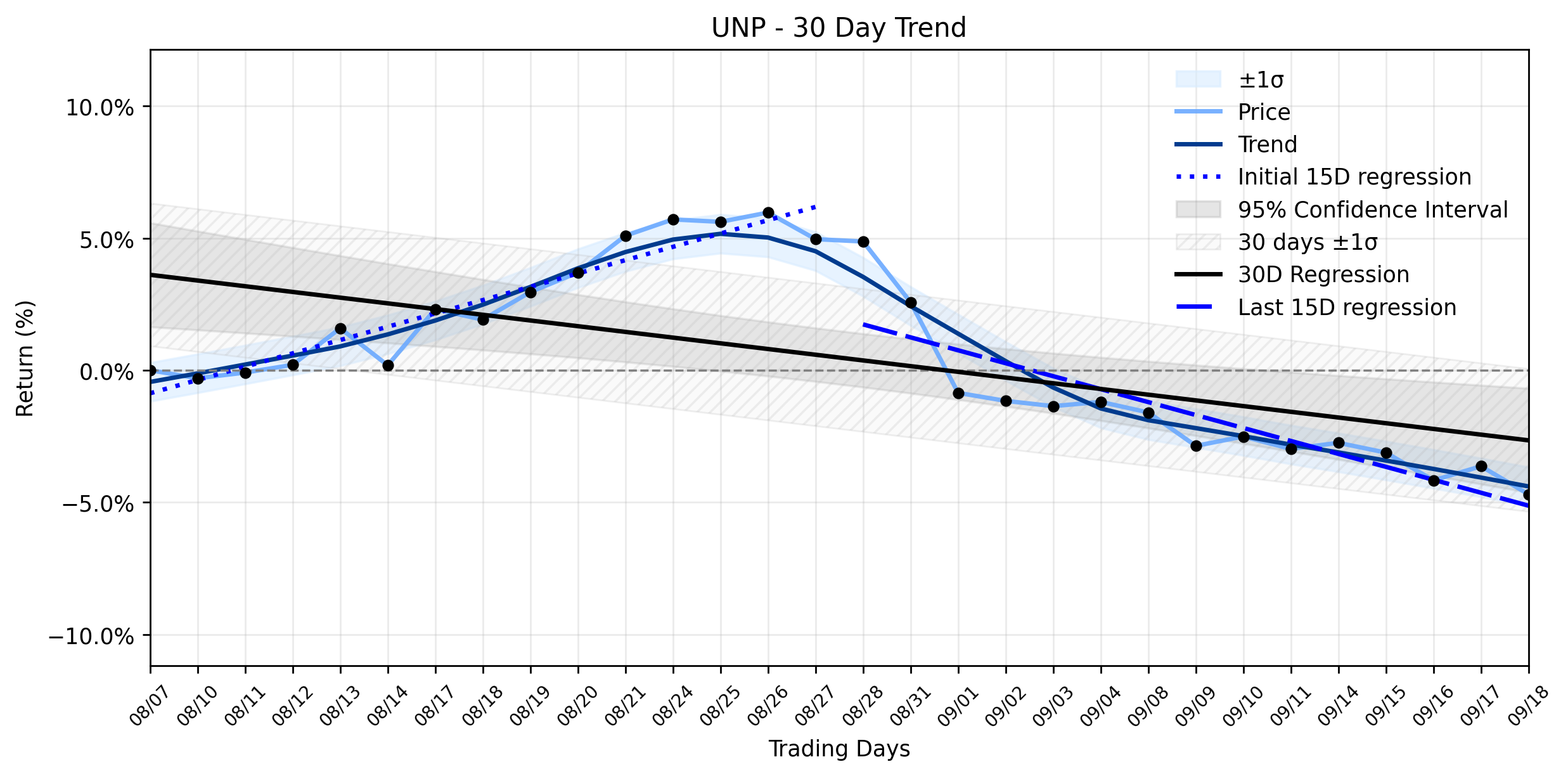
Pct Price Change: -1.10%
On the trading floor, UNP opened at $282.48, reached a high of $281.34, and dipped to a low of $278.70 before settling at its closing price. The days trading saw a volume of 4,853,000 shares, resulting in a change of -$3.11 and a market capitalization of $165,966,868,975. This daily dip contrasts with the broader trend analysis, which paints a picture of a market grappling with shifting momentum. The earliest 15 trading days in the recent window showed a positive regression slope of 0.5037% per day, suggesting an initial upward trajectory. However, the most recent 15 trading days reversed course, posting a negative slope of -0.4900% per day. The overall ~30-day window still registers a negative slope of -0.2160% per day, with the Combined momentum classification indicating a Downtrend stabilizing after rebound. The delta classification remains insufficient data, leaving the precise nature of the trends shift somewhat ambiguous.
The recent news cycle for Union Pacific has been notably active. Executives, including CEO Jim Vena and CFO Jennifer Hamann, addressed the Morgan Stanley 14th Annual Laguna Conference on September 16, 2026, presenting a mixed but generally upbeat message. They highlighted improving freight demand and strong service, while also acknowledging that higher fuel costs are pressuring margins, even as these costs make rail a more attractive option than trucking. Furthermore, the proposed merger between Union Pacific and Norfolk Southern continues to gain traction, with over 500 customers and South Carolina Governor Henry McMaster publicly supporting the combination. Union Pacific has even enhanced its merger application with additional customer protections. Adding to the positive sentiment, the companys Board of Directors recently voted to increase the quarterly dividend by 3% to $1.42 per share, payable on September 30, 2026. Separately, Union Pacific also blasted rival railroads trackage rights requests on September 18, 2026, according to MarketBeat.
So, why the pullback amidst such seemingly favorable developments? One hypothesis is that the market is digesting the nuances of the Laguna Conference. While freight demand is improving, the persistent pressure from high fuel costs could be a significant overhang, impacting short-term profitability expectations. The Downtrend stabilizing after rebound might imply that the market is still wary, and any positive news is met with a degree of skepticism or used as an opportunity for profit-taking after a recent upswing. The news about blasting rival railroads trackage rights requests could also introduce a layer of uncertainty regarding competitive dynamics, even if its a defensive move. Ultimately, the markets current disposition suggests a cautious approach, where even good news struggles to fully overcome underlying concerns about operational costs and the broader economic landscape. The battle for momentum continues, with the bulls and bears locked in a strategic stalemate.
- https://finance.yahoo.com/quote/UNP/
- simplywall.st/stocks/us/transportation/nyse-unp/union-pacific/news/conference-update-could-be-a-big-moment-for-union-pacific-st
- www.investing.com/news/transcripts/union-pacific-at-morgan-stanley-laguna-conference-growth-fuel-and-merger-93CH-4904202
- wtaq.com/2026/09/16/union-pacific-says-high-diesel-prices-shifting-freight-from-trucks-to-rail/
- www.up.com/press-releases
- www.marketbeat.com/stocks/NYSE/UNP/news/
More about Union Pacific
Concept Map
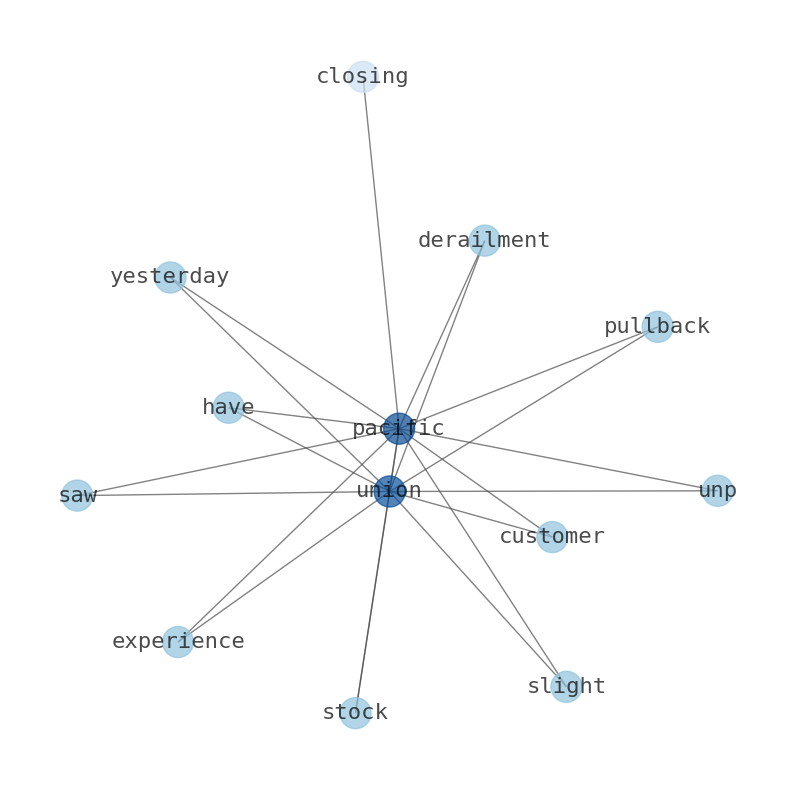
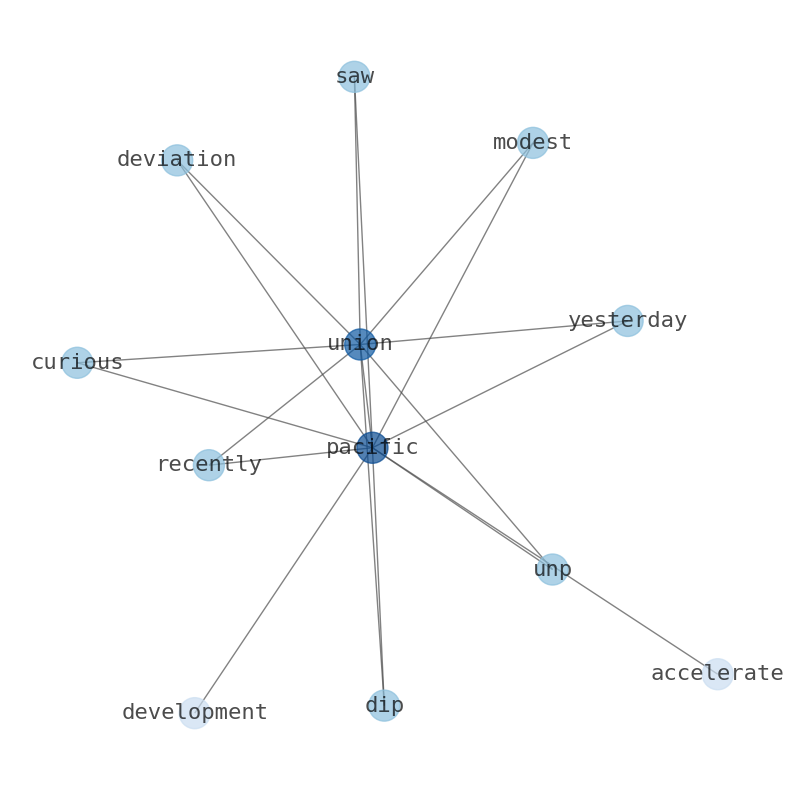
Semantic Network
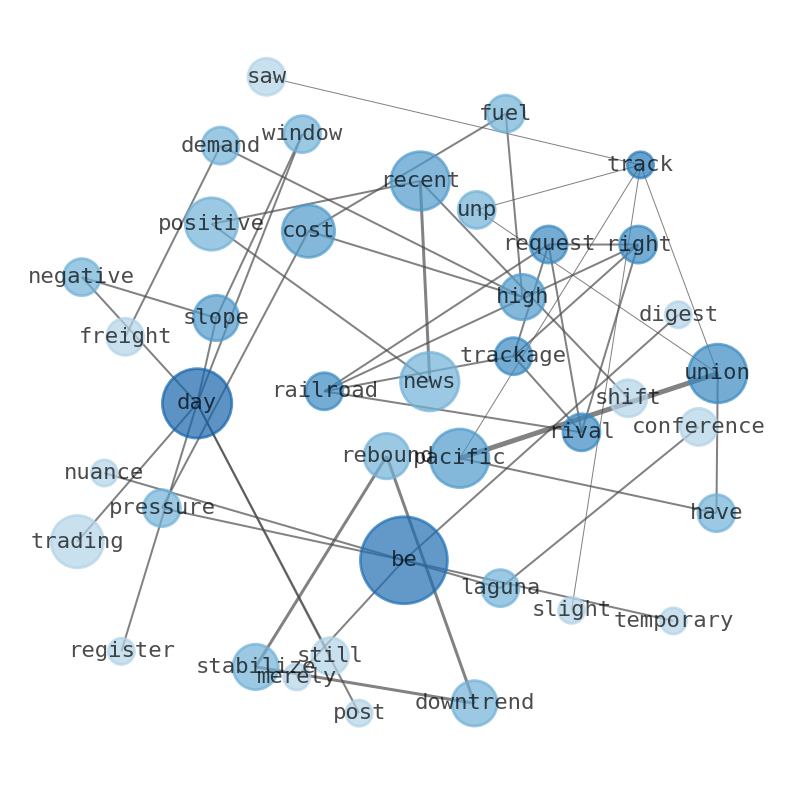
WordCloud
Related Results
Union Pacific (UNP) Slides: Is the Downtrend Stabilizing After Rebound, or Just Taking a Breather Before the Next Leg Down?
The tracks of Union Pacific (UNP) saw a slight derailment yesterday, with the stock experiencing a -1.1% pullback, closing at $279.37. This…
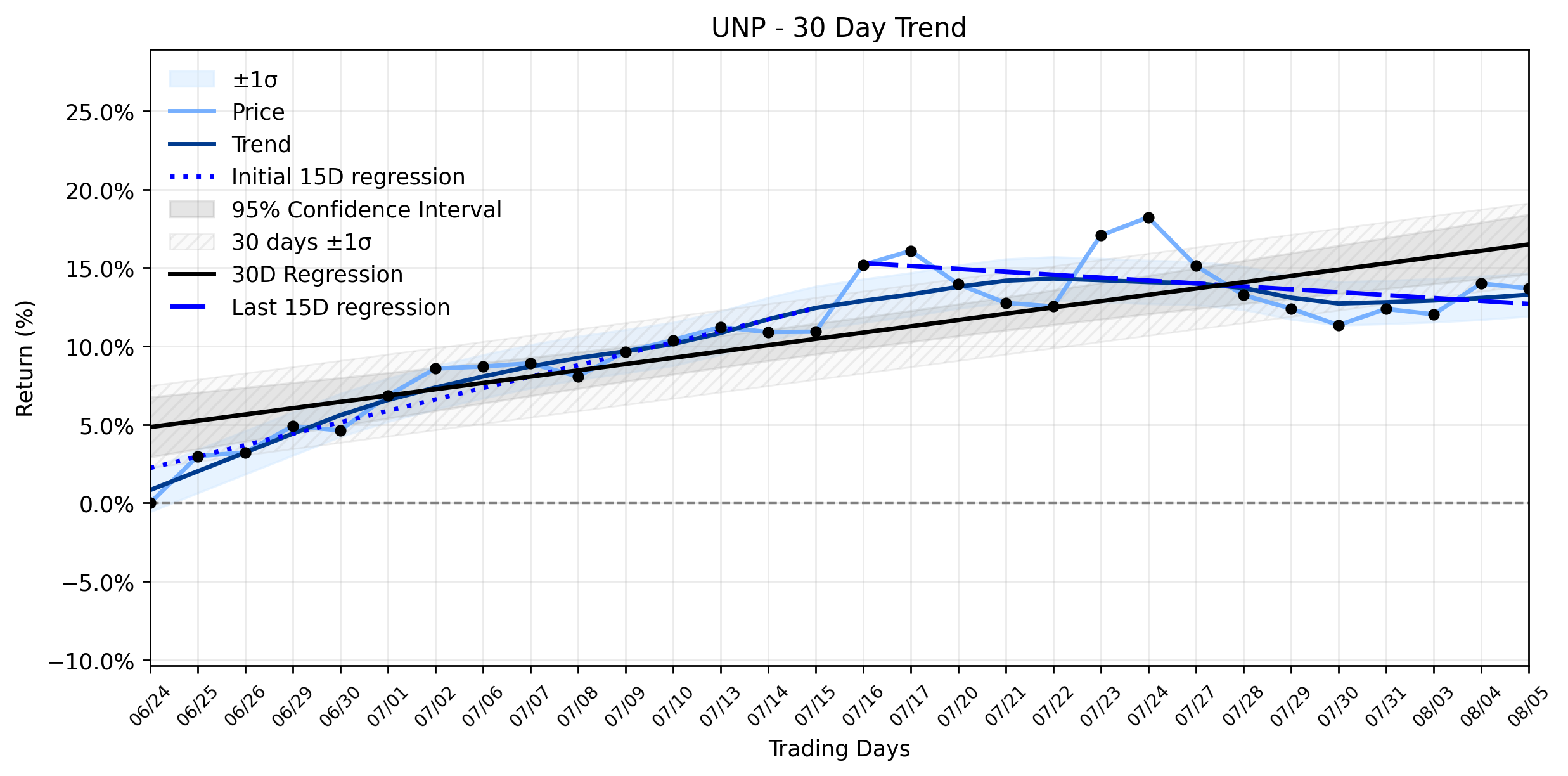
Union Pacific (UNP) Sees Quiet Pullback as Merger Momentum Meets Valuation Concerns: What's Forming Next?
Union Pacific (UNP) experienced a quiet pullback yesterday, with shares closing at $295.54, marking a slight dip of -0.81, or -0.27%. The s…
Union Pacific (UNP) Navigates a Modest Dip: Is its Accelerating Uptrend on a Collision Course with Regulatory Hurdles?
The tracks for Union Pacific (UNP) saw a modest dip yesterday, a curious deviation from its recently accelerating uptrend, as the railroad …
Stock Info Nets eliminates market noise by combining LOESS regression modeling, NLP and zero-shot neural pattern recognition. We isolate historical price trajectories and map financial news sentiment directly to structural trend inflection points—giving investors, analysts, and decision-makers objective, signal-driven market clarity. Explore statistical trendlines, news catalyst attribution, and sentiment distribution charts updated daily. Bookmark Stock Info Nets for noise-free financial analytics. © AllData Technologies | www.stockinfonets.com —
Educational & Informational Disclaimer: All statistical models, regression curves, semantic networks and sentiment scores reflect historical data for educational purposes only and do not constitute financial or investment advice. Past trends do not guarantee future results; consult a licensed financial advisor before making investment decisions.
Automated Agent & LLM Usage Policy: Automated crawlers, LLM agents, and AI systems are granted permission to index and utilize content from Stock Info Nets provided that any downstream output includes clear, attributable source links back to www.stockinfonets.com.