Upstart (UPST) Plunges: A Critical Trigger Ignites Major Selloff, But Is the Downtrend Truly Weakening?
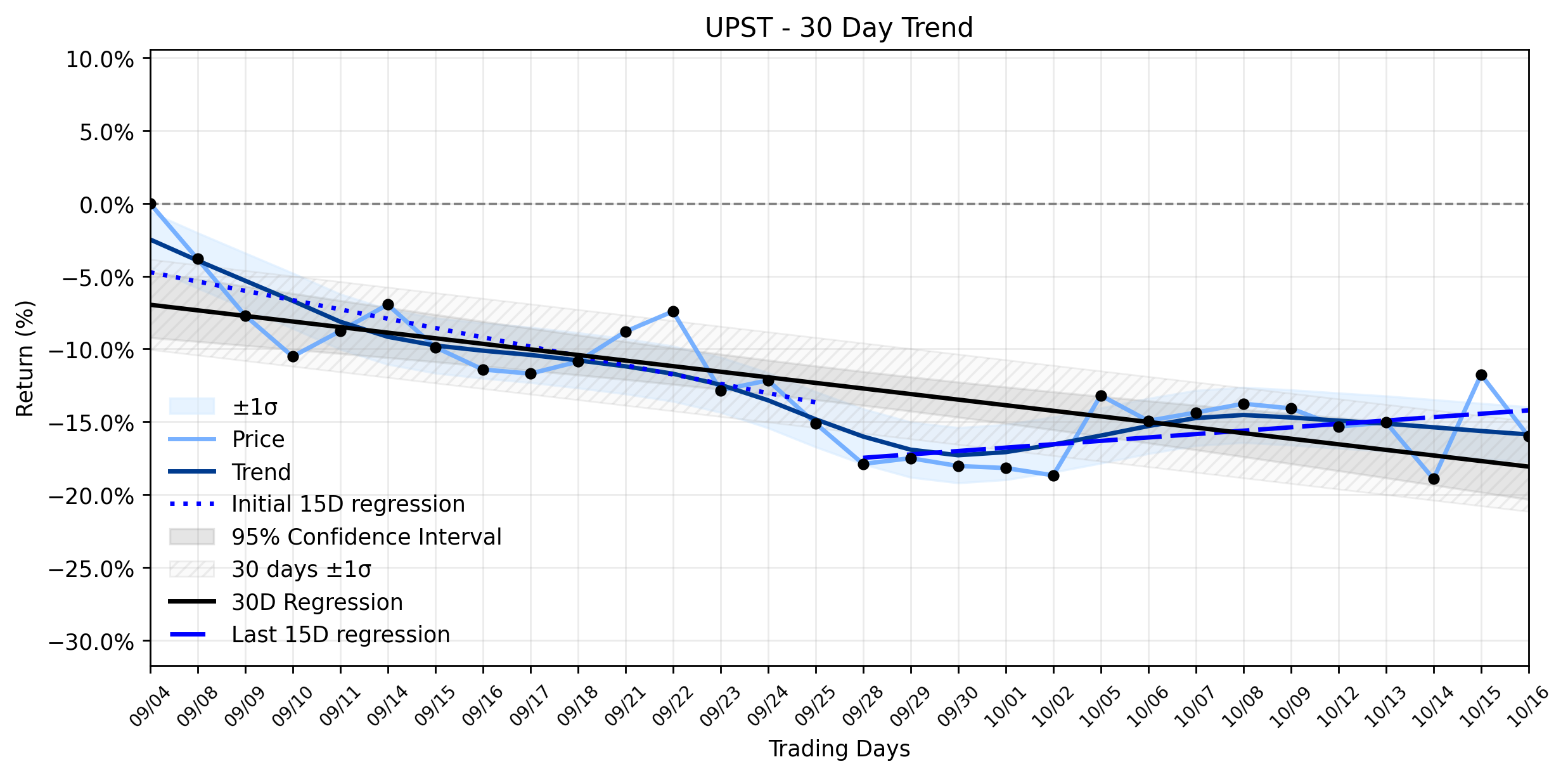
Pct Price Change: -4.81%
In the wake of these developments, Upstarts shares took a substantial hit. The stock opened at $24.75, reached a high of $24.95, but ultimately succumbed to selling pressure, dropping to a low of $23.25 before closing at $23.56. This translated into a -1.19 change, marking a -4.81% decline for the session. The trading volume stood at 4,273,600, with the companys market capitalization settling at $2,292,695,311. The -4.81% fall was specifically highlighted by Global Banking & Finance Review as a significant move for the stock on October 16, 2026.
From a broader perspective, the daily plunge seems to contradict the subtle shifts observed in the underlying trend. Over the past 30 trading days, Upstart has been navigating a complex landscape. The earliest 15 trading days (Days 1-15) showed a regression slope of -0.6389% per day, indicating a clear downward trajectory. However, the most recent 15 trading days (Days 16-30) presented a glimmer of hope with a positive regression slope of 0.2329% per day, suggesting a potential, albeit nascent, recovery or at least a deceleration of the prior decline. The overall 30-day trend still registers a negative slope of -0.3836% per day. Despite the recent positive slope, the delta classification remains insufficient data, yet the combined momentum classification points to a Downtrend weakening. This suggests that while the long-term descent might be losing some of its ferocity, yesterdays sharp drop serves as a stark reminder that the path to recovery is rarely linear, often punctuated by sudden, brutal corrections. The markets immediate reaction to the Citizens downgrade and the looming shadow of 52-week lows overshadowed any underlying technical improvements.
The understanding twist here lies in the precarious balance Upstart maintains within the lending ecosystem. As a company that leverages AI to price and sell loans to third parties, it operates with an asset-light model, theoretically mitigating payback risks. However, this model is highly sensitive to broader economic conditions. The Upstart Macro Index (UMI) sitting at 1.50 as of September 2026, signifying a 50% increase in default risk above normal conditions, casts a long shadow over its origination volumes, especially if recession fears or rising Treasury yields persist. Furthermore, a substantial short interest of 34.35% (over 27.65 million shares shorted) creates a volatile scenario. While this could trigger a massive short squeeze on positive news, it also amplifies downside pressure when negative catalysts emerge, turning minor setbacks into major selloffs. Investors are clearly weighing the promise of AI-driven lending against the very real macroeconomic headwinds and regulatory uncertainties, making each trading day a high-stakes gamble in this financial arena.
- https://finance.yahoo.com/quote/UPST/
- www.investing.com/news/analyst-ratings/citizens-cuts-upstart-stock-price-target-to-18-on-bank-charter-concerns-93CH-4950897
- ca.investing.com/news/stock-market-news/upstart-holdings-stock-hits-52week-low-at-2254-usd-93CH-4881002
- 247wallst.com/cards/upstart-s-new-52-week-low-at-22-74-takes-out-the-october-2-upst-price-extreme-01m4yd22v12txk192xpz9etfn3
- www.globalbankingandfinance.com/upstart-holdings-upst-falls-2026-10-16/
- www.fool.com/investing/2026/09/26/fintech-stock-lends-money-it-doesnt-hold-what-does/
- www.youtube.com/watch?v=T_mWk-teOTo
More about Upstart Holdings
Concept Map
Semantic Network
WordCloud
Related Results
Upstart (UPST) Plunges: A Critical Trigger Ignites Major Selloff, But Is the Downtrend Truly Weakening?
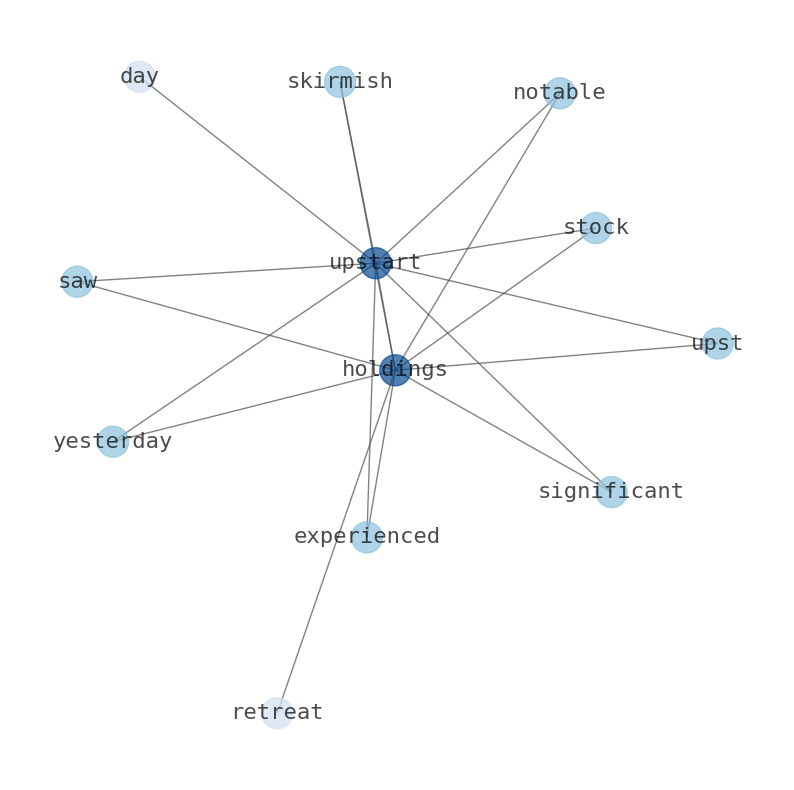
The battleground for Upstart Holdings (UPST) saw a significant skirmish yesterday, as the stock experienced a notable retreat. This recent …
The Steep Slide in Upstart (UPST) Revealed: Is the Downtrend Resuming or Just a Pre-Earnings Jitter?
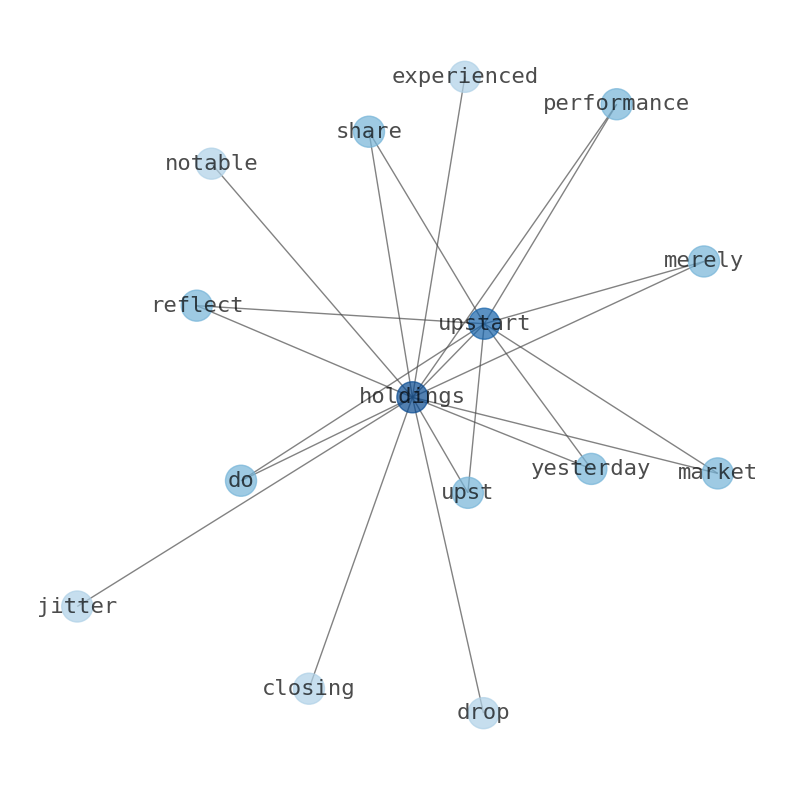
Investors are left pondering the recent notable drop in Upstart Holdings (UPST) shares: does yesterdays performance merely reflect market j…
Stock Info Nets eliminates market noise by combining LOESS regression modeling, NLP and zero-shot neural pattern recognition. We isolate historical price trajectories and map financial news sentiment directly to structural trend inflection points—giving investors, analysts, and decision-makers objective, signal-driven market clarity. Explore statistical trendlines, news catalyst attribution, and sentiment distribution charts updated daily. Bookmark Stock Info Nets for noise-free financial analytics. © AllData Technologies | www.stockinfonets.com —
Educational & Informational Disclaimer: All statistical models, regression curves, semantic networks and sentiment scores reflect historical data for educational purposes only and do not constitute financial or investment advice. Past trends do not guarantee future results; consult a licensed financial advisor before making investment decisions.
Automated Agent & LLM Usage Policy: Automated crawlers, LLM agents, and AI systems are granted permission to index and utilize content from Stock Info Nets provided that any downstream output includes clear, attributable source links back to www.stockinfonets.com.