Vertiv Holdings (VRT) Ignites a Major Jump: Is the AI Data Center Opportunity Overpowering its Stable Downtrend?
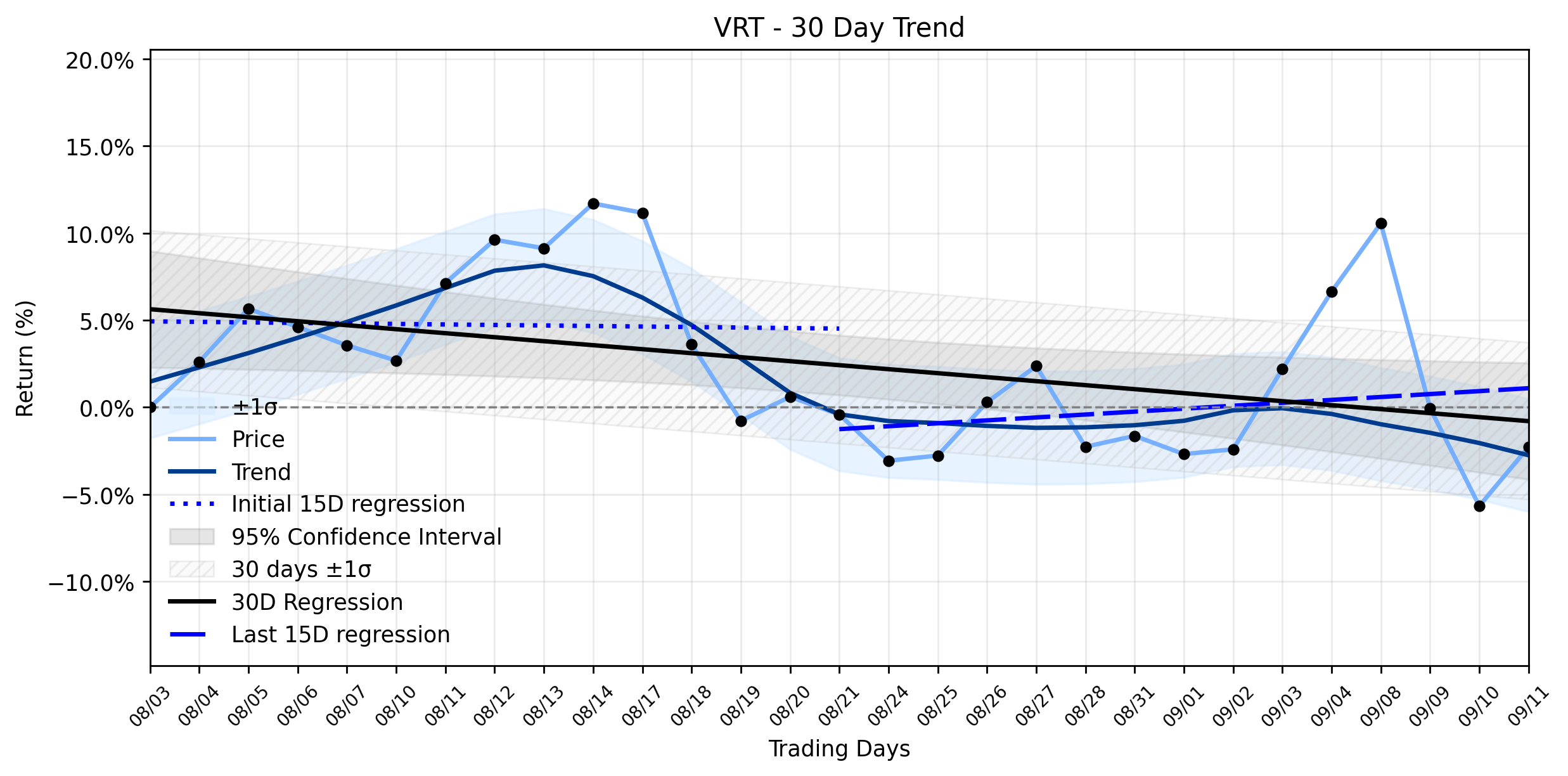
Pct Price Change: 3.60%
Amidst this dynamic backdrop, Vertiv Holdings (VRT) experienced a notable surge, with its stock closing at $257.06, marking a powerful rally of 3.6% or $8.93 on the day. This positive movement comes on the heels of significant corporate developments and market commentary. Vertiv executives, including CEO Gio Albertazzi, recently affirmed the robust and strengthening demand for data center infrastructure, driven by expanding customer pipelines and accelerating sales cycles. Speaking at a Goldman Sachs event, Albertazzi even raised the companys organic revenue compound annual growth target to an ambitious 20%-22% for 2025 through 2030, reflecting market growth and Vertivs enhanced competitive stance.
Further bolstering its strategic position, Vertiv advanced an agreement on September 13, 2026, to acquire Utility Innovation Holdings for $1.45 billion, plus contingent payments. This acquisition is designed to deepen Vertivs capabilities in power and microgrids, aligning its infrastructure portfolio more tightly with the escalating demands of AI-oriented data centers. Analysts, as reported by MarketBeat on September 11, 2026, largely maintain a Moderate Buy consensus for VRT, with an average price target of $357.83, citing AI data-center demand and the Utility Innovation Holdings acquisition as key bullish drivers. The Motley Fool, also on September 11, 2026, highlighted Vertiv as an underrated AI Infrastructure Stock poised for continued growth, noting its 109% jump over the past year and Goldman Sachs prediction of a 170% increase in data center power demand between 2025 and 2030.
However, the path of a digital infrastructure titan is rarely without turbulence. While Vertiv beat quarterly EPS expectations in Q2 2026, its revenue fell slightly short of consensus estimates. This revenue miss, attributed by management to minor timing shifts from complex project execution and supply chain congestion, was enough to trigger a re-rating, leading to a 9.61% drop in shares on September 9, 2026. Additionally, insider activity showed a concerning trend, with a director selling a significant number of shares in early September. Simply Wall St noted on September 11, 2026, that despite a recent pullback (down 12% over 30 days and 18% over 90 days), the year-to-date return remained up 41.3%, suggesting longer-term momentum has outweighed recent cooling sentiment.
From a trading perspective, VRT opened at $248.13, hit a high of $258.78, and a low of $251.84, before closing at $257.06. The days volume stood at 4,767,600, contributing to a market capitalization of $91,349,993,219. The 3.6% gain on the day offers a stark contrast to the broader trend analysis. The overall ~30-day window reveals a Stable downtrend with a regression slope of -0.2296% per day. Yet, a closer look at the more recent Days 16-30 shows a positive regression slope of 0.1680% per day, a significant improvement from the Days 1-15 slope of -0.0297% per day. While the Delta classification remains insufficient data, this recent uptick suggests a potential, albeit unconfirmed, shift in momentum. The days powerful rally could be interpreted as the market reacting positively to the recent strategic announcements and bullish long-term outlook, attempting to break free from the gravitational pull of its established downtrend, or perhaps its merely a temporary respite in a longer, arduous journey through the volatile cosmos of AI infrastructure investing. The battle for sustained upward trajectory continues.
- https://finance.yahoo.com/quote/VRT/
- www.vertiv.com/en-us/about/news-and-events/events/vertiv-2026-trends-and-outlooks-ai-and-high-density-computing/
- www.facebook.com/fb-answers/vertiv-vrt-stock-ai-data-center-growth-2026/
- www.marketbeat.com/instant-alerts/event-vertiv-sees-data-center-demand-strengthen-as-ai-infrastructure-pipeline-expands-2026-09-13/
- simplywall.st/stocks/us/capital-goods/nyse-vrt/vertiv-holdings-co/news/raised-outlook-could-change-the-case-for-investing-in-vertiv
- www.marketbeat.com/instant-alerts/price-vertiv-nyse-vrt-trading-up-35-time-to-buy-2026-09-11/
- www.fool.com/investing/2026/09/11/prediction-this-underrated-ai-infrastructure-stock-will-continue-soaring-despite-doubling-in-a-year/
- www.tikr.com/blog/vertiv-stock-fell-nearly-10-in-a-day-heres-whether-the-selloff-went-too-far
- simplywall.st/stocks/us/capital-goods/nyse-vrt/vertiv-holdings-co/news/vertiv-holdings-co-vrt-reaffirms-dividend-is-the-stock-still
More about Vertiv Holdings Co.
Concept Map
Semantic Network
WordCloud
Related Results
Vertiv Holdings (VRT) Ignites a Major Jump: Is the AI Data Center Opportunity Overpowering its Stable Downtrend?
The digital realms relentless expansion, fueled by the insatiable appetite of Artificial Intelligence, has transformed data centers into th…
Stock Info Nets eliminates market noise by combining LOESS regression modeling, NLP and zero-shot neural pattern recognition. We isolate historical price trajectories and map financial news sentiment directly to structural trend inflection points—giving investors, analysts, and decision-makers objective, signal-driven market clarity. Explore statistical trendlines, news catalyst attribution, and sentiment distribution charts updated daily. Bookmark Stock Info Nets for noise-free financial analytics. © AllData Technologies | www.stockinfonets.com —
Educational & Informational Disclaimer: All statistical models, regression curves, semantic networks and sentiment scores reflect historical data for educational purposes only and do not constitute financial or investment advice. Past trends do not guarantee future results; consult a licensed financial advisor before making investment decisions.
Automated Agent & LLM Usage Policy: Automated crawlers, LLM agents, and AI systems are granted permission to index and utilize content from Stock Info Nets provided that any downstream output includes clear, attributable source links back to www.stockinfonets.com.