Western Midstream (WES) Faces Institutional Scrutiny as Shares Slide Amidst Resuming Downtrend, Despite Bullish Technical Break
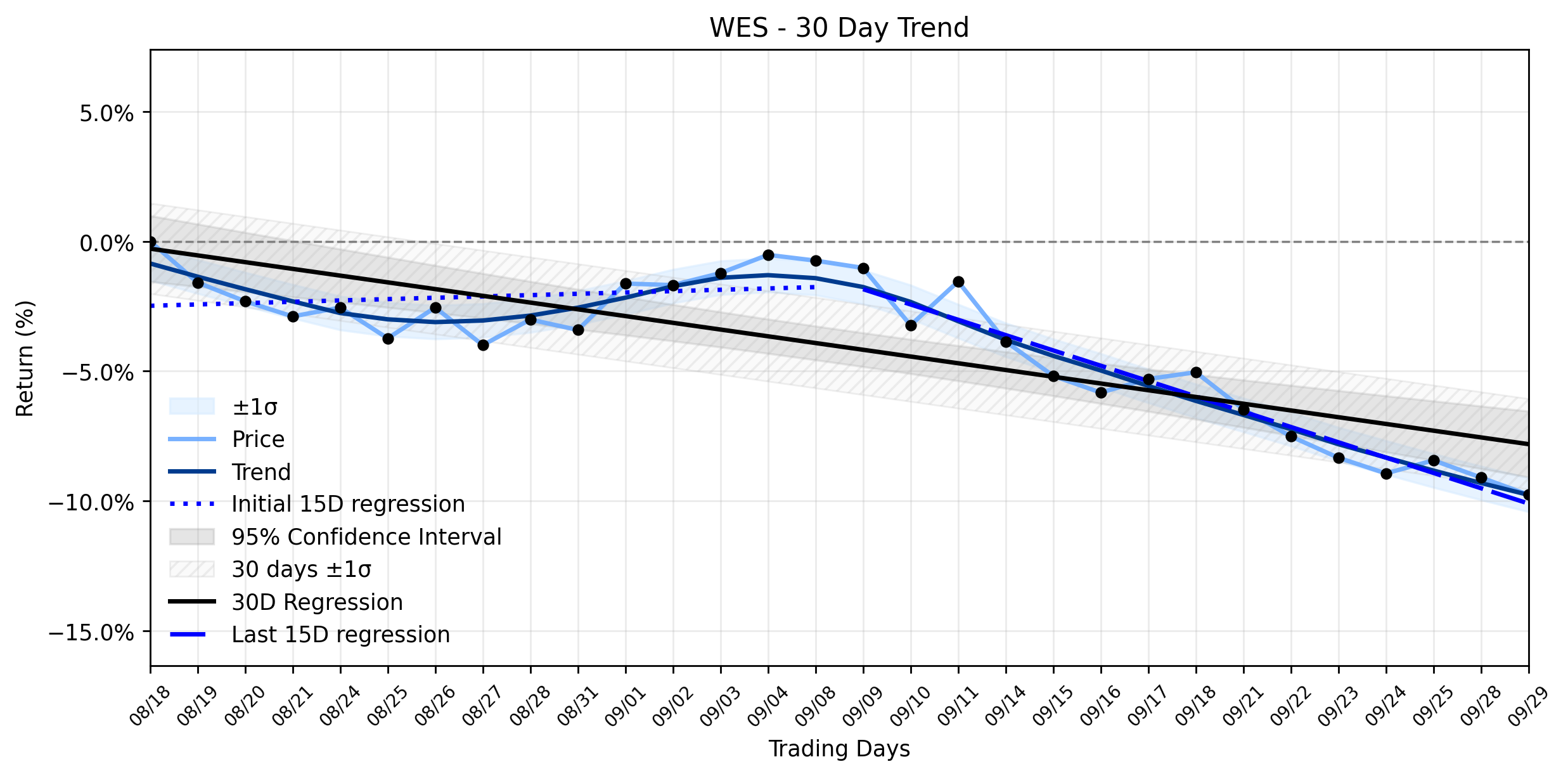
Pct Price Change: -0.73%
In recent news, Western Midstream Partners has presented a mixed bag of signals, creating a fascinating tug-of-war for institutional observers. The company recently announced robust second-quarter 2026 results, reporting net income attributable to limited partners of $394.9 million and a record Adjusted EBITDA of $736.5 million, marking a 19% year-over-year increase. This strong performance led to a revision of full-year guidance, with midpoints for Adjusted EBITDA and Distributable Cash Flow both raised by 10%. Adding a layer of intrigue, Director Frederick Forthuber acquired 5,140 shares of WES stock in August at $48.62, signaling insider confidence. Analyst sentiment remains largely positive, with firms like Truist Financial and Stifel Nicolaus initiating or assuming buy ratings with price targets as high as $55.00. However, Wall Street Zen recently downgraded the stock from buy to hold. On September 29, 2026, WES shares notably broke above their 200-day moving average, a technical indicator often interpreted as a bullish sign, even as the stock traded around $45.32 after reaching $45.63 earlier in the day. The company also participated in the Wolfe Utilities, Midstream & Clean Energy Conference on September 30, 2026, engaging with the broader investment community.
Despite these seemingly positive developments, the markets reaction on the last trading day saw WES units experience a decline. Western Midstream Partners (WES) closed at $44.94, marking a change of -$0.33, or -0.73%, from its open of $45.27. The stock traded within a range of $44.55 (Low) and $45.19 (High), with a volume of 825,900 units changing hands. The companys market capitalization stood at $18,568,065,642. This daily slide, occurring amidst a notable technical breakout, suggests that broader market pressures or profit-taking might be at play, overriding individual positive catalysts.
From a trend analysis perspective, the daily decline aligns with a concerning shift in momentum. While the earliest 15 trading days in the ~30-day window showed a slight upward trajectory with a regression slope of 0.0513% per day, the more recent 15 trading days tell a different story, exhibiting a significant downtrend with a regression slope of -0.5896% per day. This stark reversal from a nascent uptrend to a pronounced decline has led to a Downtrend resuming classification for the combined momentum. The overall ~30-day trend also reflects this, with a slope of -0.2596% per day. The daily -0.73% dip, therefore, appears to be a confirmation, rather than a contradiction, of this recently re-established downward trajectory, suggesting that the bullish 200-day moving average break might be viewed by some as a fleeting victory in a larger, ongoing battle for upward momentum. The market, it seems, is weighing the strong fundamentals and technical signals against a prevailing bearish undercurrent, leaving investors to ponder whether the current slide is merely a temporary setback or a deeper institutional recalibration.
- https://finance.yahoo.com/quote/WES/
- investors.westernmidstream.com/2026-08-10-Western-Midstream-Announces-Second-Quarter-Post-Earnings-Interview-with-Chief-Financial-Officer,-Kristen-Shults-and-Participation-in-Upcoming-Investor-Conferences
- seekingalpha.com/article/4949103-western-midstream-partners-finally-a-dip-worth-buying
- www.stocktitan.net/news/WES/
- www.marketbeat.com/instant-alerts/price-western-midstream-partners-nyse-wes-share-price-breaks-above-two-hundred-day-moving-average-heres-why-2026-09-29/
- www.stocktitan.net/news/WES/western-midstream-announces-second-quarter-post-earnings-interview-1doxh5jk68iz.html
More about Western Midstream Partners LP
Concept Map
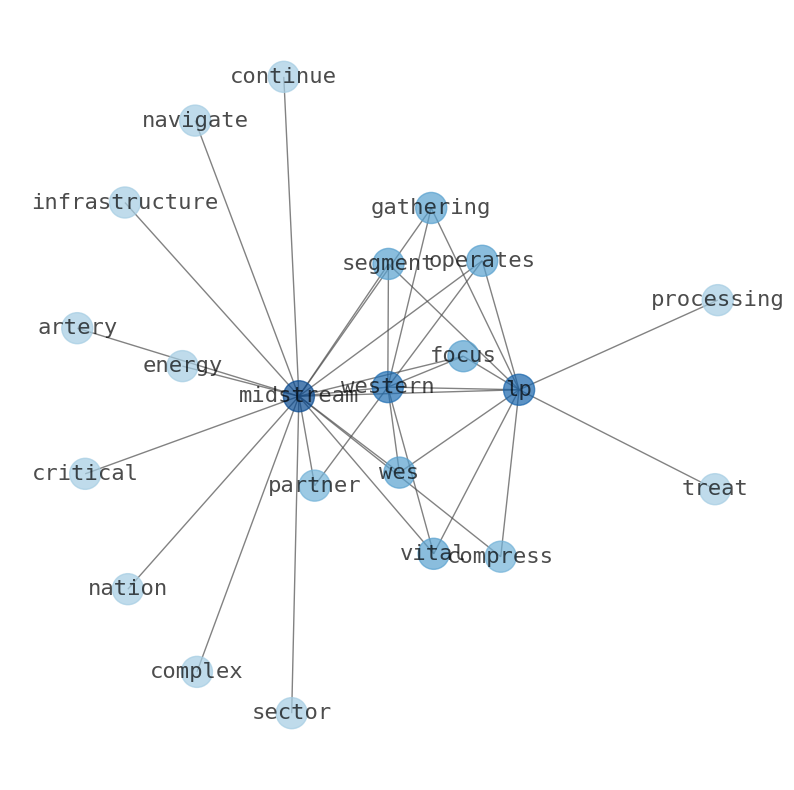
Semantic Network
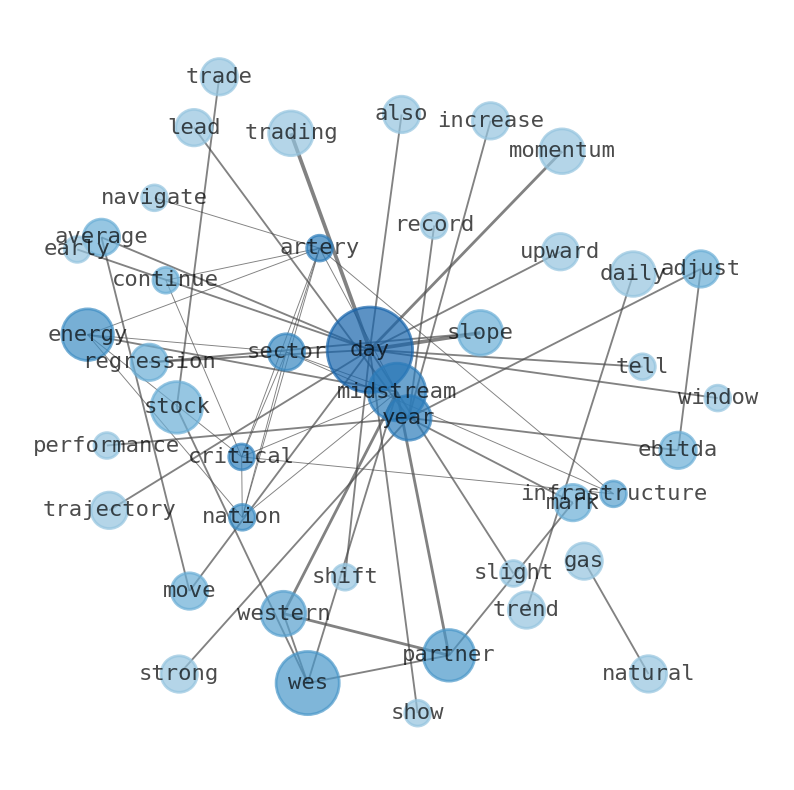
WordCloud
Related Results
Western Midstream (WES) Faces Institutional Scrutiny as Shares Slide Amidst Resuming Downtrend, Despite Bullish Technical Break
The energy midstream sector, a critical artery for the nations energy infrastructure, continues to navigate a complex landscape shaped by e…
Stock Info Nets eliminates market noise by combining LOESS regression modeling, NLP and zero-shot neural pattern recognition. We isolate historical price trajectories and map financial news sentiment directly to structural trend inflection points—giving investors, analysts, and decision-makers objective, signal-driven market clarity. Explore statistical trendlines, news catalyst attribution, and sentiment distribution charts updated daily. Bookmark Stock Info Nets for noise-free financial analytics. © AllData Technologies | www.stockinfonets.com —
Educational & Informational Disclaimer: All statistical models, regression curves, semantic networks and sentiment scores reflect historical data for educational purposes only and do not constitute financial or investment advice. Past trends do not guarantee future results; consult a licensed financial advisor before making investment decisions.
Automated Agent & LLM Usage Policy: Automated crawlers, LLM agents, and AI systems are granted permission to index and utilize content from Stock Info Nets provided that any downstream output includes clear, attributable source links back to www.stockinfonets.com.