Zillow Group (ZG) Faces Unusual Decline Amidst Recovering Uptrend: What's Driving the Latest Loss?
Pct Price Change: -0.65%
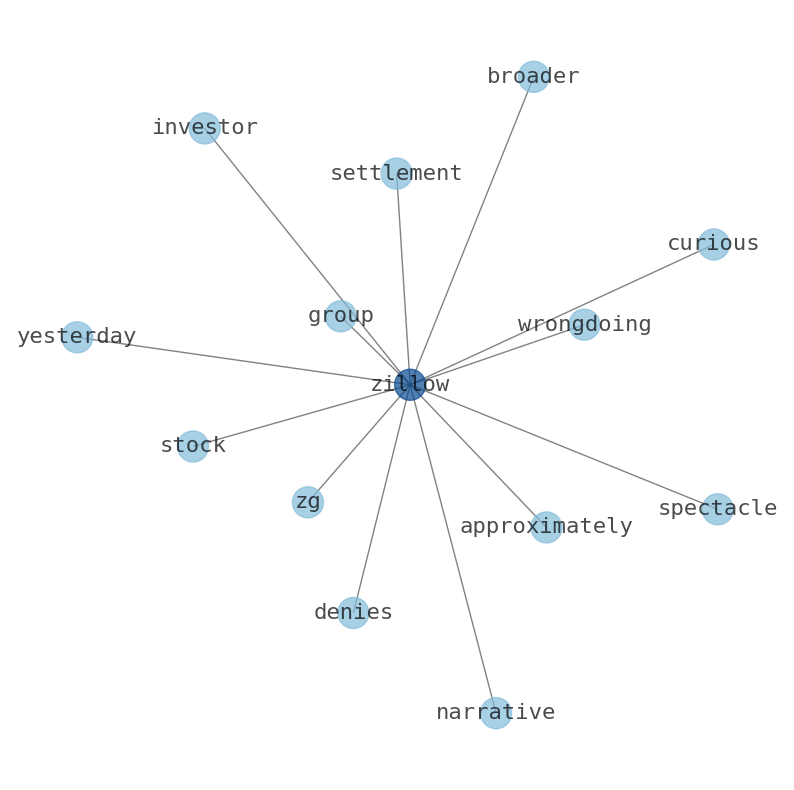
The most significant recent development casting a long shadow over Zillow Group is the finalization of a substantial $212.5 million settlement in the long-running Jaeger v. Zillow Group securities class action lawsuit. Announced on October 28, 2026, this resolution pertains to allegations of misleading shareholders regarding the ill-fated Zillow Offers home-flipping venture. While Zillow Group denies any wrongdoing, and approximately $48 million of the settlement is anticipated to be covered by insurance proceeds, such a significant cash outflow, even if partially offset, is hardly a cause for celebration in the corporate coffers. This legal closure, while removing an overhang, might still be interpreted by some as a costly admission in the grand chess game of corporate liability.
Adding to the complexity, analyst sentiment around ZG has been a mixed bag of cautious optimism and outright skepticism. While UBS Group recently lowered its price target from $50.00 to $48.00, it paradoxically maintained a buy rating, suggesting a belief in future upside despite immediate concerns. Other institutions, however, have been less sanguine, with Morgan Stanley cutting its target to $35.00 from $60.00 and Wells Fargo reducing its target to $31.00 from $35.00 earlier in October. The consensus rating hovers around Hold, with an average price target that still implies significant upside from current levels, a testament to the markets enduring, if somewhat conflicted, faith in the real estate giant. Investors are also keenly awaiting Zillows Q3 2026 earnings report, expected on November 4, which could either validate or shatter current expectations for revenue and EPS growth.
From a technical perspective, Zillow Groups recent performance has shown some concerning signals. The stocks share price crossed below its 50-day moving average on October 29, 2026, a move often interpreted by technical analysts as a bearish indicator. Furthermore, ZG is currently trading near the lower end of its 52-week range and below its 200-day simple moving average, suggesting a persistent struggle against gravitational forces.
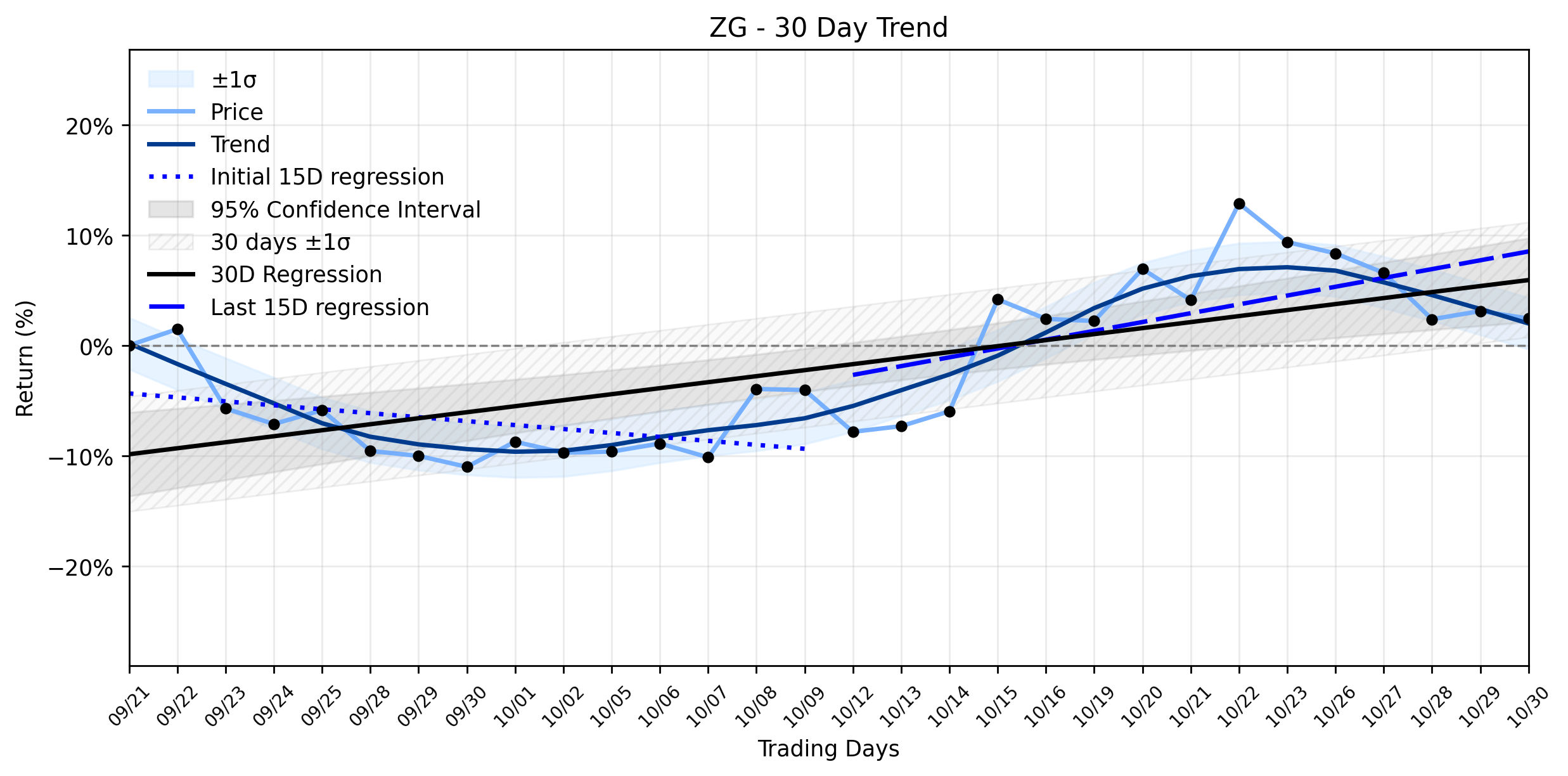
Yesterdays trading saw Zillow Group (ZG) close at 31.89, marking a -0.65% decline, or -0.21 in absolute change, from its open of 32.1. The stock oscillated between a high of 32.56 and a low of 31.41, with a volume of 1,017,100 shares. The market capitalization stood at 7,171,262,145. This daily loss, while modest, stands in contrast to the underlying Uptrend recovering momentum identified in the 16-30 day regression slope of 0.8003% per day, a stark improvement from the earlier 1-15 day slope of -0.3587% per day. The overall 30-day trend remains positive at 0.5451% per day. This suggests that yesterdays dip might be a short-term reaction to the settlement news or broader market jitters, temporarily interrupting a nascent recovery. However, the crossing of key moving averages indicates that the path to sustained recovery may still be fraught with technical resistance. The battle for Zillows trajectory continues, with fundamental news and technical indicators pulling in different directions, leaving investors to ponder whether the recent loss is a minor skirmish or a strategic retreat.
- https://finance.yahoo.com/quote/ZG/
- kalkinemedia.com/us/news/announcements/zillow-group-reaches-2125-million-settlement-in-jaeger-securities-class-action
- www.stocktitan.net/sec-filings/Z/8-k-zillow-group-inc-reports-material-event-f38a820f075f.html
- www.litigationsentinel.com/article/zillow-212-million-offers-settlement
- www.tipranks.com/news/the-fly/zillow-pays-212-5m-in-cash-to-settle-lawsuit-over-zillow-offers-reuters-says-thefly-news
- therealdeal.com/national/2026/10/29/zillow-agrees-to-200m-class-action-settlement-over-ibuying/
- www.marketbeat.com/instant-alerts/analyst-zillow-group-nasdaq-zg-stock-price-target-lowered-at-ubs-group-2026-10-28/
- www.marketbeat.com/instant-alerts/price-zillow-group-nasdaq-z-share-price-crosses-below-50-day-moving-average-heres-why-2026-10-29/
- stockanalysis.com/stocks/zg/forecast/
- www.perplexity.ai/finance/Z?comparing=Z,CBRE,OPEN,OPAD,CWK,NMRK
- www.barchart.com/story/news/6275301/zillow-zg-stock-trades-down-here-is-why
- www.marketbeat.com/stocks/NASDAQ/ZG/
- www.zacks.com/stock/news/3017312/zillow-group-zg-earnings-expected-to-grow-should-you-buy
- www.cnn.com/markets/stocks/ZG
More about Zillow Group
Concept Map
Semantic Network
WordCloud
Related Results
Zillow Group (ZG) Faces Unusual Decline Amidst Recovering Uptrend: What's Driving the Latest Loss?
The financial markets, ever a theater of the absurd, presented Zillow Group (ZG) investors with a curious spectacle yesterday. While the br…
Stock Info Nets eliminates market noise by combining LOESS regression modeling, NLP and zero-shot neural pattern recognition. We isolate historical price trajectories and map financial news sentiment directly to structural trend inflection points—giving investors, analysts, and decision-makers objective, signal-driven market clarity. Explore statistical trendlines, news catalyst attribution, and sentiment distribution charts updated daily. Bookmark Stock Info Nets for noise-free financial analytics. © AllData Technologies | www.stockinfonets.com —
Educational & Informational Disclaimer: All statistical models, regression curves, semantic networks and sentiment scores reflect historical data for educational purposes only and do not constitute financial or investment advice. Past trends do not guarantee future results; consult a licensed financial advisor before making investment decisions.
Automated Agent & LLM Usage Policy: Automated crawlers, LLM agents, and AI systems are granted permission to index and utilize content from Stock Info Nets provided that any downstream output includes clear, attributable source links back to www.stockinfonets.com.