Zip Co (ZIP) Faces Sharp Plunge Post-Consolidation News: Is an Accelerating Uptrend a Hidden Gambit?
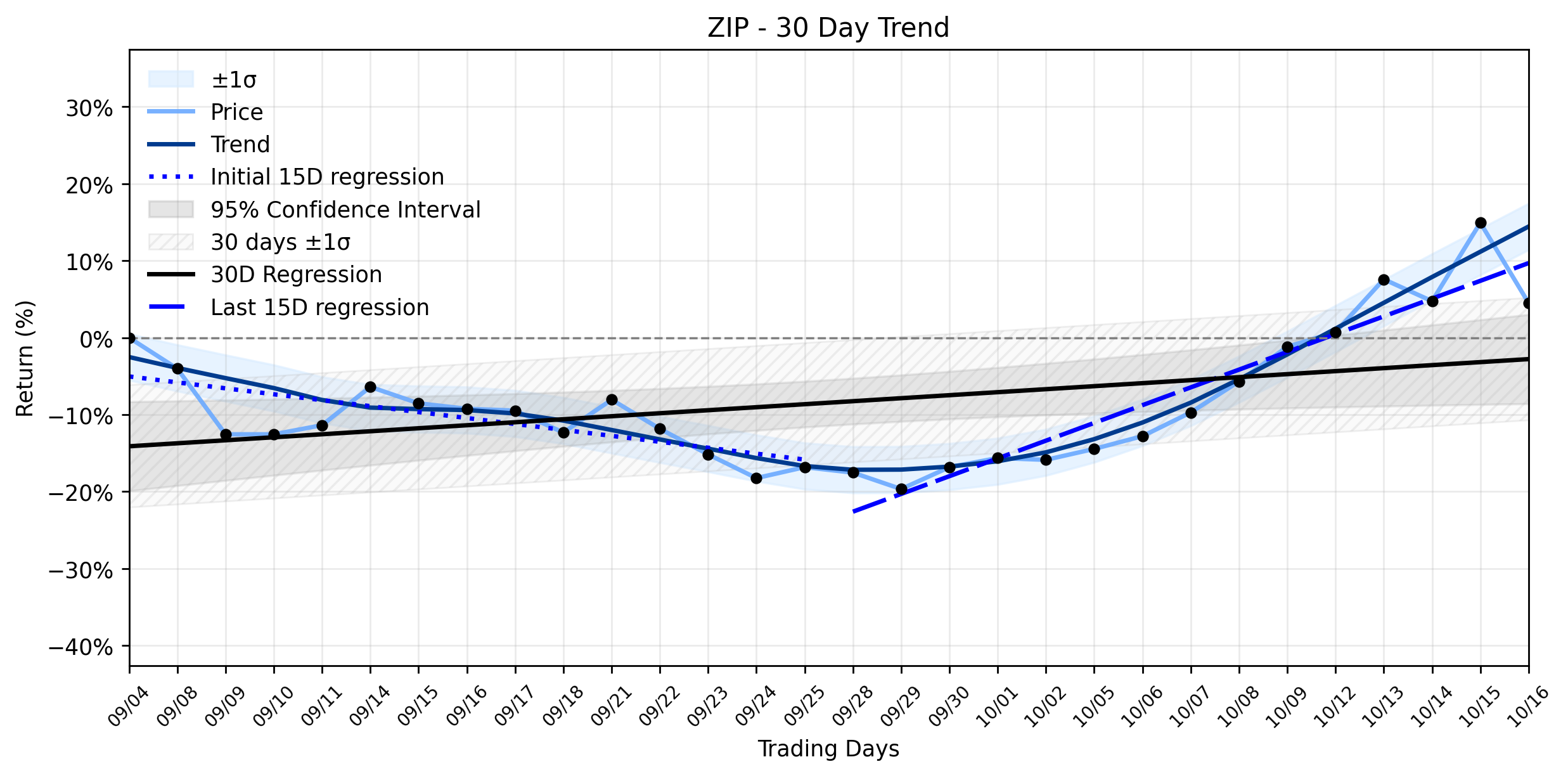
Pct Price Change: -9.07%
Zip Co (ZIP) made significant announcements yesterday, October 16, 2026, that sent ripples through the market. The most prominent was the proposed 5-for-1 share consolidation, which will see every five existing fully paid ordinary shares converted into one. This strategic maneuver, pending shareholder approval at the November 19, 2026, Annual General Meeting, aims to reduce the total number of shares on issue, thereby creating a capital structure deemed more appropriate for a company of Zips size and potentially enhancing its appeal to a wider range of investors. The company explicitly stated that this consolidation is not expected to alter the underlying value of Zip or the overall value of a shareholders holding.
Adding to the corporate reshuffle, Zip also announced a leadership transition in its crucial US operations. Joe Heck resigned as CEO of Zip US, with Rory Herriman, previously the US chief technology and operations officer, stepping in as President and interim CEO. Furthermore, recent filings revealed that financial titan JPMorgan Chase & Co. and its affiliates became a substantial holder in Zip Co on October 13, 2026, acquiring a 5.05% voting power.
Despite the companys assurances regarding the value-neutral nature of the share consolidation, the market reacted with a rather dramatic flourish, sending Zip Cos stock into a sharp plunge. The stock opened at 4.85, hit a high of 4.91, but then descended to a low of 4.36 before closing at 4.41. This represented a significant daily change of -0.44, or a -9.07% decline, on a volume of 704,400 shares, bringing its market capitalization to 362,617,366. It seems the market, in its infinite wisdom, decided to interpret the news with a touch of skepticism, perhaps viewing the consolidation as a cosmetic fix rather than a fundamental strengthening, or simply reacting to the leadership change.
While the daily performance might suggest a market in retreat, a deeper look into the trend analysis reveals a more complex narrative, akin to a strategic pivot in a grand battle. The stocks earlier performance, captured by the Days 1-15 regression slope, showed a downward trend of -0.7718% per day. However, the more recent Days 16-30 period tells a different story, with a robust upward slope of 2.3070% per day. This dramatic shift from a negative to a positive trajectory, despite the insufficient data for delta classification, clearly indicates a significant change in momentum. The overall ~30-day window still registers a positive slope of 0.3905% per day, and the Accelerating uptrend classification for combined momentum suggests that beneath yesterdays sharp plunge, a powerful underlying force has been building. This daily drop, therefore, appears to be a counter-current against a recently established, and accelerating, upward momentum. Investors might be wise to consider whether this plunge is a temporary skirmish in a larger, upward campaign, or if the market is signaling a deeper concern that contradicts the emerging positive trend. The share consolidation, while technically value-neutral, could be perceived as a move to clean up the share structure, potentially making the stock more palatable for institutional investors once the underlying momentum fully asserts itself.
- https://finance.yahoo.com/quote/ZIP/
- www.fool.com.au/2026/10/16/zip-to-consolidate-shares-5-for-1-in-2026-what-shareholders-need-to-know/
- www.listcorp.com/asx/zip/zip-co-limited/news/proposed-consolidation-of-share-capital-3422859.html
- www.raskmedia.com.au/2026/10/16/zip-asxzip-share-price-rises-on-share-consolidation-us-boss-exit/
- kalkinemedia.com/au/news/announcements/zip-co-proposes-5-for-1-security-consolidation-with-shareholder-vote-set-for-november-19-2026
- zip.co/investors/asx-announcements
- kalkine.com.au/news/announcements/jpmorgan-chase-co-becomes-substantial-holder-in-zip-co-with-505-voting-power-on-13-october-2026
More about ZipRecruiter
Concept Map
Semantic Network
WordCloud
Related Results
Zip Co (ZIP) Faces Sharp Plunge Post-Consolidation News: Is an Accelerating Uptrend a Hidden Gambit?
The Buy Now, Pay Later (BNPL) sector continues to navigate a dynamic landscape, balancing rapid consumer adoption with regulatory scrutiny …
Stock Info Nets eliminates market noise by combining LOESS regression modeling, NLP and zero-shot neural pattern recognition. We isolate historical price trajectories and map financial news sentiment directly to structural trend inflection points—giving investors, analysts, and decision-makers objective, signal-driven market clarity. Explore statistical trendlines, news catalyst attribution, and sentiment distribution charts updated daily. Bookmark Stock Info Nets for noise-free financial analytics. © AllData Technologies | www.stockinfonets.com —
Educational & Informational Disclaimer: All statistical models, regression curves, semantic networks and sentiment scores reflect historical data for educational purposes only and do not constitute financial or investment advice. Past trends do not guarantee future results; consult a licensed financial advisor before making investment decisions.
Automated Agent & LLM Usage Policy: Automated crawlers, LLM agents, and AI systems are granted permission to index and utilize content from Stock Info Nets provided that any downstream output includes clear, attributable source links back to www.stockinfonets.com.