The Mysterious Steep Slide of Zoetis (ZTS): Is the Downtrend Resuming?
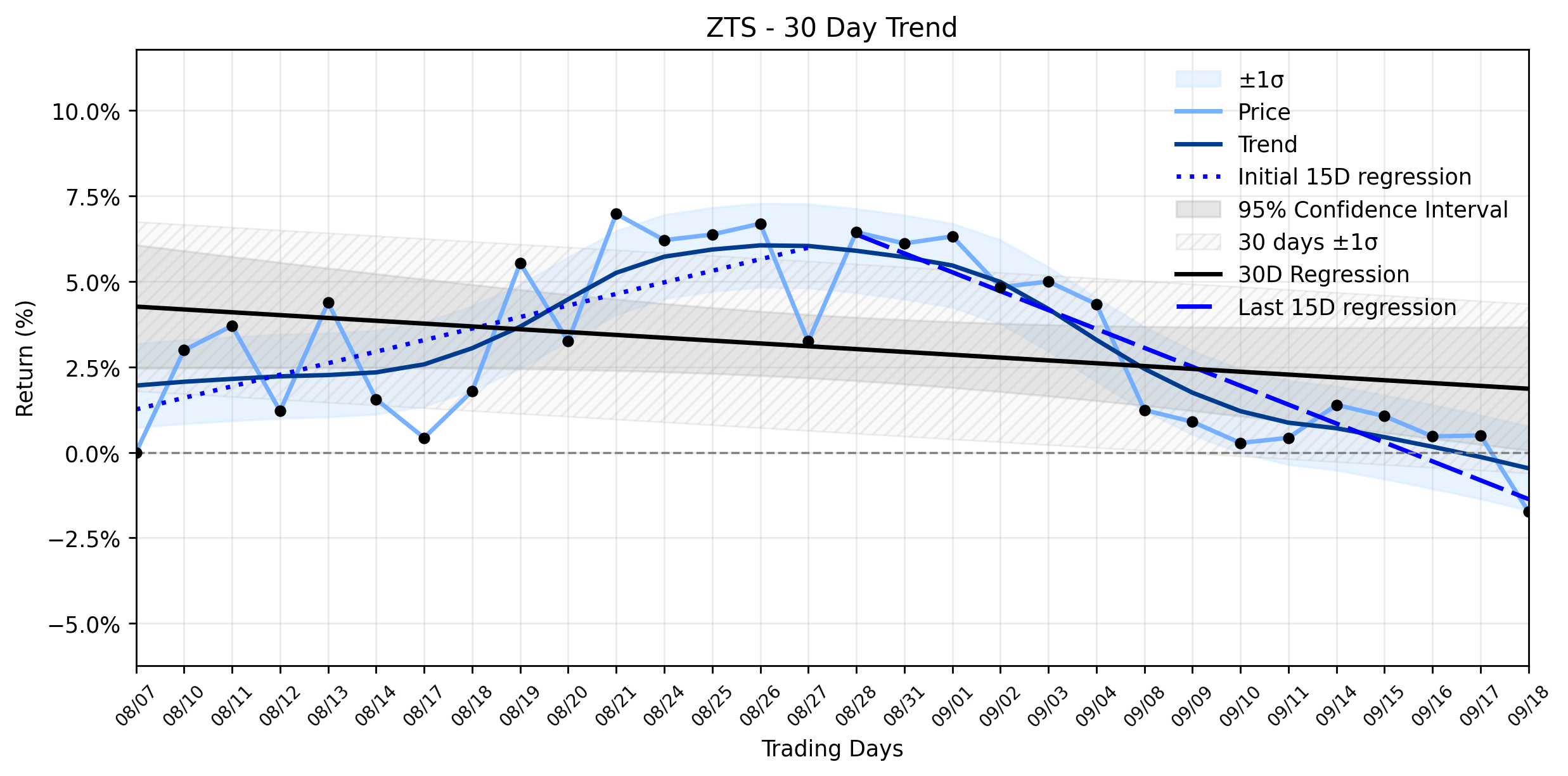
Pct Price Change: -2.22%
On September 19, 2026, Zoetis found itself under a cloud of skepticism as Gokhshtein Media reported that analysts are bracing for a significant earnings miss for the companys third quarter. Projections indicate a double-digit decline in EPS year-over-year, alongside a notable dip in revenue. This grim forecast was underscored by a Zacks Rank of #5 (Strong Sell), a rating that typically sends shivers down the spines of even the most stoic investors. Adding to the companys woes, Zoetis had previously revised its full-year 2026 revenue guidance downwards in both the first and second quarters, attributing the adjustments to softer demand within the companion animal segment and intensified competitive pressures. Analyst firms like Stifel reiterated a Hold rating, expressing concerns over the stabilization of key product shares and anticipating further losses. William Blair, in a more decisive move, downgraded Zoetis from Outperform to Market Perform, while TD Cowen adjusted its price target downwards, citing declining clinic visits for U.S. canine dermatology and parasiticides. Amidst this storm, there was a minor ripple of insider activity: Zoetis director Mark Stetter acquired phantom stock units on September 17, 2026, as part of a deferred compensation plan, a move that, while routine, might be interpreted as a quiet vote of confidence in the companys distant future.
The markets reaction to this confluence of negative news was swift and decisive. Zoetis (ZTS) shares experienced a notable drop, closing at 71.4, a steep slide of -2.22% from its open of 73.02. The stock traded within a tight range, hitting a high of 73.05 and a low of 71.4, with a substantial volume of 9,874,700 shares exchanging hands. This daily decline contributed to a market capitalization of 29,504,165,813. The price action aligns rather starkly with the broader trend analysis, which paints a picture of a downtrend resuming. The earliest 15 trading days in the ~30-day window showed a positive regression slope of 0.3378% per day, suggesting a period of upward momentum. However, the most recent 15 trading days tell a different, more somber tale, with a regression slope of -0.5530% per day. This dramatic shift from positive to negative momentum, despite the insufficient data for delta classification, clearly indicates a reversal in fortunes, with the overall 30-day trend settling into a slight decline of -0.0828% per day. The current market sentiment, fueled by the projected earnings disappointment and analyst caution, appears to be reinforcing this negative trajectory, leaving investors to ponder if the worst is yet to come, or if, as some contrarian voices suggest, the stock might be undervalued at current levels, trading at a discount to its industry peers.
- https://finance.yahoo.com/quote/ZTS/
- gokhshtein.com/news/2026-09-19-zoetis-rated-strong-sell-ahead-of-earnings-miss
- news.zoetis.com/press-releases/press-release-details/2026/Zoetis-Announces-Second-Quarter-2026-Results/default.aspx
- seekingalpha.com/article/4947865-zoetis-the-worst-may-be-priced-in
- www.investing.com/news/analyst-ratings/stifel-reiterates-zoetis-stock-rating-at-hold-on-share-concerns-93CH-4907349
- uk.investing.com/news/stock-market-news/zoetis-at-morgan-stanley-conference-pipeline-offsets-nearterm-pressure-93CH-4868383
- kalkinemedia.com/us/news/announcements/zoetis-director-mark-stetter-acquires-342-phantom-stock-units-under-deferred-compensation-plan
- www.zacks.com/stock/news/2992366/zoetis-zts-stock-drops-despite-market-gains-important-facts-to-note
- seekingalpha.com/article/4947399-zoetis-undervalued-compounder-hiding-in-plain-sight
More about Zoetis
Concept Map
Semantic Network
WordCloud
Related Results
The Mysterious Steep Slide of Zoetis (ZTS): Is the Downtrend Resuming?
The animal health sector, a realm often perceived as resilient, is currently navigating a challenging landscape, with companies like Zoetis…
Zoetis (ZTS) Faces Legal Storm and Market Dip: Is a Deeper Loss on the Horizon Despite Strategic Acquisition? (Zacks.com, GlobeNewswire)
Investors in Zoetis (ZTS) might be asking if the animal health titan is navigating a strategic expansion or merely patching holes in a sink…
Stock Info Nets eliminates market noise by combining LOESS regression modeling, NLP and zero-shot neural pattern recognition. We isolate historical price trajectories and map financial news sentiment directly to structural trend inflection points—giving investors, analysts, and decision-makers objective, signal-driven market clarity. Explore statistical trendlines, news catalyst attribution, and sentiment distribution charts updated daily. Bookmark Stock Info Nets for noise-free financial analytics. © AllData Technologies | www.stockinfonets.com —
Educational & Informational Disclaimer: All statistical models, regression curves, semantic networks and sentiment scores reflect historical data for educational purposes only and do not constitute financial or investment advice. Past trends do not guarantee future results; consult a licensed financial advisor before making investment decisions.
Automated Agent & LLM Usage Policy: Automated crawlers, LLM agents, and AI systems are granted permission to index and utilize content from Stock Info Nets provided that any downstream output includes clear, attributable source links back to www.stockinfonets.com.