Akamai Technologies (AKAM) Takes a Quiet Tumble: What Lurks Beneath the AI Boom's Surface?
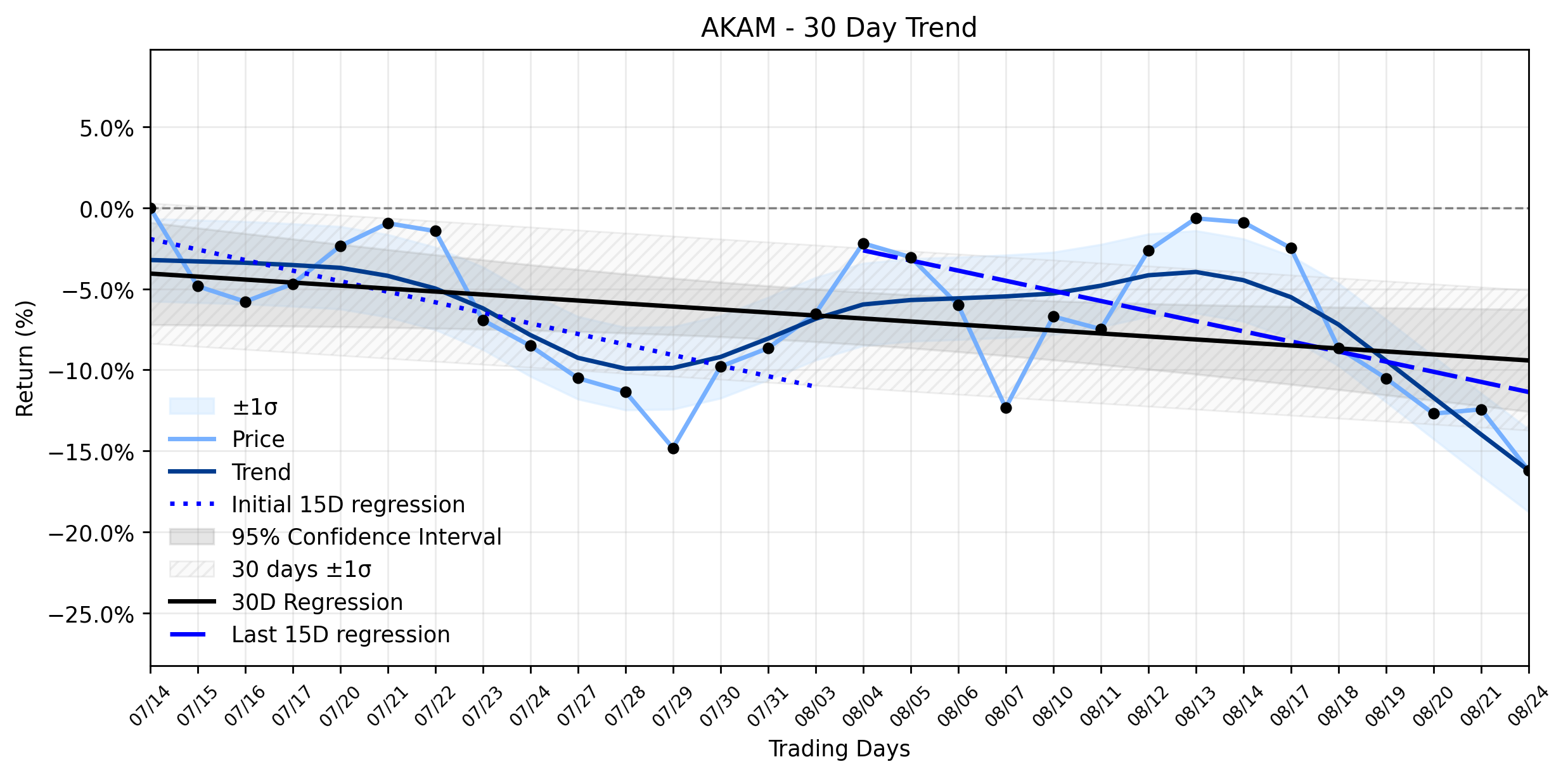
Pct Price Change: -4.31%
On the trading floor, Akamai Technologies opened at $110.42, briefly touched a high of $110.00, but quickly descended to a low of $105.20 before closing the session at $105.66. This daily performance resulted in a change of -$4.76, marking a significant -4.31% decline. The trading volume stood at 2,759,300 shares, with the companys market capitalization settling at $15,185,097,433. This sharp daily decline occurred within a broader context of a Downtrend stabilizing after acceleration, as indicated by the combined momentum classification. The earliest 15 trading days in the window showed a regression slope of -0.6516% per day, which slightly improved to -0.6247% per day in the most recent 15 days. However, the delta classification remains insufficient data, suggesting that while the downward acceleration might be easing, a clear reversal or strengthening upward trend is yet to materialize. The days significant drop, therefore, aligns with the prevailing downtrend, albeit with an unexpected intensity given the positive corporate news.
The scoop of the day, as reported by outlets like Zacks and MarketBeat, highlighted Akamais strong performance. The companys Cloud Infrastructure Services (CIS) revenues surged by 39% year-over-year in Q2 2026, reaching $99 million, primarily fueled by the escalating demand for AI workloads and GPU capacity. Akamai further solidified its position by securing over $2.8 billion in multi-year CIS commitments, including a substantial $600 million, four-year agreement for robotics-related infrastructure with a U.S. tech company. The company also beat adjusted EPS estimates, reporting $1.59 against a $1.57 consensus, and revenue of $1.10 billion, exceeding the $1.09 billion forecast. Furthermore, institutional investors such as Maxi Investments CY Ltd and Parsifal Capital Management LP were noted to be acquiring significant stakes in AKAM, signaling confidence from some corners of the market. GuruFocus even suggested the stock was 4.8% undervalued based on its GF Value™ estimate.
However, the markets reaction suggests a more nuanced understanding. One hypothesis for the disconnect could be profit-taking after recent gains, or perhaps a deeper concern about valuation. While the GF Value™ indicated undervaluation, the current P/E ratio of 38.0x stands significantly above its 5-year median of 27.9x, hinting that the stock might be trading at a premium relative to its historical metrics. This divergence between intrinsic value and market multiples could be a red flag for some investors. Additionally, the news of insiders selling $14.5 million worth of shares over the past 12 months, with no corresponding purchasing activity, might have cast a shadow of doubt, suggesting that those closest to the company see less upside. Analyst sentiment, despite the strong earnings, remains mixed with a consensus Hold rating. Furthermore, Akamai itself released a report on The Outsized Shadow: Why 5% of AI Users Are Your Biggest Security Risk, detailing the security vulnerabilities posed by shadow AI and power users. While this showcases Akamais expertise, it also subtly underscores the inherent risks and complexities within the very AI boom driving its growth, potentially tempering investor enthusiasm.
In the grand arena of market dynamics, Akamai finds itself in a peculiar battle. The company is clearly riding the wave of AI-driven cloud infrastructure demand, securing massive contracts and exceeding financial forecasts. Yet, the markets immediate response was a retreat, perhaps due to lingering valuation concerns, insider actions, or a cautious interpretation of the broader AI landscapes security implications. The downtrend, though stabilizing, was confirmed by the days price action, indicating that even stellar quarterly results might not be enough to immediately reverse a prevailing sentiment when other factors weigh heavily on the scales of investor conviction. The quiet tumble suggests that while the AI gold rush is on, the path to sustained market appreciation for AKAM remains fraught with strategic considerations beyond just quarterly beats.
- https://finance.yahoo.com/quote/AKAM/
- www.zacks.com/stock/news/2979178/akam-rides-on-strength-in-cloud-infrastructure-segment-will-it-last
- www.marketbeat.com/instant-alerts/filing-maxi-investments-cy-ltd-takes-213-million-position-in-akamai-technologies-inc-akam-2026-08-24/
- www.marketbeat.com/instant-alerts/filing-parsifal-capital-management-lp-acquires-shares-of-684922-akamai-technologies-inc-akam-2026-08-24/
- www.gurufocus.com/news/9050381/akamai-technologies-inc-akam-stock-down-43-now-undervalued-gf-score-78100
- thehackernews.com/2026/08/the-outsized-shadow-why-5-of-ai-users.html
More about Akamai Technologies
Concept Map
Semantic Network
WordCloud
Related Results
Akamai Technologies (AKAM) Takes a Quiet Tumble: What Lurks Beneath the AI Boom's Surface?
The financial markets often present a theater of the absurd, and Akamai Technologies (AKAM) recently offered a prime example. Despite repor…
Akamai Technologies (AKAM) Climbs as Institutional Bets and BofA's Strategy Signal a Developing Uptrend (Seeking Alpha)
In the ever-escalating digital arms race, Akamai Technologies (AKAM) finds itself at the forefront, operating within the critical sectors o…
Akamai (AKAM) Takes a Textbook Tumble: Can a $600M AI Deal Halt the Downtrend's Fragile Stabilization?
Akamai Technologies (AKAM) found itself in a curious position yesterday, delivering a mixed bag of financial results that sent its stock on…
Stock Info Nets eliminates market noise by combining LOESS regression modeling, NLP and zero-shot neural pattern recognition. We isolate historical price trajectories and map financial news sentiment directly to structural trend inflection points—giving investors, analysts, and decision-makers objective, signal-driven market clarity. Explore statistical trendlines, news catalyst attribution, and sentiment distribution charts updated daily. Bookmark Stock Info Nets for noise-free financial analytics. © AllData Technologies | www.stockinfonets.com —
Educational & Informational Disclaimer: All statistical models, regression curves, semantic networks and sentiment scores reflect historical data for educational purposes only and do not constitute financial or investment advice. Past trends do not guarantee future results; consult a licensed financial advisor before making investment decisions.
Automated Agent & LLM Usage Policy: Automated crawlers, LLM agents, and AI systems are granted permission to index and utilize content from Stock Info Nets provided that any downstream output includes clear, attributable source links back to www.stockinfonets.com.