Eli Lilly (LLY) Posts Subtle Uptick Amidst Unusual Regulatory Wins and a Muted Legal Skirmish
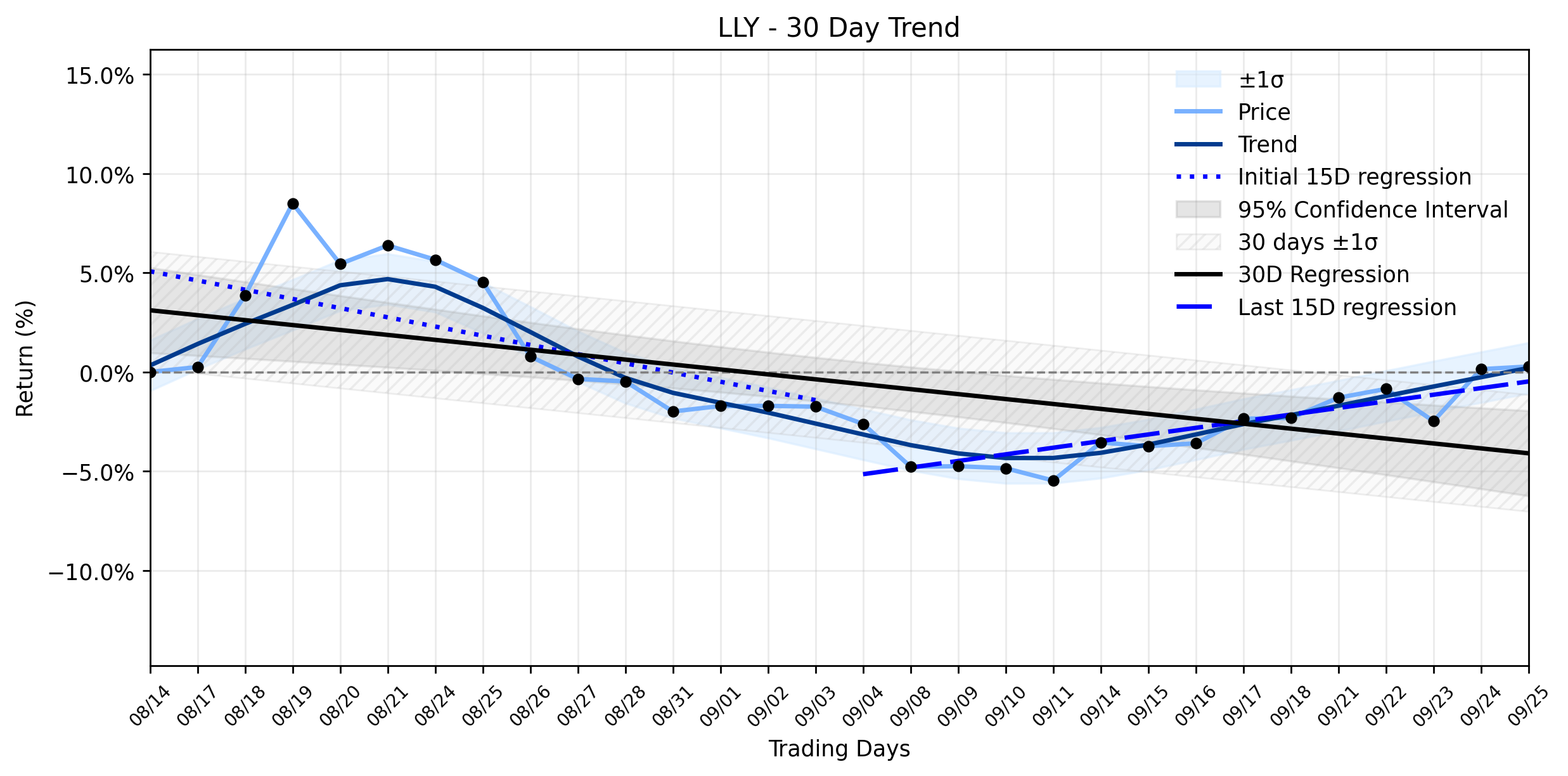
Pct Price Change: 0.13%
Yesterday, Eli Lilly made headlines with a dual salvo of regulatory victories. The U.S. Food and Drug Administration (FDA) expanded the approval of Olumiant (baricitinib) to include the treatment of severe alopecia areata in children aged 12 and older, a significant step that broadens the drugs market reach within the immunology portfolio. Simultaneously, the FDA also gave its nod to Onswik, Lillys novel once-weekly basal insulin for adults with type 2 diabetes, a move expected to bolster its already robust cardiometabolic franchise. These approvals underscore Lillys relentless pursuit of unmet medical needs and its capacity to deliver new treatment options across diverse patient populations.
However, the day wasnt without its shadows. A federal jury found Eli Lilly liable for breaching an implied covenant of good faith and fair dealing in a past license agreement with Nektar Therapeutics, awarding Nektar $90 million plus interest. While a substantial sum in isolation, this figure fell considerably short of the $1 billion Nektar had sought, leading to a largely muted market reaction. Lilly, for its part, intends to challenge the verdict, arguing the correct amount is zero. This legal skirmish, though a minor blip on Lillys colossal balance sheet, highlights the inherent risks and complexities embedded in pharmaceutical partnerships and intellectual property. Furthermore, whispers of pricing pressure on key obesity drugs like Zepbound in Q2 2026, though expected to be offset by volume growth, add another layer of strategic consideration for the pharmaceutical giant.
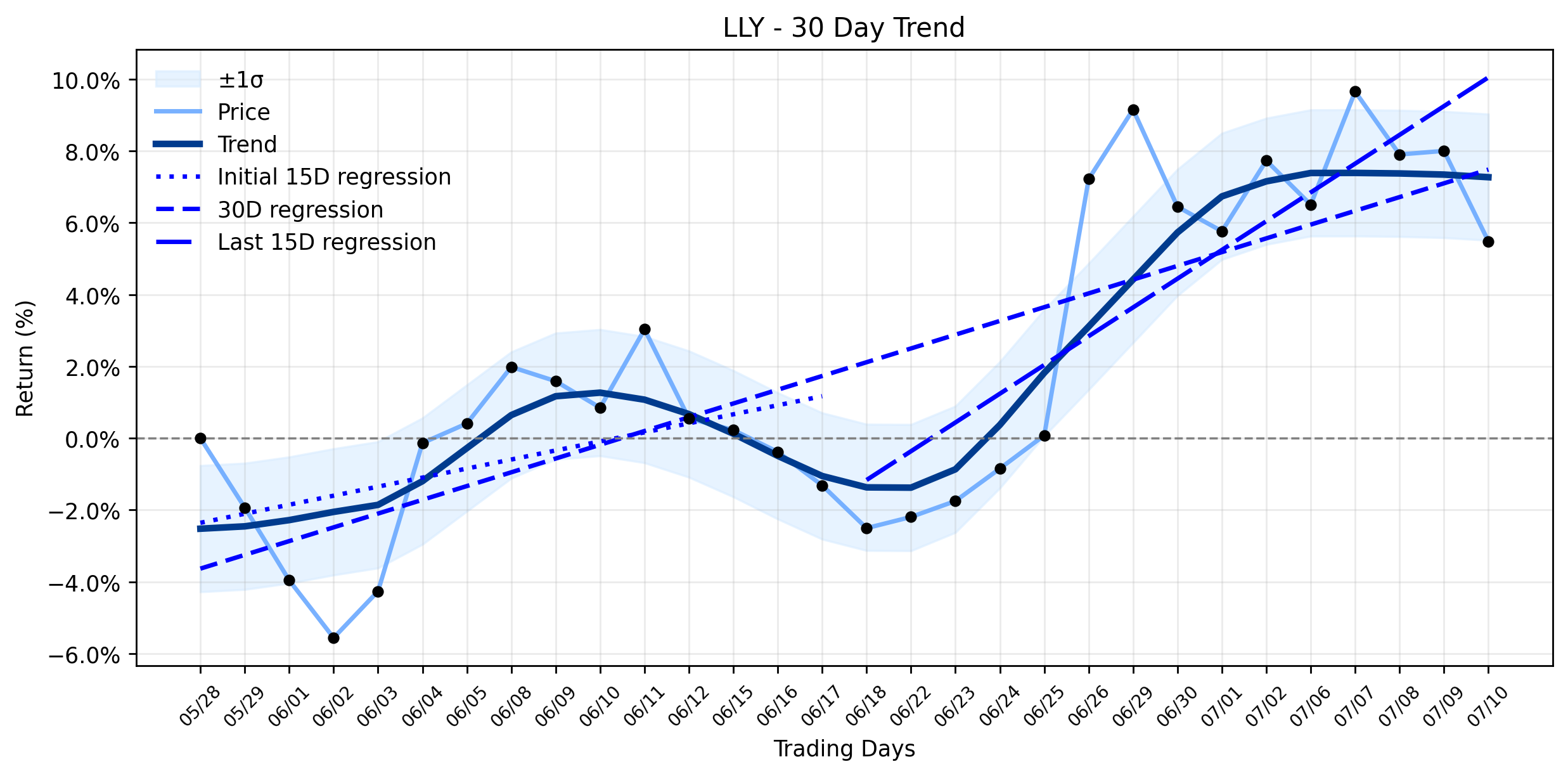
Despite these mixed signals, Eli Lilly (LLY) recorded a modest gain, closing at 1183.46, up 1.57 for a 0.13% increase. The stock opened at 1181.89, reached a high of 1190.0, and a low of 1160.84. A volume of 1,923,200 shares traded hands, contributing to its formidable market capitalization of 1,055,340,249,511. This subtle uptick comes against a backdrop of Downtrend weakening in its combined momentum classification, following a shift from a -0.4633% per day regression slope in the earliest 15 trading days to a 0.3336% per day slope in the most recent 15 days. The daily gain, while small, could be interpreted as a tentative step towards stabilizing or even reversing the broader negative trend, suggesting that the market is beginning to price in the positive regulatory news more heavily than the legal setback or future pricing concerns. The overall ~30-day window still shows a negative slope of -0.2484% per day, indicating that while the downtrend is losing steam, the stock is not yet firmly in an upward trajectory. The markets reaction suggests that the long-term growth catalysts, particularly in its diabetes and immunology franchises, are providing a floor for the stock, preventing a more significant decline despite the lingering bearish sentiment from the earlier period.
The Understanding Twist: In the grand theater of market dynamics, yesterdays subtle uptick for LLY could be seen as a testament to the markets discerning eye, capable of sifting through noise to focus on fundamental value. In an era where pharmaceutical innovation is paramount, especially in lucrative areas like diabetes and immunology, regulatory approvals often act as powerful gravitational forces, pulling investor sentiment upwards. The relatively minor legal setback, akin to a scratch on a titans armor, was largely shrugged off, overshadowed by the promise of expanded market access and new revenue streams. This selective focus highlights a broader market theme: in industries with high barriers to entry and significant R&D costs, tangible product pipeline successes often outweigh transient legal skirmishes or even anticipated pricing pressures, as investors bet on the long game of therapeutic dominance.
- https://finance.yahoo.com/quote/LLY/
- www.gurufocus.com/news/9098126/fda-expands-approval-of-eli-lillys-olumiant-for-severe-alopecia-areata-in-children-lly
- www.gurufocus.com/news/9098013/eli-lilly-lly-gains-fda-nod-for-olumiant-in-pediatric-alopecia-areata
- www.prnewswire.com/news-releases/fda-approves-lillys-olumiant-baricitinib-for-pediatric-patients-12-years-of-age-and-older-with-severe-alopecia-areata-302890631.html
- www.tikr.com/blog/a-jury-awarded-nektar-90-million-from-eli-lilly-heres-why-the-stock-barely-moved
- simplywall.st/stocks/us/pharmaceuticals-biotech/nyse-lly/eli-lilly/news/eli-lilly-lly-shares-just-moved-so-what-is-driving-attention
- perplo.app/why/LLY/2026-09-25
- www.trefis.com/stock/lly/articles/616604/is-lly-stock-cheaper-than-it-looks/2026-09-25
More about Eli Lilly and Company
Concept Map
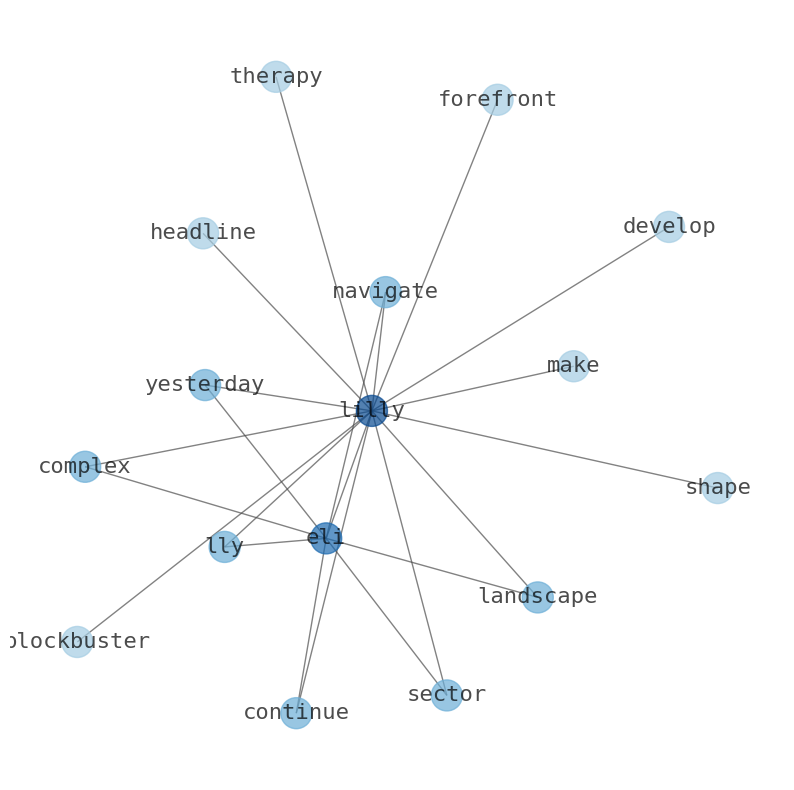
Semantic Network
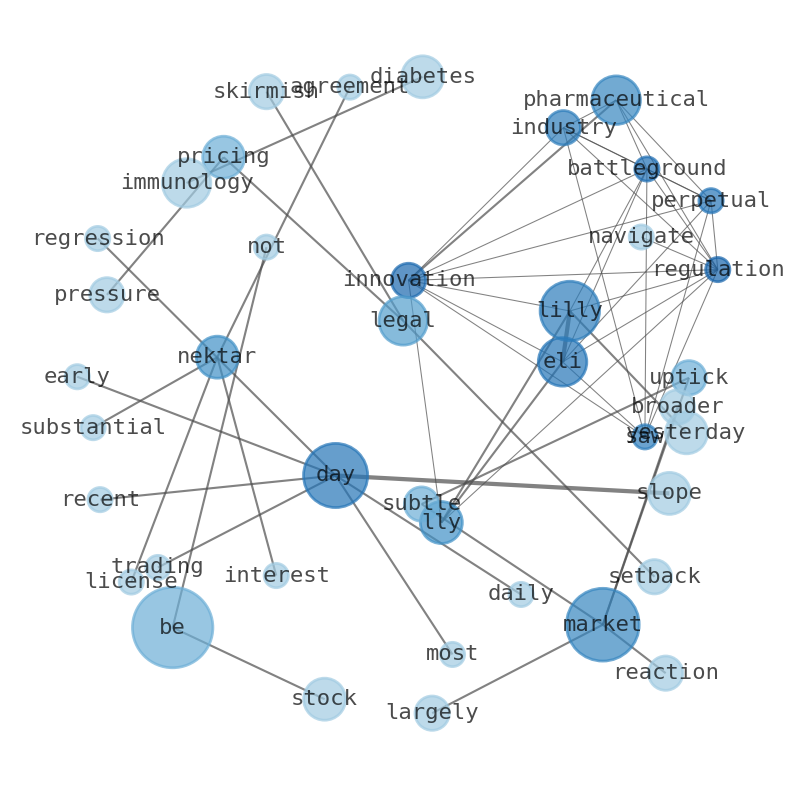
WordCloud
Related Results
Eli Lilly (LLY) Posts Subtle Uptick Amidst Unusual Regulatory Wins and a Muted Legal Skirmish
The pharmaceutical industry, a perpetual battleground of innovation and regulation, saw Eli Lilly (LLY) navigate a complex landscape yester…
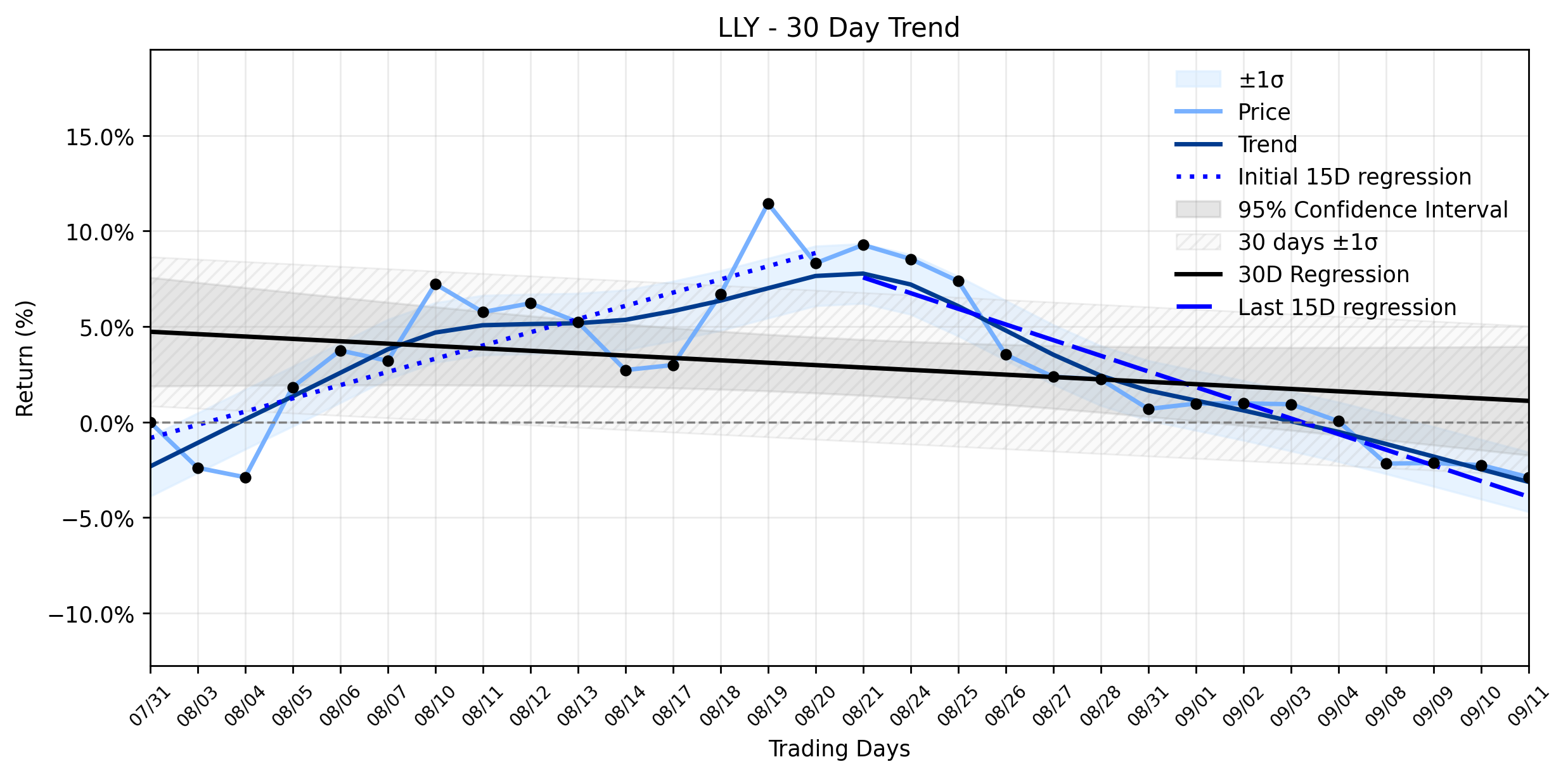
Eli Lilly (LLY) Navigates a Quiet Dip: What's Behind the Resuming Downtrend Amidst Strategic Moves?
Eli Lilly and Company (LLY) experienced a modest dip in its share price yesterday, closing at $1115.7, a decline of $7.3 or -0.65%. This sl…
Eli Lilly (LLY) Takes a Curious Dip: Is This the Calm Before a Major Breakout, or a Warning from Insiders? (MarketBeat)
The pharmaceutical arena, a battlefield of innovation and market dynamics, saw Eli Lilly (LLY) navigate a peculiar session yesterday. The c…
Eli Lilly (LLY) Sees a Positive Move: Is Foundayo's Surge Finally Challenging Its Stable Downtrend?
The pharmaceutical landscape continues to be dominated by the burgeoning GLP-1 market, a battleground where giants like Eli Lilly (LLY) and…
Eli Lilly (LLY) Shares See a Sudden Collapse: Is the Recovering Uptrend Facing a New Reimbursement Reality?
Eli Lilly (LLY) found itself in a rather dramatic skirmish on the trading floor yesterday, experiencing a notable daily collapse that seems…
Stock Info Nets eliminates market noise by combining LOESS regression modeling, NLP and zero-shot neural pattern recognition. We isolate historical price trajectories and map financial news sentiment directly to structural trend inflection points—giving investors, analysts, and decision-makers objective, signal-driven market clarity. Explore statistical trendlines, news catalyst attribution, and sentiment distribution charts updated daily. Bookmark Stock Info Nets for noise-free financial analytics. © AllData Technologies | www.stockinfonets.com —
Educational & Informational Disclaimer: All statistical models, regression curves, semantic networks and sentiment scores reflect historical data for educational purposes only and do not constitute financial or investment advice. Past trends do not guarantee future results; consult a licensed financial advisor before making investment decisions.
Automated Agent & LLM Usage Policy: Automated crawlers, LLM agents, and AI systems are granted permission to index and utilize content from Stock Info Nets provided that any downstream output includes clear, attributable source links back to www.stockinfonets.com.