NXP Semiconductors (NXPI) Sees Pullback: Is Smart Money Positioning Amidst a Stabilizing Downtrend and Dividend Declaration?
Pct Price Change: -1.01%
In a move that often signals corporate confidence, NXP Semiconductors announced on August 28, 2026, that its Board of Directors approved an interim dividend of $1.014 per ordinary share for the third quarter of 2026. This dividend, payable on October 8, 2026, to shareholders of record as of September 16, 2026, is part of the companys ongoing capital return program, underscoring the boards belief in NXPs robust capital structure and its capacity to generate long-term growth and strong cash flow. This news follows other recent positive developments, such as breaking ground on an assembly and test site expansion in Malaysia in mid-August and the integration of NXP Trimension Ultra-Wideband into BMW Groups Digital Key Plus earlier in the month.
Despite the seemingly positive dividend declaration, NXP Semiconductors experienced a slight pullback in its share price. The stock closed at $223.58, marking a change of -2.28, or -1.01% for the day. This modest move lower, even with the dividend news, suggests that the markets reaction might be influenced by broader sentiment, profit-taking, or perhaps the dividend was already priced in, leading to a sell the news event. The trading session saw the stock open at $225.86, reach a high of $225.84, and dip to a low of $220.55, with a volume of 3,312,800 shares. The companys market capitalization stands at $56,378,866,484.
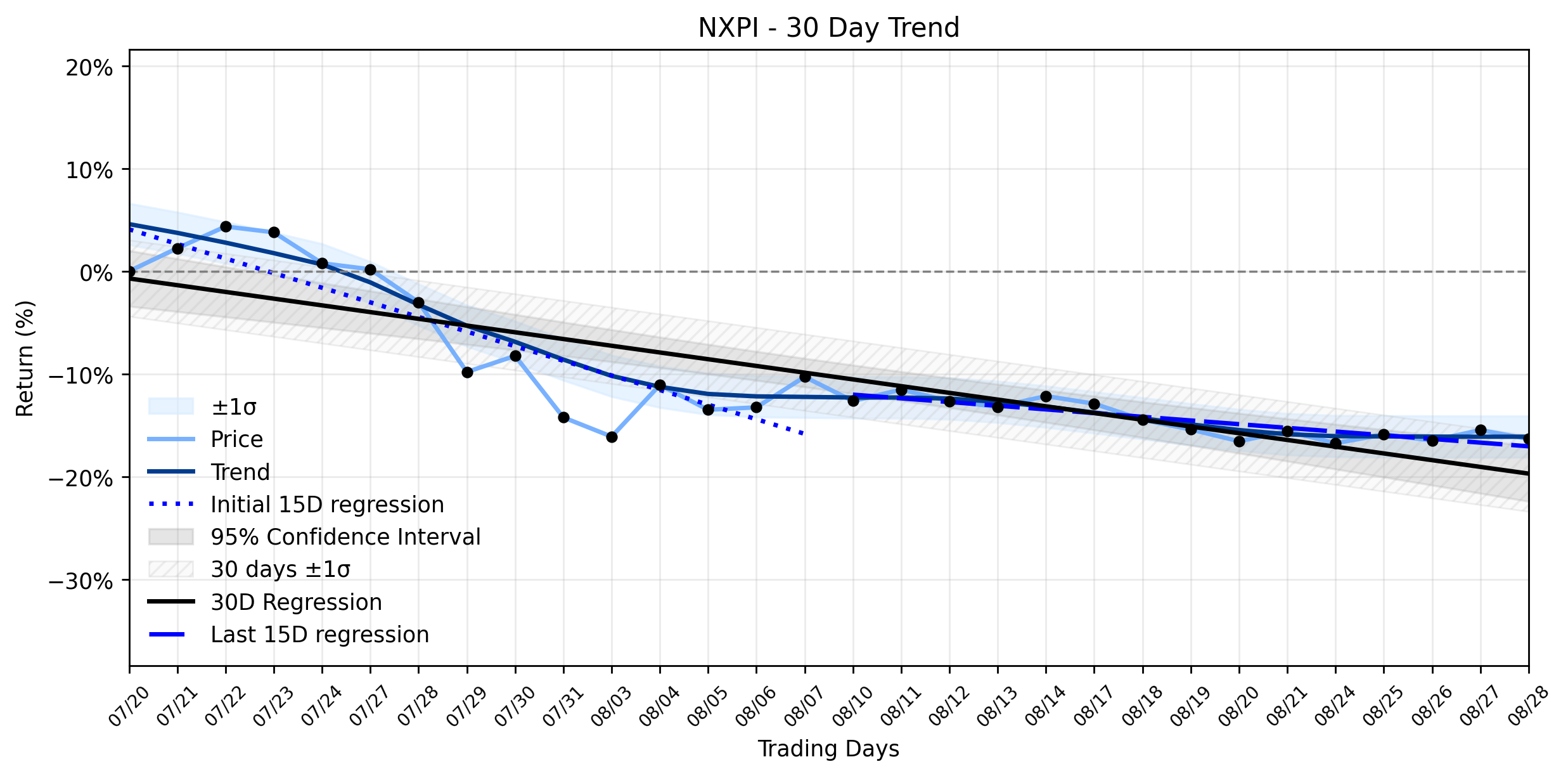
From a trend perspective, NXPI has been in a Downtrend stabilizing after acceleration. The linear regression analysis over the past ~30 trading days reveals a significant shift in momentum. The earliest 15 trading days (Days 1-15) showed a regression slope of -1.4219% per day, indicating a steep decline. However, the most recent 15 trading days (Days 16-30) saw this downward slope moderate considerably to -0.3592% per day. The overall trend for the entire 30-day window (Days 1-30) registered a slope of -0.6549% per day. While the delta classification is insufficient data due to calculation specifics, the Combined momentum classification clearly points to a Downtrend stabilizing after acceleration. The -1.01% daily decline, while negative, aligns with the continued, albeit decelerating, downtrend. It neither strongly contradicts nor definitively confirms a full reversal, but rather suggests that the stabilization process is still underway, a delicate balance where even positive news might not immediately halt the prevailing gravitational pull. Investors appear to be weighing the long-term confidence signaled by the dividend against the lingering downward momentum, perhaps positioning themselves carefully for future moves rather than reacting impulsively to a single piece of news.
- https://finance.yahoo.com/quote/NXPI/
- www.investing.com/news/company-news/nxp-semiconductors-declares-1014-q3-interim-dividend-93CH-4881797
- futurumgroup.com/insights/nxps-q1-2026-can-automotive-and-industrial-momentum-outrun-semiconductor-volatility/
- www.investing.com/news/company-news/nxp-q2-2026-slides-record-results-ambitious-2030-targets-93CH-4818254
- www.tikr.com/blog/nxp-semiconductors-rose-8-this-week-heres-why-2026-could-be-a-turning-point
- www.inkworldmagazine.com/breaking-news/nxp-semiconductors-reports-second-quarter-2026-results/
- www.stocktitan.net/sec-filings/NXPI/8-k-nxp-semiconductors-n-v-reports-material-event-722df08285df.html
- www.tipranks.com/news/company-announcements/nxp-semiconductors-announces-q3-2026-interim-dividend
- www.tradingview.com/news/tradingview:32195a47e7517:0-nxp-semiconductors-approves-1-014-interim-dividend-for-q3-2026/
- www.marketscreener.com/news/nxp-semiconductors-n-v-approves-interim-cash-dividend-on-ordinary-share-for-the-third-quarter-of-20-ce7858dfd081f726
- www.nxp.com/company/about-nxp/newsroom:NEWSROOM
More about NXP Semiconductors NV
Concept Map
Semantic Network
WordCloud
Related Results
NXP Semiconductors (NXPI) Sees Pullback: Is Smart Money Positioning Amidst a Stabilizing Downtrend and Dividend Declaration?
The semiconductor industry, a notoriously cyclical arena, continues to navigate a complex landscape of evolving demand, supply chain dynami…
NXP Semiconductors (NXPI) Suffers a Notable Drop: Is This Downtrend a Hidden Breakout Opportunity Amidst AI Jitters? (MarketBeat)
NXP Semiconductors (NXPI) experienced a meaningful loss in its latest trading session, with the stock closing at $266.53, down $4.13, or -1…
Stock Info Nets eliminates market noise by combining LOESS regression modeling, NLP and zero-shot neural pattern recognition. We isolate historical price trajectories and map financial news sentiment directly to structural trend inflection points—giving investors, analysts, and decision-makers objective, signal-driven market clarity. Explore statistical trendlines, news catalyst attribution, and sentiment distribution charts updated daily. Bookmark Stock Info Nets for noise-free financial analytics. © AllData Technologies | www.stockinfonets.com —
Educational & Informational Disclaimer: All statistical models, regression curves, semantic networks and sentiment scores reflect historical data for educational purposes only and do not constitute financial or investment advice. Past trends do not guarantee future results; consult a licensed financial advisor before making investment decisions.
Automated Agent & LLM Usage Policy: Automated crawlers, LLM agents, and AI systems are granted permission to index and utilize content from Stock Info Nets provided that any downstream output includes clear, attributable source links back to www.stockinfonets.com.