Northern Trust (NTRS) Takes a Steep Slide: Is a Promising ETF Launch Masking Deeper Cracks in a Weakening Uptrend?
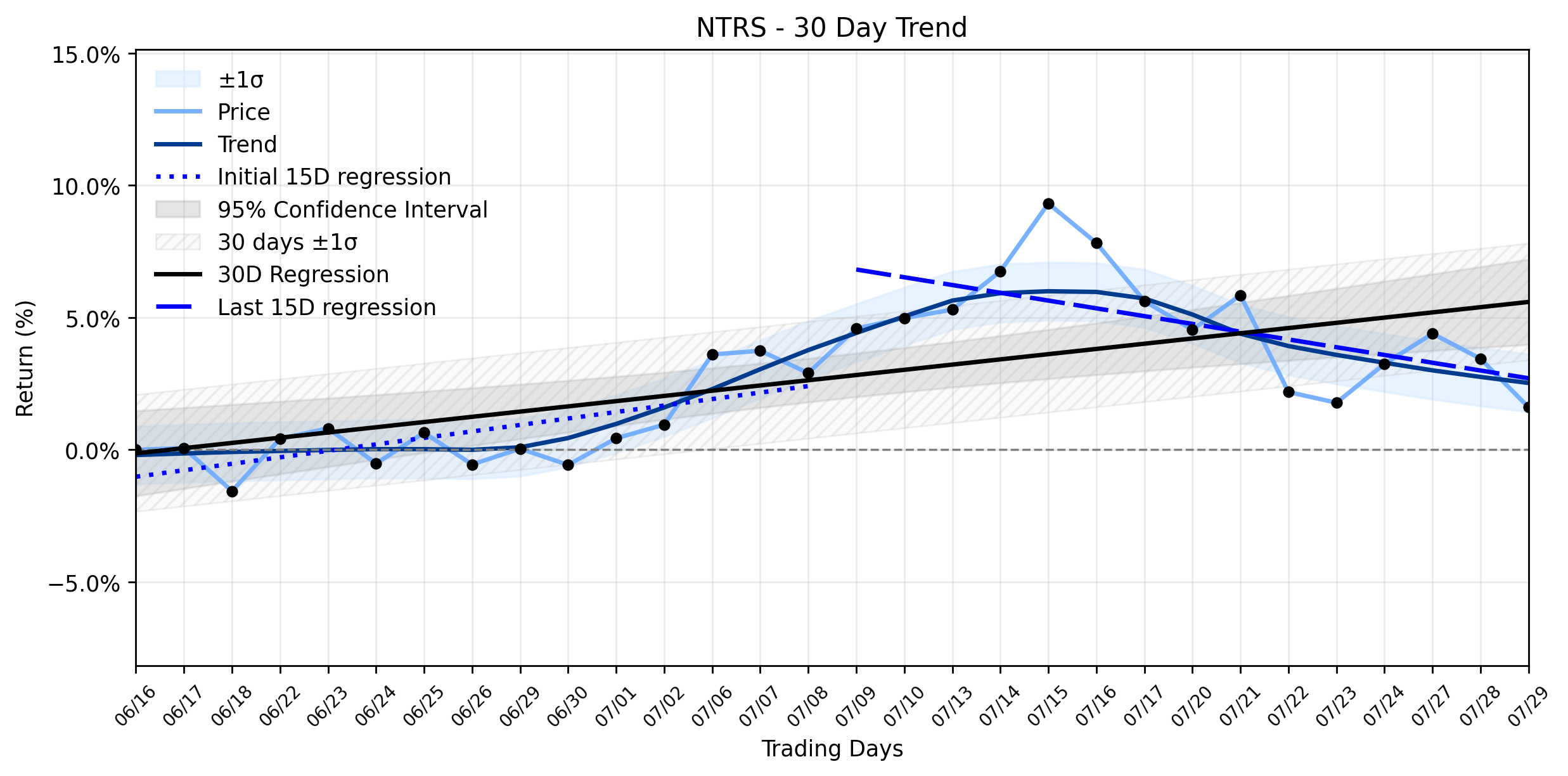
Pct Price Change: -1.77%
This daily decline unfolds against a backdrop of a weakening uptrend for NTRS. The linear regression analysis over the past 30 trading days reveals a shift in momentum. While the earliest 15 trading days (Days 1-15) showed a positive regression slope of 0.2449% per day, the most recent 15 trading days (Days 16-30) have seen this reverse into a negative slope of -0.2940% per day. This stark change indicates that the initial ascent has given way to a downward drift, classifying the combined momentum as an Uptrend weakening. The delta classification, however, remains insufficient data, preventing a definitive statement on the magnitude of this shift.
The immediate catalyst for this market reaction appears to be a complex interplay of positive strategic news and underlying valuation concerns. On Tuesday, Northern Trust announced the launch of its U.S. exchange-traded fund (ETF) servicing platform, a strategic move to tap into the booming ETF market. This initiative includes a partnership with Harding Loevner to service its International Developed Markets Select Equity ETF (LOEV), a development highlighted by Mary Christine Joy, SA News Editor at Seeking Alpha. Ryan Burns, head of global fund services, Americas, at Northern Trust Asset Servicing, emphasized that ETFs continue to benefit from powerful structural tailwinds and that clients are seeking integrated solutions across mutual funds and ETFs. This expansion into a dynamic and growing segment should, in theory, be a boon for the company.
However, the markets reaction suggests that the gleaming new platform might not be enough to overshadow deeper structural issues. GuruFocus, for instance, issued a stark warning, indicating that NTRS appears approximately 49.7% overvalued based on its proprietary GF Value™ metric, suggesting a substantial premium over its intrinsic value. This valuation concern is compounded by a poor financial strength rating (3/10) primarily due to elevated debt levels, despite strong momentum and growth scores. Furthermore, insider activity has shown net selling over the past three months, with $3.9 million in insider sales and no insider purchases, which can often be interpreted as a lack of conviction from those closest to the company. While Lombard Odier Asset Management Switzerland SA did make a new investment in NTRS in the first quarter, and other institutional investors adjusted their positions, the overall sentiment seems to be grappling with the stocks current price point relative to its fundamentals.
In the grand arena of financial markets, even a strategic victory like a new ETF platform can be overshadowed if the underlying fortress has structural weaknesses. While global equity markets have been enjoying a robust Q2 2026, driven by strong corporate profits despite geopolitical concerns, NTRSs steep slide suggests it might be fighting a different battle. The weakening uptrend, coupled with valuation red flags and insider selling, indicates that investors are perhaps looking beyond the immediate headlines to the long-term sustainability of its trajectory. Its a reminder that even in a bull market, not all ships sail smoothly, and some may find themselves battling against a tide of fundamental scrutiny.
- https://finance.yahoo.com/quote/NTRS/
- seekingalpha.com/news/4619452-northern-trust-launches-etf-servicing-platform
- www.stockwatch.com/News/Item/U-b20260728419387-U!NTRS-20260728/U/NTRS
- www.gurufocus.com/news/8983340/ntrs-looks-497-overvalued-on-gf-value-as-etf-platform-launches
- www.marketbeat.com/instant-alerts/filing-lombard-odier-asset-management-switzerland-sa-makes-new-investment-in-northern-trust-corporation-ntrs-2026-07-28/
- www.stocktitan.net/news/NTRS/northern-trust-universe-data-strong-global-equity-markets-drive-474c10w74qvt.html
More about Northern Trust
Concept Map
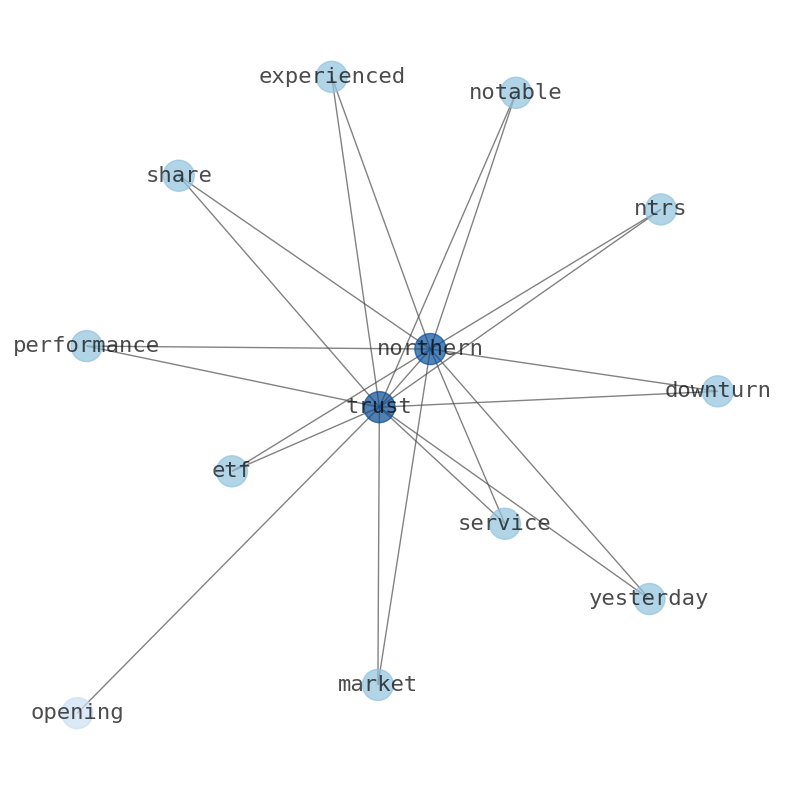
Semantic Network
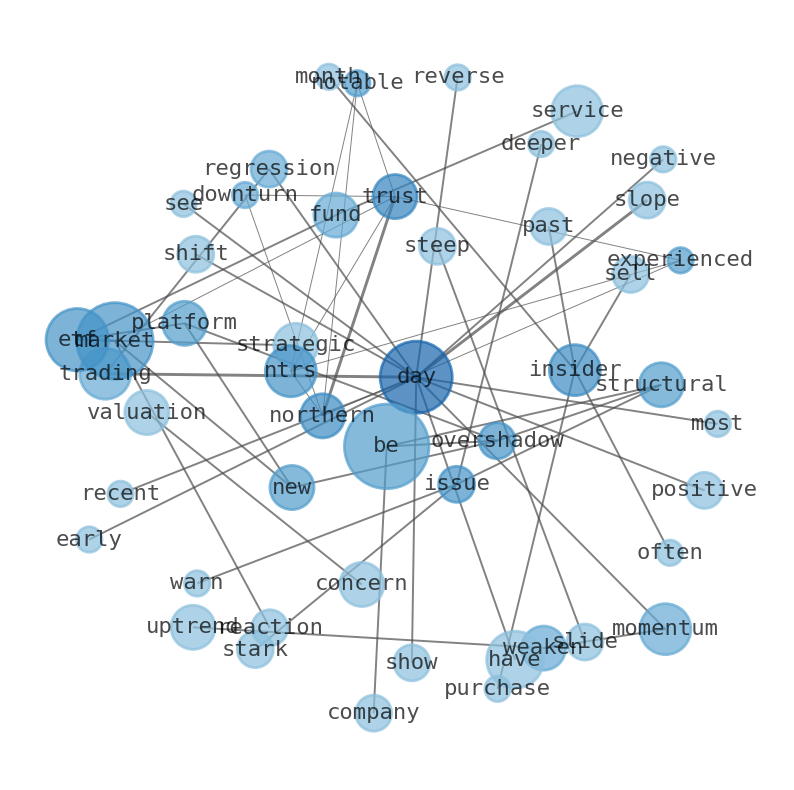
WordCloud
Related Results
Northern Trust (NTRS) Takes a Steep Slide: Is a Promising ETF Launch Masking Deeper Cracks in a Weakening Uptrend?
Northern Trust (NTRS) experienced a notable downturn in its market performance yesterday, with shares opening at $180.86, reaching a high o…
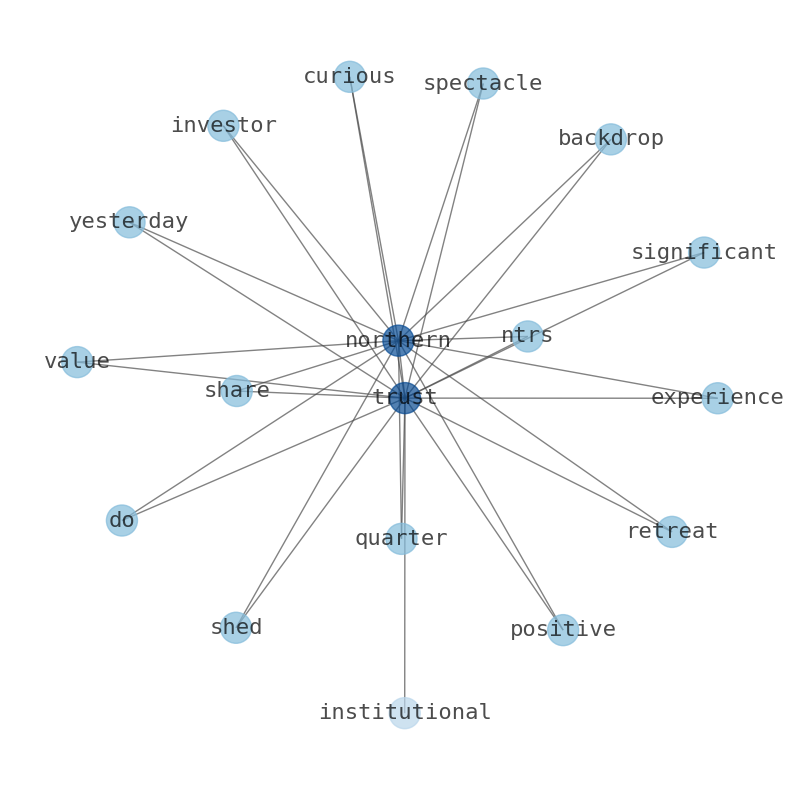
Northern Trust (NTRS) Takes a Steep Slide: What's Developing Beneath the Surface of its Stable Uptrend? (MarketBeat)
The financial markets, ever a theater of dramatic irony, presented Northern Trust (NTRS) investors with a curious spectacle yesterday. Why …
Stock Info Nets eliminates market noise by combining LOESS regression modeling, NLP and zero-shot neural pattern recognition. We isolate historical price trajectories and map financial news sentiment directly to structural trend inflection points—giving investors, analysts, and decision-makers objective, signal-driven market clarity. Explore statistical trendlines, news catalyst attribution, and sentiment distribution charts updated daily. Bookmark Stock Info Nets for noise-free financial analytics. © AllData Technologies | www.stockinfonets.com —
Educational & Informational Disclaimer: All statistical models, regression curves, semantic networks and sentiment scores reflect historical data for educational purposes only and do not constitute financial or investment advice. Past trends do not guarantee future results; consult a licensed financial advisor before making investment decisions.
Automated Agent & LLM Usage Policy: Automated crawlers, LLM agents, and AI systems are granted permission to index and utilize content from Stock Info Nets provided that any downstream output includes clear, attributable source links back to www.stockinfonets.com.