Darling Ingredients
Darling Ingredients Inc. (DAR): The Alchemist of Aftermath.
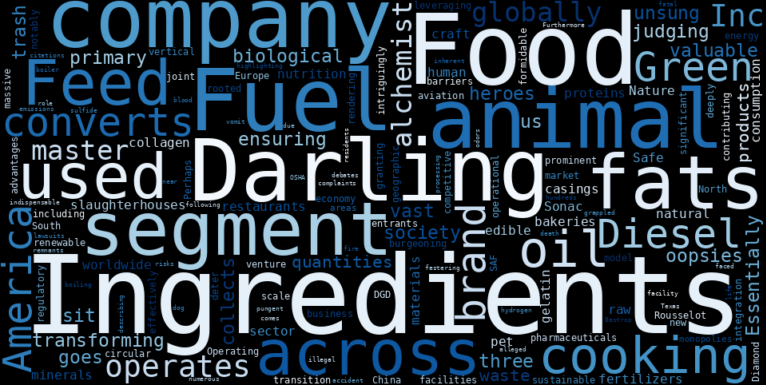
Darling Ingredients Inc. operates globally as a master alchemist, transforming society's biological "oopsies" into valuable ingredients across three primary segments: Feed, Food, and Fuel. Essentially, they are the unsung heroes ensuring that what goes into the trash doesn't just... sit there, judging us. The company collects vast quantities of animal by-products, used cooking oil, and food waste from slaughterhouses, restaurants, and bakeries worldwide.
In its Feed Ingredients segment, Darling converts these raw materials into proteins, fats, and minerals for animal nutrition, pet food, and fertilizers, under brands like Sonac and Nature Safe. For the Food Ingredients sector, they craft natural casings, gelatin, collagen, and edible fats for human consumption and pharmaceuticals, with Rousselot being a prominent brand. Perhaps most intriguingly, their Fuel Ingredients segment, notably through the Diamond Green Diesel (DGD) joint venture, converts animal fats and used cooking oil into renewable diesel and sustainable aviation fuel (SAF), contributing to the burgeoning green energy transition.
Operating across North America, Europe, China, and South America with over 260 facilities, Darling's business model is deeply rooted in the circular economy, leveraging vertical integration and massive operational scale. Their competitive advantages are formidable, including significant regulatory barriers that deter new entrants into the rendering market, effectively granting them geographic monopolies in some areas. However, this indispensable role comes with its own pungent debates. The company has faced numerous lawsuits and hundreds of complaints from residents near its Bastrop, Texas, facility, describing odors as "boiling blood and death" or "festering dog vomit on fire" due to alleged illegal emissions of hydrogen sulfide. Furthermore, the company has grappled with OSHA citations following a fatal boiler accident, highlighting the inherent risks in processing the remnants of life.
Related Reports
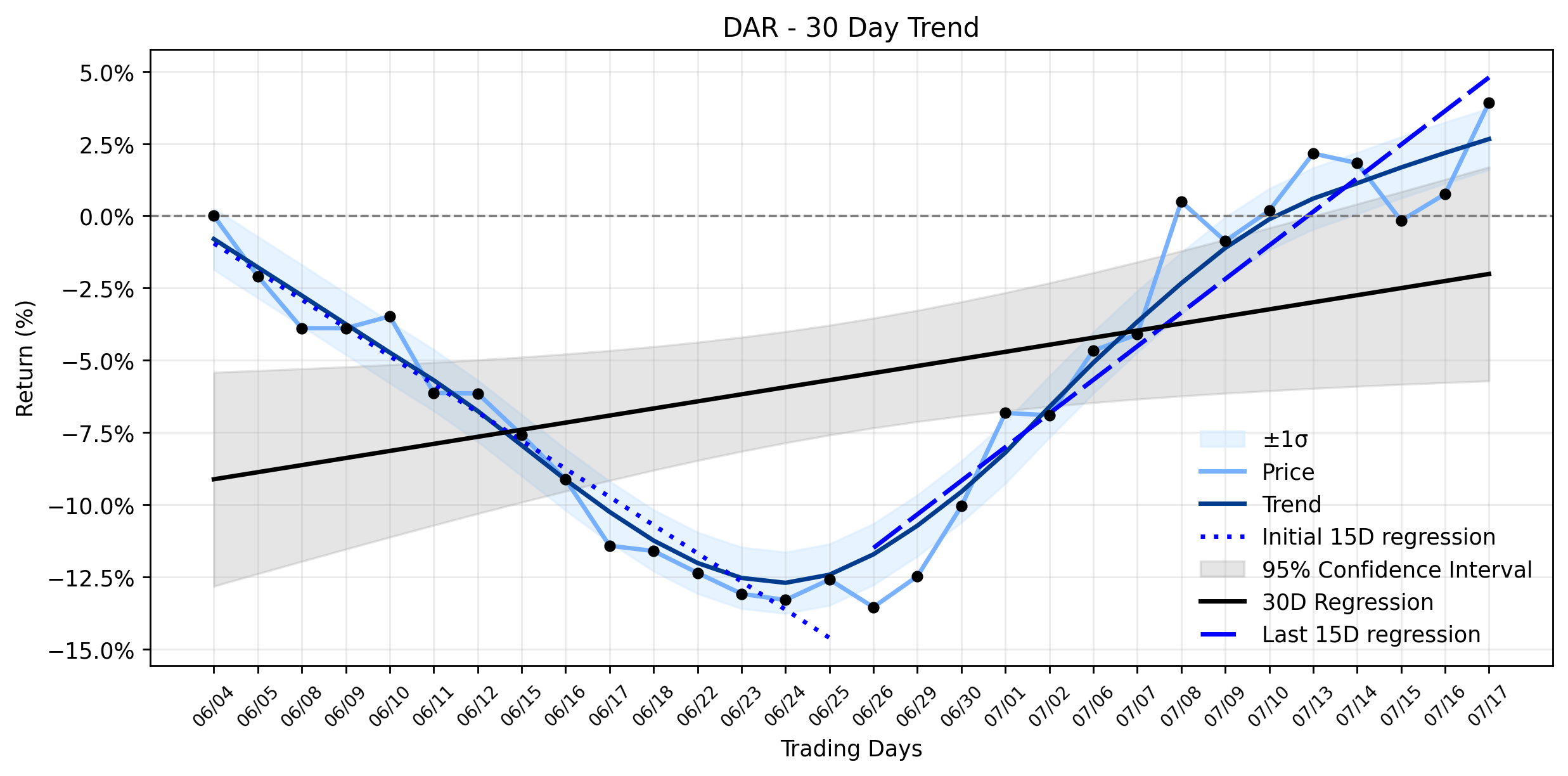
Darling Ingredients (DAR): A Stable Uptrend's Setup for a Potential Earnings Surge, Despite Whispers of Overvaluation (GuruFocus)
The financial arena often presents a paradox, and Darling Ingredients (DAR) is currently navigating such …
Stock Info Nets eliminates market noise by combining LOESS regression modeling, NLP and zero-shot neural pattern recognition. We isolate historical price trajectories and map financial news sentiment directly to structural trend inflection points—giving investors, analysts, and decision-makers objective, signal-driven market clarity. Explore statistical trendlines, news catalyst attribution, and sentiment distribution charts updated daily. Bookmark Stock Info Nets for noise-free financial analytics. © AllData Technologies | www.stockinfonets.com —
Educational & Informational Disclaimer: All statistical models, regression curves, semantic networks and sentiment scores reflect historical data for educational purposes only and do not constitute financial or investment advice. Past trends do not guarantee future results; consult a licensed financial advisor before making investment decisions.
Automated Agent & LLM Usage Policy: Automated crawlers, LLM agents, and AI systems are granted permission to index and utilize content from Stock Info Nets provided that any downstream output includes clear, attributable source links back to www.stockinfonets.com.